
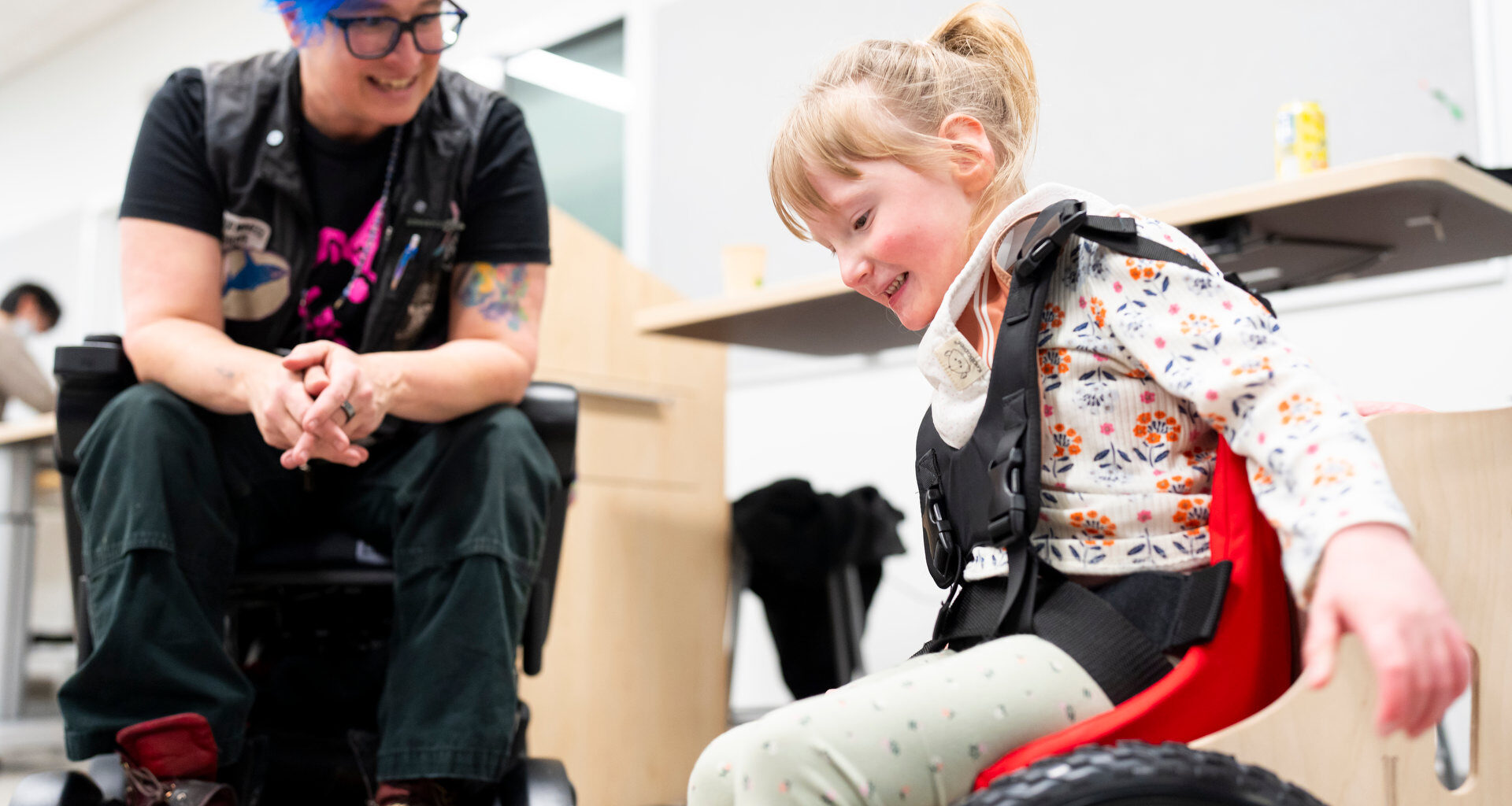
UC Berkeley students gather at the Jacobs Institute to assemble assistive devices for young children with disabilities
February 20, 2026 by Marni Ellery
On February 13, 15 UC Berkeley students gathered at the Jacobs Institute for Design Innovation, ready to roll up their sleeves. They were there to assemble Toddler Mobility Trainers (TMTs), assistive devices designed for toddlers who cannot walk or crawl. By providing a mobility device tailored to a toddler’s size and abilities, the student volunteers aimed to give these youngsters the joy of motion and a greater sense of independence.
Dana Yichye Shwachman, a Design Fellow with the Jacobs Institute at UC Berkeley College of Engineering, led the three-hour community event. A senior industrial designer specializing in inclusive design and open-source assistive technology, she is director of MakeGood West and the former design lead at Tikkun Olam Makers (TOM), where she led the design of the small and large wooden TMT.
According to Yichye Shwachman, the Jacobs build party was a unique opportunity for student volunteers to interact with the community and see the impact of human-centered solutions.
“A lot of times, students touch theory through their studies, but they don’t touch real people and real materials,” she said. “This is a project and an approach where we touch materials and touch the hearts of people.”
Yichye Shwachman explained that children typically don’t fit into a standard wheelchair until age 5, leaving caregivers to carry or push them in strollers during their toddler years. The TMT is ergonomically designed for a range of toddler sizes and provides an open-source solution that makes the product easy to replicate, as well as affordable and simple to manufacture.
It can also be easily distributed through build parties like the one at Jacobs Institute. To date, it’s been replicated by more than 1,200 users worldwide, and a 3D-printed version designed by Link PCB, in collaboration with MakeGood and TOM, recently became available, further expanding its reach.
Toddlers may need a few minutes to a few weeks to understand how to operate their new mobility device, but the impact can last a lifetime. From aiding cognitive development to training toddlers how to use their upper body in preparation for their first wheelchair, the device gives these young children a way to explore the world on their terms and be more independent in their surroundings.
Yichye Shwachman added that a toddler’s increased mobility can also lead to more social time with family members. “Suddenly, they can create human interaction thanks to the fact they’re able to move around the house,” she said.
Together, the student volunteers — a mix of master of design (MDes) students and Jacobs Makerspace members from departments across Berkeley Engineering — assembled four TMTs. All the product’s parts were fabricated in advance of the build party.
Ruo-Lin Wang, an MDes student with a strong interest in healthcare, saw the build party as a chance to learn and gain greater insight into human-centered design.
“When the opportunity arose to learn from Dana and her extensive work in toddler mobility, I knew I wanted to join to gain inspiration for my own future designs,” said Wang. “Dana also highlighted the importance of user-focused details, such as ensuring the rough side of the Velcro faces outward, so it doesn’t scratch the child. This experience was a great reminder that paying attention to the finer details is crucial when designing for people.”
When the devices were fully assembled, 4-year-old Charlotte Posthumus came to pick up her new wheels. The other devices will be delivered to users and childhood development centers in the area.
Yichye Shwachman hopes that this event will serve as a model for future build parties at the Jacobs Institute. “For me, the goal is to bring together design engineering knowledge and the Berkeley community in a spirit of volunteerism and service to others,” she said. “I hope students will see how using their tools and giving their time can affect others in a good way.”