
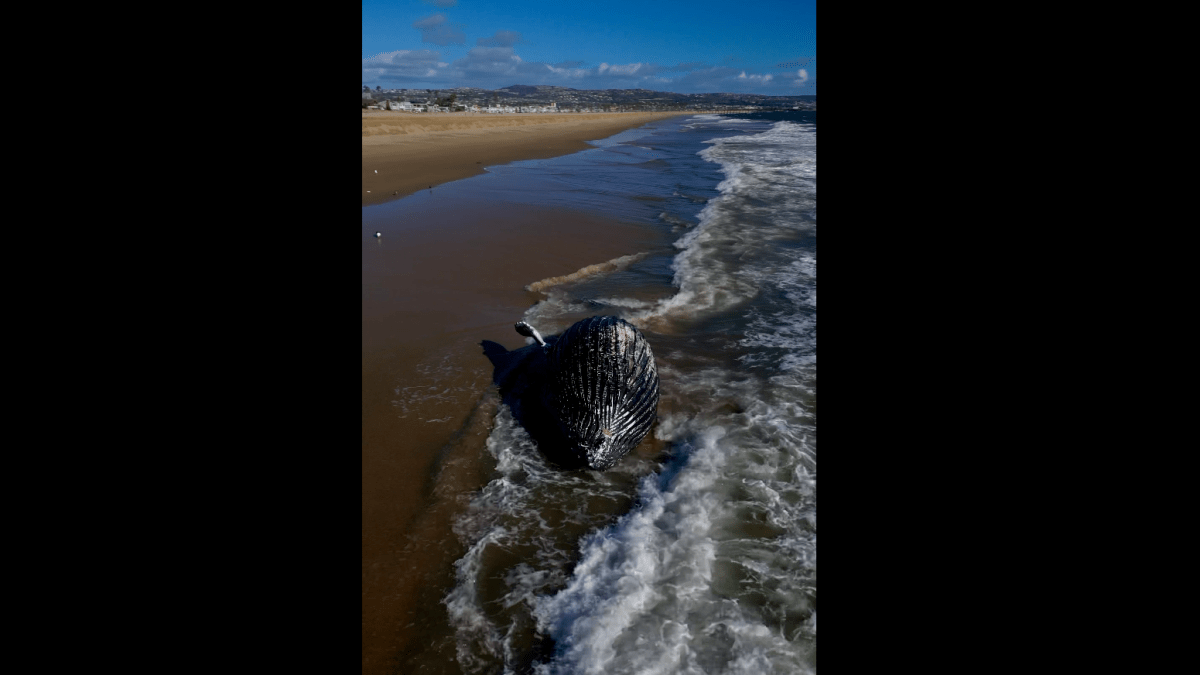
A dead humpback whale who washed ashore in Newport Beach earlier this week was washed back out to sea with the rising tides Thursday night. On Friday morning, scientists located the whale and were able to attach a tracking tag to it.
Sophia Felger of the Laguna Beach-based Pacific Marine Mammal Center (PMMC), told NBC Los Angeles on Friday that her team was able to find the whale off the coast of Corona Del Mar.
They worked with the Ocean Animal Response & Research Alliance (OARRA) and a local tow service, Tow Boat US, to attach a satellite tag to the whale’s carcass, which will help researchers track its movement offshore and gather data on post-stranding drift patterns and ocean currents.
Tow service Captain Tyler Wayman told NBC LA the whale was found at around 8 a.m. near rocks under the lookout near Corona del Mar. After the organizations tagged the whale, Wayman was tasked with towing it out further to sea.
He said Newport Beach Lifeguards made the decision to have the whale towed 20 miles offshore. Based on current conditions, Wayman said that distance will allow for nature to take its course and for the whale to stay offshore. The goal was not to have it wash ashore again along any beaches down the coast.
Before the tides returned the whale to the Pacific Ocean, PMMC and OARRA scientists were able to gather important information about the marine mammal that will contribute to ongoing regional research.
The whale, a “subadult” female comparable to a teenager in human years, washed ashore at around 3 p.m. Wednesday near 13th Street, between the Newport and Balboa Piers.
Felger said the whale was dead when it came onto the shore and had been seen floating south earlier Wednesday.
PMMC’s Whale Response Team responded to the scene alongside Newport Beach Lifeguards and public works crews. PMMC specializes in marine mammal rescue, rehabilitation, and research, and responds to stranded mammals along 52 miles of Orange County’s coastline.
Scientists worked Wednesday and Thursday to gather information, measurements, and biological samples from the animal that the organization says will “provide critical insight into ocean health.”
The whale was 29.5 feet long and weighed approximately 23,000 pounds, or 11 tons, the PMCC confirmed.
Amid this week’s powerful winter storms, rough waves and rising tides made it unsafe and difficult for experts to conduct a full necropsy Wednesday evening.
On Thursday, necropsy teams from PMMC and OARRA returned to the beach to collect additional samples from the whale, including skin, blubber, and fluids for laboratory analysis. Crews were then able to determine the whale was a female.
PMMC also deployed a drone to assess the whale for visible injuries and document the stranding.
PMCC said in a press release that while whale strandings are difficult to witness, they offer a rare and valuable opportunity for scientific investigation. These types of examinations can help provide insights into “the overall health of whale populations along the Southern California coast” amid shifting ocean conditions.
“Humpback whales are a sentinel species,” said Dr. Alissa Deming, Veterinarian and Vice
President of Conservation Medicine and Science at PMMC in a press release. “Every stranding represents both a loss and an opportunity — a unique chance to better understand the threats these animals face and how we can protect the population as a whole.”
In 2025, PMCC and OARRA conducted four whale necropsies together, and in 2024, the organizations conducted two.