
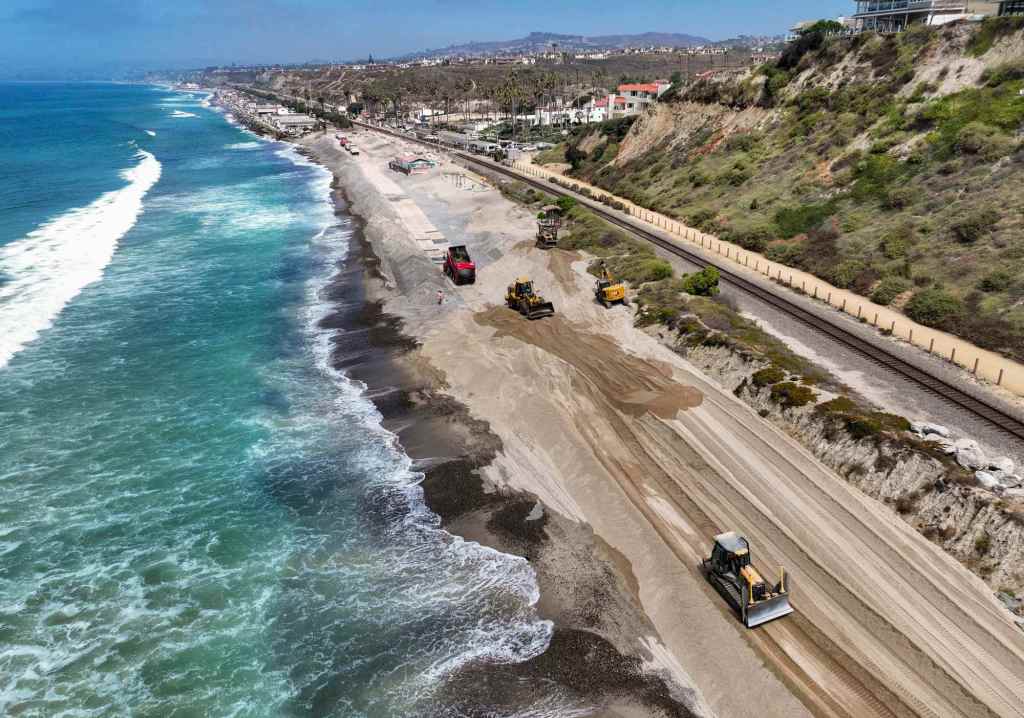
More than a decade ago, a detailed report advised Orange County on how the region’s beaches should be maintained and sustained, an “OC Regional Sediment Management Plan” meant to serve as a roadmap on how to manage an eroding coastline.
But that report, released in 2013, was put on a shelf and forgotten about as the area’s southern beaches shrank, sand space disappearing more and more with each passing year.
The Board of Supervisors last week approved the South County Beach Coalition, a collaboration among beach community decision makers and others who all have the same goal: help the region’s struggling beaches figure out solutions.
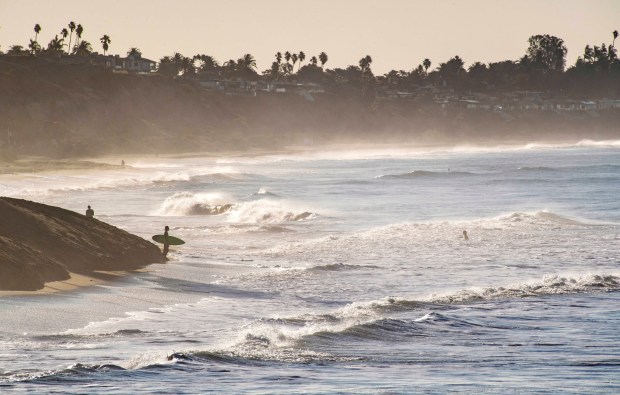 A surfer stands at the edge of a sand berm and checks out the waves before entering the water just south of the San Clemente Pier as a king tide moves on shore in 2020. (Photo by Mark Rightmire, Orange County Register/SCNG)
“Fast forward 12, 13 years later, we are finally doing something about it,” said Fifth District County Supervisor Katrina Foley, who spearheaded the effort. “The coalition is intended to create a group of experts, find funding and advocate for redesigns of systems and develop a sand management plan for the coast.”
The multi-agency approach aims to cut regulatory red tape and streamline sand renourishment efforts. The long-term goal focuses on creating a sand maintenance plan to ensure the stability of our beaches for the future, reads a county staff report summary.
While the coalition’s formation was just now formally adopted, Foley has been working to create it for the past year, meeting with community groups and funding the hiring of coastal planning manager Makana Nova for OC Parks.
“We are stronger as a unified voice in talking to the state, the federal government as it relates to permitting, planning, etc,” Foley said.
In addition to hiring a coastal administrator and creating a coalition, as recommended in the original study done years ago, Foley’s team is also partnering with UC Irvine to explore how sand in the Prado Dam could be transported to the coast, also a recommendation in the original report.
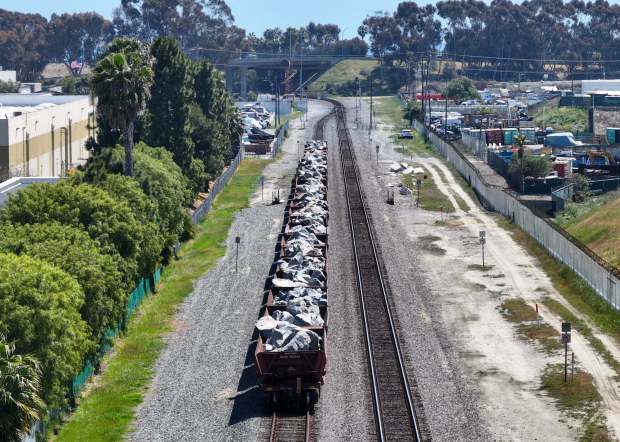 Various size boulders wait in railcars in San Juan Capistrano in 2025. A newly-formed coalition will explore ideas of bringing sand to the beach from Prado Dam, with one possible solution by rail. (Photo by Jeff Gritchen, Orange County Register/SCNG)
“Nobody has ever done it,” she said.
Her office recently funded a grant to team up with UCI students to come up with a solution on how to move the built-up sediment and get it to the beach by using a train, rail, pipeline or trucks, and a session was held recently with OCTA, OC Water District and other agencies to talk about logistics and challenges in transporting sand.
There have been recent studies on issues like how the Dana Point Harbor impacts sediment flow. During the recent collaboration session with UCI and others earlier this month, Foley learned that when the harbor was built in the ’60s, the county was supposed to deliver up to 50,000 cubic yards of sand each year to Doheny State Beach.
“If that had happened, maybe we would not be in this dire situation we are now,” Foley said. “So we are trying to play catch-up, learn from the past and go forward.”
The beaches today, in some areas, are much different than when the original report was released. Capistrano Park Beach, for example, was a low priority on the list because, at the time, it had a wide, healthy beach.
“That’s no longer the case,” she said.
Fast forward to the present day, and it’s a stretch of county beach that is severely eroded following heavy storms and high tides that destroyed a basketball court and restroom building, and has hardly enough sand to lay out a towel.
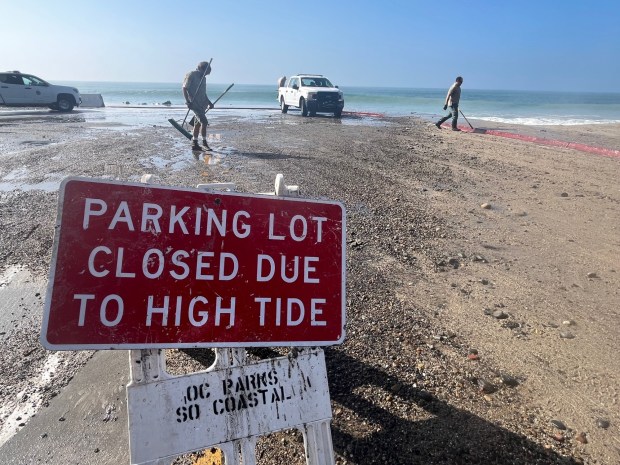 Capistrano Beach got slammed by big waves and high tide on Nov. 7, 2025. Officials have been trying to fix the area for the past eight years, but have come up short on funding. A newly-formed coalition hopes to explore funding, ideas on how to fix the area. (Photo by Laylan Connelly/SCNG)
Another recommendation was to pursue “nature-based solutions,” everything from dunes to projects in the ocean.
There used to be an annual “State of the Coast” report that hasn’t been done in about a decade, which will also be resurrected under the direction of the South County Beach Coalition.
“We obviously have more knowledge than we did then,” Foley said. “I think the community is becoming very informed about sand.”
The newly-formed coalition will report back to the Board of Supervisors with suggestions.
“The coalition is intended to create a group of experts, find funding and advocate for redesigns of systems and develop a sand management plan for the coast,” she said.
The region’s beaches are worth investing in, she said. Tourism and hospitality rely on big, sandy beaches, not to mention the recreational and health benefits of visiting the coast.
“We have to reevaluate how sand gets to the beach when it can’t flow from the rivers to the shores, like it used to,” she said. “This group helps us develop a master plan for maintaining the beaches, and it becomes part of our normal planning process, like pothole repair, capital improvement and replacing light fixtures. We should have a plan for maintaining our beaches as well. They are critical infrastructure.”