
The Supreme Court ruling striking down many of the Trump administration’s tariffs brought swift and sometimes divided reactions — along with no shortage of new questions after the president’s follow-up news conference, during which he vowed to find other avenues to pursue his tariff goals.
Affected by the ruling specifically are tariffs President Donald Trump imposed with national emergency declarations. The 6-3 ruling essentially said the tariffs violated the Constitution because only Congress has the power to enact taxes — which is what tariffs are.
Port of Los Angeles Executive Director Gene Seroka said the court’s decision “affects about two-thirds of the tariffs that have been collected to date and opens new avenues of uncertainty.”
“First,” Seroka said in a statement, “there is not yet clarity on whether there will be refunds from the U.S. Treasury Department on tariffs already paid. Second, the administration has already announced a new 10% global tariff in the wake of the ruling with no indication as to when that will take effect.”
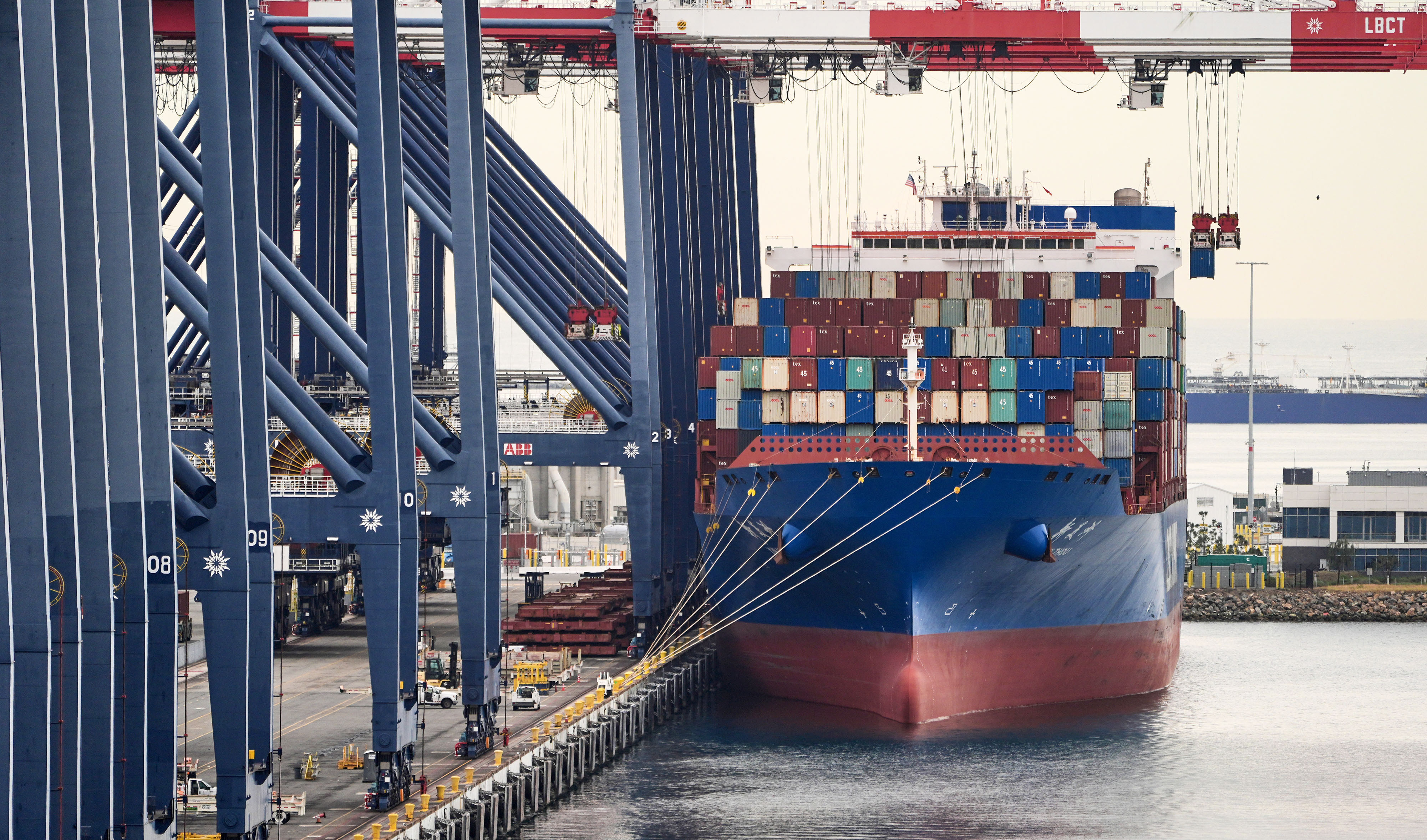
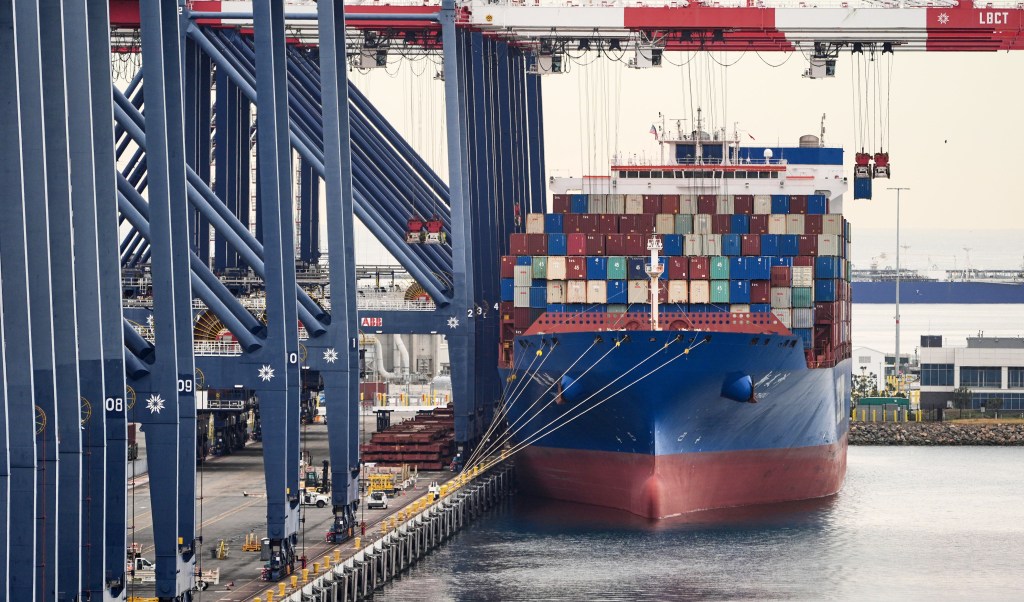
A container ship is docked at the Port of Long Beach Friday, Feb. 20, 2026, in Long Beach, Calif. (AP Photo/Damian Dovarganes)
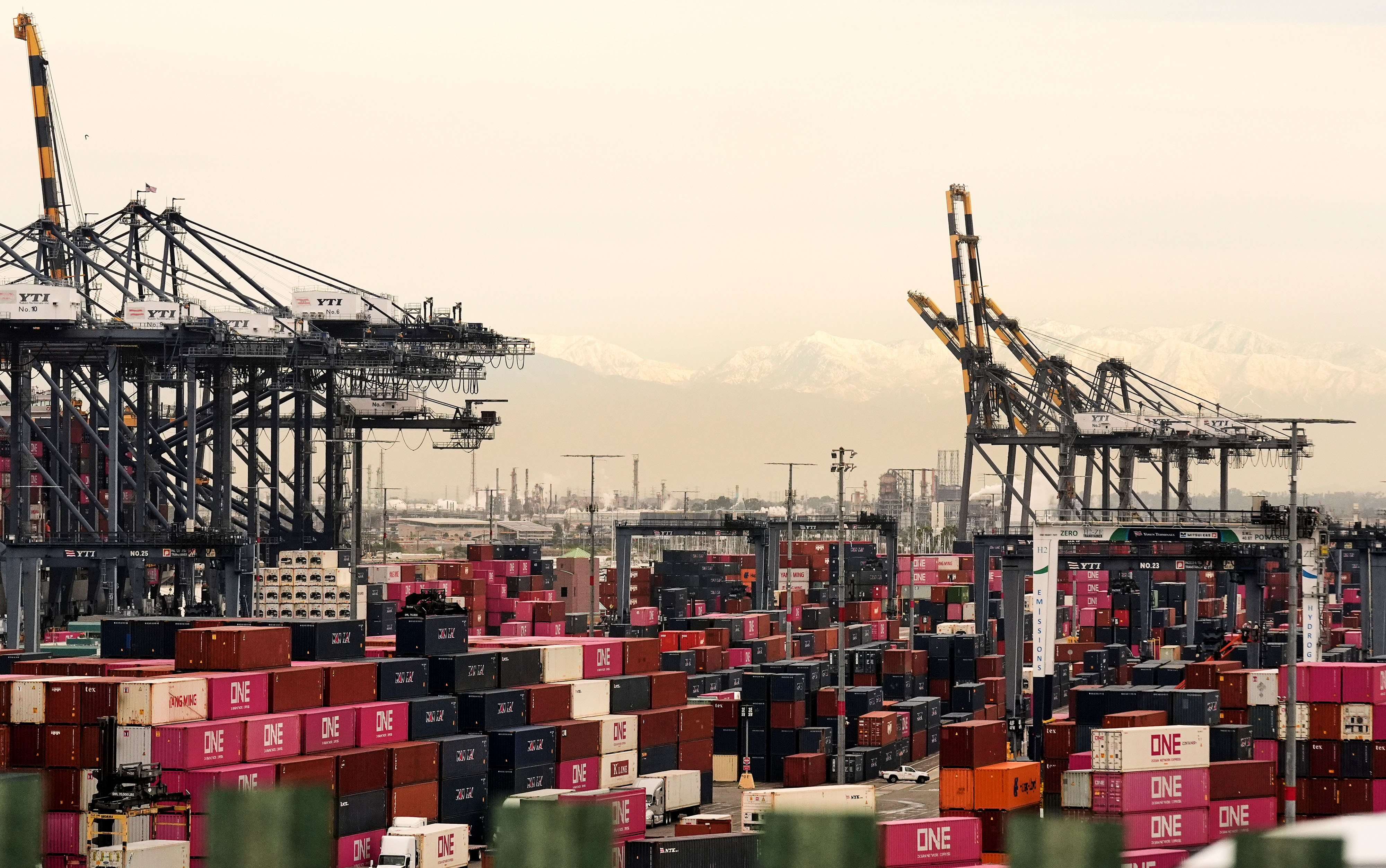
Containers are stacked at the Port of Los Angeles Friday, Feb. 20, 2026, in Los Angeles. (AP Photo/Damian Dovarganes)
Show Caption
1 of 2
A container ship is docked at the Port of Long Beach Friday, Feb. 20, 2026, in Long Beach, Calif. (AP Photo/Damian Dovarganes)
The Supreme Court’s decision also came amid the Lunar New Year when, Seroka said, “most of the factories in China and across Asia are closed for the holiday and not expected to reopen until at least next week.”
Before Trump’s follow-up comments, Seroka told CNN that the ruling could bring a cargo surge at the nation’s largest port.
But uncertainty now remains around Trump’s aims — announced later -— to pursue a 10% across-the-board tariff.
“The Port of Los Angeles and its network of supply chain partners,” Seroka said in his statement, “stand ready to manage any fluctuation in cargo and get it through the system swiftly without delay.”
Port of Long Beach CEO Noel Hacegaba, meanwhile, said stability is critical.
The port, its customers and partners “depend on clear, predictable trade policy to plan investments, move cargo efficiently, and keep goods flowing to American businesses and consumers,” Hacegaba said. “An orderly approach to tariffs helps businesses plan, and ports like Long Beach maximize their contribution to the U.S. economy.
“We hope the ruling,” he added, “brings greater certainty to the supply chain.”
National Retail Federation Executive Vice President of Government Relations David French agreed.
The ruling, French said in a written statement, provides “much-needed certainty for U.S. businesses and manufacturers, enabling global supply chains to operate without ambiguity.”
Certainty is something that has been lacking over the last year.
Earlier this month, in fact, the National Retail Federation and Hackett Associates cited tariffs as the reason for why import volume at the nation’s major container ports was expected to see “a significant year-over-year decline during the first half of 2026.”
“With tariffs still a matter of debate in the courts and in Congress, their effect on imports is being clearly seen,” Jonathan Gold, NRF’s vice president for supply chain and customs policy, said in a news release, almost two weeks before Friday’s Supreme Court ruling. “The situation underscores the need for clear and predictable trade policies that support supply chain certainty and reliability, business planning and consumer affordability. Tariffs are a tax on U.S. businesses that is ultimately paid by consumers through higher prices.”
And on Tuesday, Seroka — during his monthly news conference, at which he reported a 12% cargo dip last month compared to January 2025 — said, “U.S. trade policy continues to keep everyone on edge.”
Seroka’s guest this month was economist Chad Brown, a leading authority on tariffs and trade policy impacts, who said cargo this year faces uncertainty.
Tariffs under the current administration have been unpredictable, he said, and they are “something that even economists are trying to figure out.”
Through the first eight to nine months of tariffs, Brown said, “almost 100% of the tariffs are being paid for by ‘somebody’ in the U.S.,” though he added that doesn’t always filter through directly to sticker prices being paid by consumers.
Now that the Supreme Court has shot down many of the tariffs the Trump administration had imposed, the next question is what will happen — if anything — with the money already collected.
“Clear and consistent trade policy,” French said in his statement, “is essential for economic growth, creating jobs and opportunities for American families. We urge the lower court to ensure a seamless process to refund the tariffs to U.S. importers. The refunds will serve as an economic boost and allow companies to reinvest in their operations, their employees and their customers.”
Paul Granillo, president and CEO of the Inland Empire Economic Partnership — noting significant growth and economic mobility — said the high court ruling will also impact manufacturers. Because of Trump’s tariffs, he said, those manufacturers were paying billions and forced to reckon where they had been doing business.
“The ruling has been expected because it affects imports,” Granillo said, adding that “42% of all imported goods that come into the U.S. come through our L.A. ports, and it affects the manufacturing we have here.”
Even with bustling shipping ports and warehouses busier than ever, tariffs have “from the beginning, put a lot of uncertainty and instability” on the whole industry, Granillo said. While some companies chose to eat up extra costs, others have tacked them directly onto consumers — adding to the “affordability crisis.”
Economics and trade industry experts, meanwhile, weren’t the only ones who reacted swiftly to the court’s ruling.
U.S. Rep. Laura Friedman, D-Glendale, for example, announced Friday that she is helping to lead new federal legislation that would “guarantee automatic refunds to small businesses that were impacted by the Trump Administration’s tariffs.”
Rep. Robert Garcia, D-Long Beach, criticized the president for causing “chaos” with this tariff policies.
“The Supreme Court has made it clear that these tariffs are illegal and harming consumers,” said Garcia, who co-chairs the Congressional Ports Opportunity, Renewal, Trade and Security Caucus. “It’s time to move forward and bring costs down for families.”
“President Trump’s global tariffs were illegal from the start,” said Rep. Linda Sánchez, D-Whittier, the ranking member on the Ways and Means Trade Subcommittee, also said the president’s tariffs were always illegal, though she also cautioned that his “obsession with tariffs won’t go away.”
Trump, for his part, scoffed at the Supreme Court’s ruling — and seemed determined to continue imposing tariffs.
“I don’t have to,” Trump said when asked why wouldn’t he just work with lawmakers on tariffs. “I have the right to do tariffs, and I’ve always had the right to do tariffs.”
Trump said he would impose a 10% global tariff, though they would be temporary — lasting 150 days unless extended by Congress.
Rep. Young Kim, R-Anaheim Hills, did not say whether she agreed with the Supreme Court’s ruling, but did acknowledge its legitimacy, while also confirming her support for the president’s policies.
“I respect the authority of the Supreme Court and its role in interpreting the law,” Kim said. “I will continue working with President Trump to put America first, strengthen our economy, protect American workers and critical industries, and crack down on countries that are ripping us off.”
Whether Congress as a whole would extend the new temporary tariffs — if that’s the route the administration chooses to take — remains to be seem.
But it’s unlikely there would be any support from the minority party.
“From the beginning, Democrats have been calling out this administration for illegally sidestepping Congress in order to execute this disastrous trade policy that has been hurting hardworking families,” said House Democratic Caucus Chair Pete Aguilar, of Redlands. “Unfortunately, House Republicans have stood in the way at every turn.”
Staff writers Kaitlyn Schallhorn, Linh Tat and Allyson Vergara, as well as the Associated Press, contributed to this report.