
The Supreme Court on Friday struck down a large chunk of President Donald Trump’s tariff agenda, delivering a major rebuke of a key economic policy that experts say brings immediate relief to shippers but raises new questions about the president’s next moves and when, or if, anyone will be refunded for tariffs they already paid.
In a 6-3 ruling, the court decided that a 1977 law meant for national emergencies did not justify most of the tariffs that the Trump administration unveiled last April. It’s the first time the conservative-leaning court has overruled one of Trump’s second-term policies.
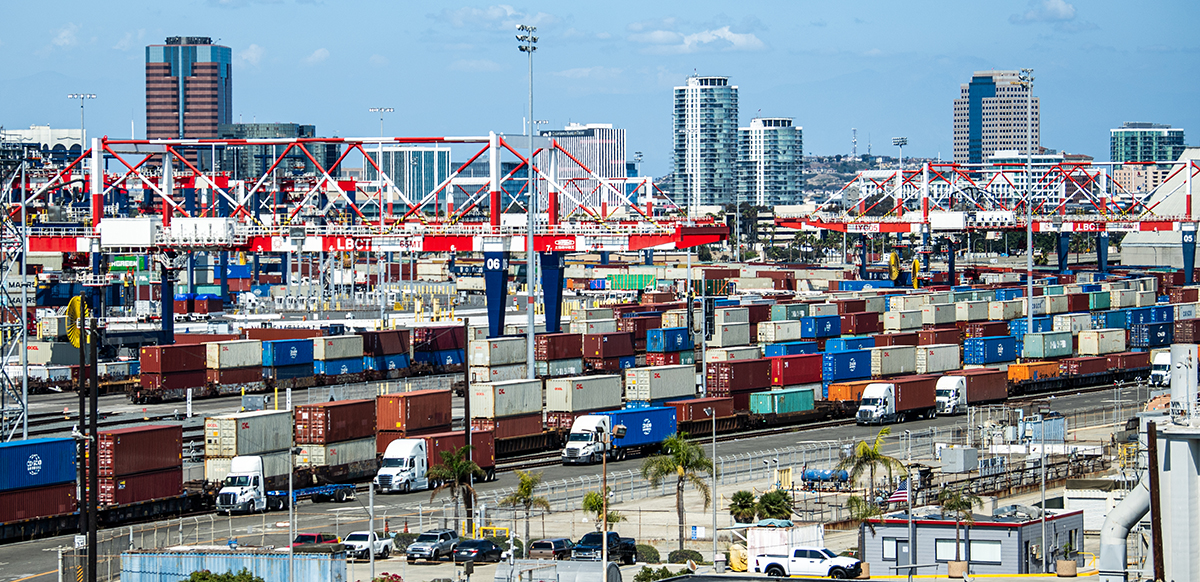
In a statement Friday, Long Beach Port CEO Noel Hacegaba said he hopes the ruling brings “greater certainty to the supply chain.”
“For now,” he added, “the only certainty is more uncertainty.”
“The Port of Long Beach customers and logistics partners depend on clear, predictable trade policy to plan investments, move cargo efficiently, and keep goods flowing to American businesses and consumers,” he added. “An orderly approach to tariffs helps businesses plan, and ports like Long Beach maximize their contribution to the U.S. economy.”
A spokesperson for Hacegaba said Port officials will share more details on the decision’s effects at a news conference on Wednesday.
This comes as the city seaport finished its busiest year on record — 9.9 million TEUs, or cargo containers — and entered the new year with aspirations to move at least another 9 million containers despite headwinds from federal tariffs. The Port of Los Angeles ended the year at 10.2 million TEUs, making it the nation’s busiest for the 23rd year in a row. But the LA Port reported a 13% drop in imports in January, which Executive Director Gene Seroka attributed in part to tariff policies.
Seroka said the court’s decision will affect “two thirds of the tariffs that have been collected to date” and will “open new avenues of uncertainty.”
Some experts now posit whether the Supreme Court could force the government to pay hefty refunds to importers. The federal government has collected about $130 billion in import taxes under the act.
“First, there is not yet clarity on whether there will be refunds from the U.S. Treasury Department on tariffs already paid,” Seroka said. “Second, the administration has already announced a new 10% global tariff in the wake of the ruling with no indication as to when that will take effect.”
Nevertheless, the ruling dealt a massive blow to one of Trump’s boldest assertions of executive power since retaking office. Trump imposed tariffs to aggressively reshape U.S. trade policy, upending decades of agreements and collecting tens of billions of dollars under the International Emergency Economic Powers Act, or IEEPA, which grants authority to regulate international trade during a national emergency.
But this use was unconstitutional, according to Chief Justice John Roberts, who wrote in the opinion that the president had exceeded his authority in imposing what amounted to taxes, a power reserved for the legislative branch.
“And they gave Congress ‘alone … access to the pockets of the people,” the opinion reads. “The Framers did not vest any part of the taxing power in the executive branch.”
Speaking to several of the nation’s governors on Friday, Trump called the ruling a “disgrace.”
Congressman Robert Garcia, D-Long Beach, praised the decision Friday, saying tariffs have only “raised costs for small businesses, consumers and families.”
“Donald Trump has caused chaos globally with his reckless tariff policies that have raised prices and impacted America’s ports,” Garcia said. “The Supreme Court has made it clear that these tariffs are illegal and harming consumers. It’s time to move forward and bring costs down for families.”