
As the region’s lead homelessness agency, the main job of the Los Angeles Homeless Services Authority this year was to dole out nearly $700 million to contractors who operate shelters and other services for unhoused people.
But it turns out that more than halfway through the budget year, many of LAHSA’s 116 service providers are still waiting for LAHSA to pay them for those services. In all, the agency told LAist that it owes at least $69 million in outstanding invoices to providers. About 40% of those invoices are more than two months old.
Those delayed payments are causing cash flow problems for organizations large and small. Several providers told LAist that they’ve have had to dip into reserves or take on debt.
“These delays are one of the biggest issues for our organization because if we cannot pay our staff, we don’t operate,” said Stephanie Klasky-Gamer, CEO of the nonprofit LA Family Housing. “That breaks the entire system and renders people homeless.”
Learn the ins and outs behind L.A.’s housing crisis.
Sign up for Building Your Block, a seven-issue newsletter course from LAist that explains the obstacles around housing development in L.A. and what you can do to make things better.
Where things stand
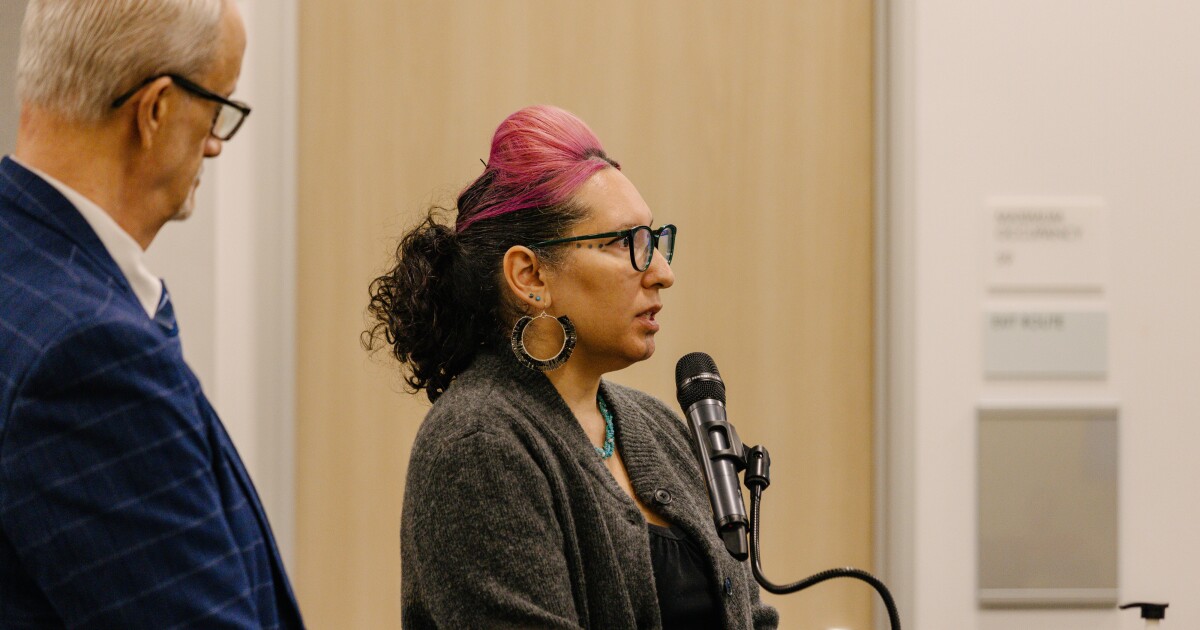
At a LAHSA Finance Committee meeting Friday, Janine Lim, the agency’s deputy chief financial office, broke down the issues based on agency.
Under contracts funded by city, the agency doesn’t have some of the money it owes providers, Lim said.For county-funded contracts, LAHSA has the funds, but has failed to pass some of them to providers, she said.
Lim acknowledged her department failed to request certain county funds and told commissioners her team is overwhelmed by staff turnover and nonstop crisis management.
Lindsey Horvath’s rebuke
The meeting prompted a harsh rebuke from L.A. County Supervisor Lindsey Horvath Friday night, who issued a statement demanding a public hearing about LAHSA’s late payments, a forensic audit and immediate payment of all outstanding invoices to county-funded contractors.
“If LAHSA were a publicly traded company, regulators would shut them down.” Horvath said, in a statement “LAHSA balance sheets don’t balance, and they fail to provide real-time financial information to their very own commissioners.”
LAHSA officials have said they’re working to fix delays and make internal changes so that they don’t happen again.
And they offered more details on how they got here:
They said some payments were delayed because the agency is struggling to process an influx of recently submitted invoices. Other payments are delayed because the agency is still waiting for millions in payments, mostly from the city of L.A.
“While a combination of contracting delays, outdated internal policies, and a leadership vacuum caused by the historic funding shifts happening within the rehousing system all contributed to this bottleneck, we are already taking corrective action,” Ahmad Chapman, a LAHSA spokesperson, said in a statement.
LAHSA’s funding sources
LAHSA has an approved budget of about $828 million this fiscal year. Most of that money — $697 million — comes from a variety of government sources and passes along to contracted service providers.
This budget year it breaks down like this, according to LAHSA records:
46% from L.A. County35% from the city of Los AngelesNearly 11% from the federal governmentMore than 8% from the state of CaliforniaA small fraction from private philanthropy,
LAHSA representatives said the delayed payments stem partly from delays in finalizing contracts with homeless service providers this fiscal year, which started July 1.
By that time, the agency had only finalized about one third of its contracts with providers. Providers can’t file invoices until those contracts are final.
Now, eight months into the budget year, LAHSA said more than 99% of contracts are in place. But many weren’t finalized until December. Now that contracts are executed, there’s an “avalanche” of recent invoices from providers, covering the past six months, according to LAHSA officials.
Challenges for providers
South L.A homeless services provider HOPICS said LAHSA owed it nearly $20 million as of last month, because of late contract executions and delayed payments across two budget years.
“Providers cannot continue operating on uncertainty and IOUs,” the Kelvin Driscoll, the nonprofit’s director, told LAist. “To keep services operating, we, like other organizations, have had to exhaust reserves and take on debt.”
Some homeless services providers said late payments have been a problem, but not an insurmountable one.
“The issue of floating unpaid invoices is part of business, especially if we’re working with bureaucracy and government.” said Rowan Vansleve, president of Hope The Mission. “Anybody who’s taken a contract with the government is not expecting to be paid incredibly quickly.”
Still, as the size of L.A.’s homeless services sector has grown, some service providers say they are being asked to take on larger financial burdens. LA Family Housing is waiting on both reimbursement payments and advances for recent months, its CEO said.
“Our contract is with LAHSA,” said Klasky-Gamer. “We are delivering on our end of the contract by delivering the service. They’re not able to deliver on their end of the contract because they don’t have access to the money to pay us.”
At the Friday meeting, LAHSA Commissioner Amy Perkins said she had received “countless” calls from leaders of large providers who are considering closing down.
“They don’t want to say that publicly because they don’t want to scare their staff and they will do everything they can not to close,” Perkins said. “They have maxed out their lines of credit. There’s no more rocks to turn over. Vendors are walking off jobs.”
Commissioners demands answers
Last year, L.A. County supervisors voted to strip LAHSA of about $300 million in county funding from LAHSA, beginning this July. Until then, county homelessness funding still goes through LAHSA.
Perkins, appointed to the LAHSA Commission by Horvath, told LAHSA officials on Friday that the payment crisis shows why the county’s move was necessary.
“This is exactly why we have said for a long time that the structure of LAHSA doesn’t work,” Perkins said. “How are you supposed to administer funding for people who won’t pay you?”
Justin Szlasa, another LAHSA Commission member said he has frequently heard service providers complain that LAHSA pays them late.
Szlasa said he asked for an itemized summary of all of LAHSA’s unpaid bills. The report should have been easy to generate immediately, Szlasa said.
Months later, LAHSA still has not produced the document, he said. This month, he filed a public records request for that information, including which contractors LAHSA owes money to and how behind on payments it is.
“We as commissioners don’t have visibility into how we’re doing if we don’t know how much money we owe and how late we are with payments to these service providers on the front lines of our homelessness response,” Szlasa said.
LAHSA officials said the agency will work with outside consultants to update the agency’s finance operations to ensure providers are paid accurately and on time.