
Valley growers have long hoped for winter rain, but this week’s storm showed how too much precipitation at the wrong time can create challenges for agriculture.
Several crops across the Central Valley were in delicate stages of development when heavy rain, wind and hail moved through the region, including orchards already in bloom. At Fresno State, the university’s agriculture department is closely monitoring conditions and assessing the impact on its wide range of crops.
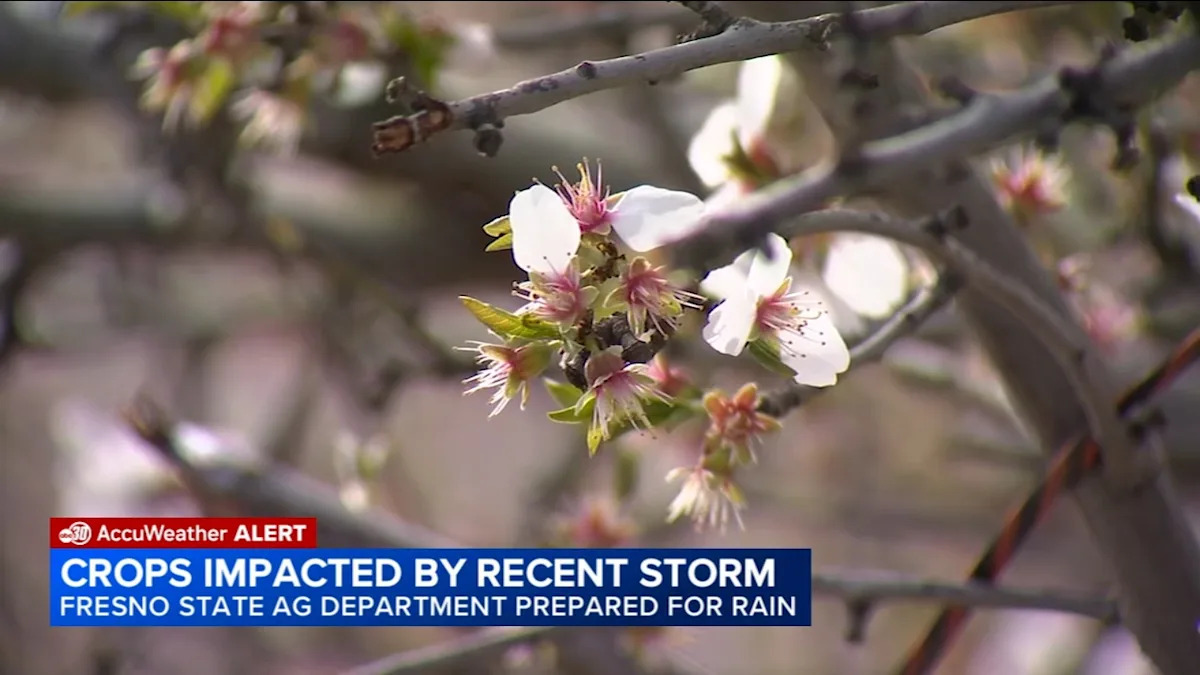
Normally, almond trees on campus would be covered in blossoms. After the storm, many petals could be seen scattered on the ground, a visible sign of damage from the rain and wind.
Fresno State Orchard Manager Robert Willmott oversees several acres of orchards and fields that include citrus, almonds, alfalfa, corn and wheat, along with dozens of other crops, more than 50 in total.
“My old saying is, if you pray for rain, you better be prepared to deal with the mud,” Willmott said.
Some crops weathered the storm with little concern. Willmott said several tree varieties remain dormant and were not significantly affected.
“My pomegranates, my pistachios, my persimmons…my walnuts, they are still asleep so I am not too worried about them,” he said.
Other fields, however, faced greater challenges. Almond trees sustained damage as heavy rain, strong winds and hail knocked off blooms, potentially affecting production. A wheat field on campus, which will later be used as cattle feed, also suffered from the conditions.
“A lot of it lodged, so it fell over on its side. Hopefully, with some good sunny weather and dry days, it will be able to stand back up, but I know not all of it will stand back up,” Willmott said.
The weather also complicated pollination efforts. Bees struggle to work in temperatures below 55 degrees, Willmott said, though hives had been placed earlier in the season as a precaution.
“Lucky for us, we had our bees here; the bees were working hard for us while they could with these colder temperatures and the rain, it slowed them down,” he said.
Across campus, puddles and muddy rows of citrus trees have forced farm equipment to remain idle.
“We are going to wait for it to dry out so we can get back in the fields, we are at a standstill right now,” Willmott said.
Despite the setbacks, Willmott emphasized the long-term benefits of winter storms, particularly the snowpack building in nearby mountains.
“It is absolutely great to see the snow on the mountain sides and snow is going to equate to water for us to irrigate our crops this season, so I have to be hopeful that more snow shows up,” he said.
Willmott said he remains ready for more rain and snow, noting that growers across the Central Valley continue working through difficult conditions to support the global food supply.
For news updates, follow Elisa Navarro on Facebook, X and Instagram.