
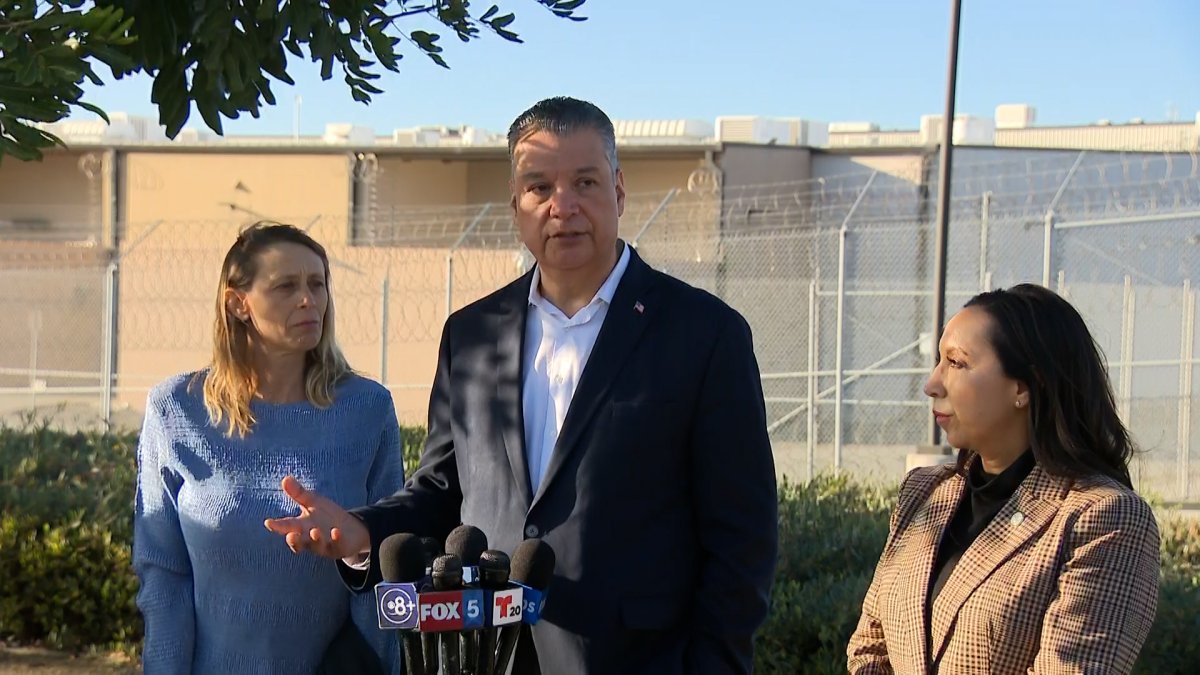
U.S. Sen. Alex Padilla and two San Diego County Board supervisors were denied entry into the Otay Mesa Detention Center Friday as they attempted to conduct oversight visits of the facility following reports of harsh conditions for detainees held inside.
“What do they have to hide?” Padilla asked, after he waited for about an hour in his unsuccessful attempt to tour the facility. “What does this administration have to hide? Secretary [Kristi] Noem herself was here recently and said, ‘Oh, the detainees are being very well taken care of.’ If that’s the case, what are they afraid of? What do they have to hide?”
Padilla said staff told him he was not allowed to enter because he did not give their required seven days’ notice, but he and several other members of Congress contend they have the legal authority to conduct oversight visits of any federal facility at any time, including unannounced – so they can see them when no one knows they’re coming.
Padilla’s visit came two weeks after Rep. Juan Vargas (D-San Diego) was also turned away in his attempt to visit the facility, days after a detainee threw an empty lotion bottle over the fence with a note attached, detailing allegations of bad food and widespread illness.
“It’s cold here, the food is very poor. For 290 [days] we haven’t eaten a single piece of fruit, banana, orange or anything else,” the letter reads. “We’re in one big room with no doors or windows. We can’t see any grass or trees. We’re constantly sick.”
There are new, gruesome allegations about what’s happening inside the Otay Mesa Detention Center. Some claims prompted a member of Congress to try and inspect the facility, but he was turned away. NBC 7’s Shelby Bremer has details.
That was one of several reports that prompted the San Diego County Board of Supervisors to initiate a health inspection, which they said falls under their scope as part of California law. Board Chair Terra Lawson-Remer and Supervisor Paloma Aguirre said that inspection was scheduled for Friday and they tried to enter the facility as part of that effort. Neither was allowed in.
“It’s very deeply concerning to me, to be quite honest,” Lawson-Remer said afterwards. “If they will not let us in after more than a week of notice when they would have potentially had enough time to make sure that they are in compliance, then I can only imagine how terrible and horrific the conditions are for individuals that are inside.”
They said the county’s chief medical officer was allowed into the facility earlier in the day but he was not allowed to meet with any detainees or review any medical records. Lawson-Remer and Aguirre said they were both given prior approval, showing emails confirming they would be allowed access.
“What we truly want to see is what are people experiencing there and talk to them,” Aguirre added. “We have the allegations that they have not had access to healthy foods or fresh foods, some for over 300 days. They have not had the ability to go outside and breathe in clean air.”
In a statement, CoreCivic – the private prison company that runs the detention facility – said, “The safety, health and well-being of the individuals entrusted to our care is our top priority,” adding that the facility is regularly reviewed and audited.
“The leadership and staff at OMDC welcome the oversight of the San Diego County Health and Human Services Agency and are cooperating fully with the Public Health Officer related to an on-site visit,” the statement continued, adding that all visits or tours must be coordinated and approved by Immigration and Customs Enforcement.
ICE did not respond to request for comment or answer any questions related to why the supervisors were denied access.
A woman who has no criminal history but was arrested during her final green card interview in November, then detained for nine days thereafter, said she was not given medication for her diabetes while inside the Otay Mesa Detention Center and that the food was hardly recognizable.
“It seemed like it was for animals,” said Hanne Engan. “It seemed like it was not meant for human consumption. It smelled weird. It tasted really weird. I, for the most part, didn’t eat because of my medication. But it was minimal protein, no fat. Not a balanced meal at all.”
She said she had heard about the note thrown over the fence and agreed with several other parts of it – including the temperature.
“It’s unbearably cold. The guards, they’re wearing winter jackets inside. But we don’t have that luxury. When we got there, they had run out of sweaters, so they didn’t give us sweaters for the first day. They only gave us T-shirts,” Engan said. “You’re just shivering nonstop and it’s like a level of cold that hurts your bones. Like it’s not just being uncomfortable. It’s like really painful.”
Lawson-Remer and Aguirre said they would be filing a lawsuit over the denial of their inspection. Padilla said he was considering litigation too, as well as applying what he called “legislative pressure,” referencing the partial government shutdown over the Department of Homeland Security and its practices in immigration enforcement.
Engan said she “can’t believe” elected officials had not been allowed in, and it made her angry.
“I think it’s abuse. It’s a violation of human rights to deny people their medication, to not provide sanitary products, to not have running water or give people water when they’re in this temporary holding cell,” Engan said. “I think it’s inhumane to not provide adequate clothing for the temperatures. And I think they’re going to probably cover up that people sleep on the floor.”
“Everyone deserves adequate treatment and medical treatment in jail. Everyone deserves to be safe,” she continued. “You can’t treat humans like they’re not human.”