
Jim Tanimoto remembers a lot from his 102 years of life, but not who took the photograph blown up on his office wall.
The black-and-white picture shows 28 men of Japanese descent, American citizens, lined up on wooden stairs leading to a mess hall at Tule Lake, one of 10 internment camps in the western United States during World War II.
A 20-year-old man seated on the front row of steps, hair dark and skin young like the rest, looks away from the frame. His eyeline, askance and away from the camera, appears to meet the future version of himself, more than 80 years later, standing beside the image and explaining its significance.
“I’m the last guy,” Tanimoto said. “Just like my family. I’m the last guy in my family also.”
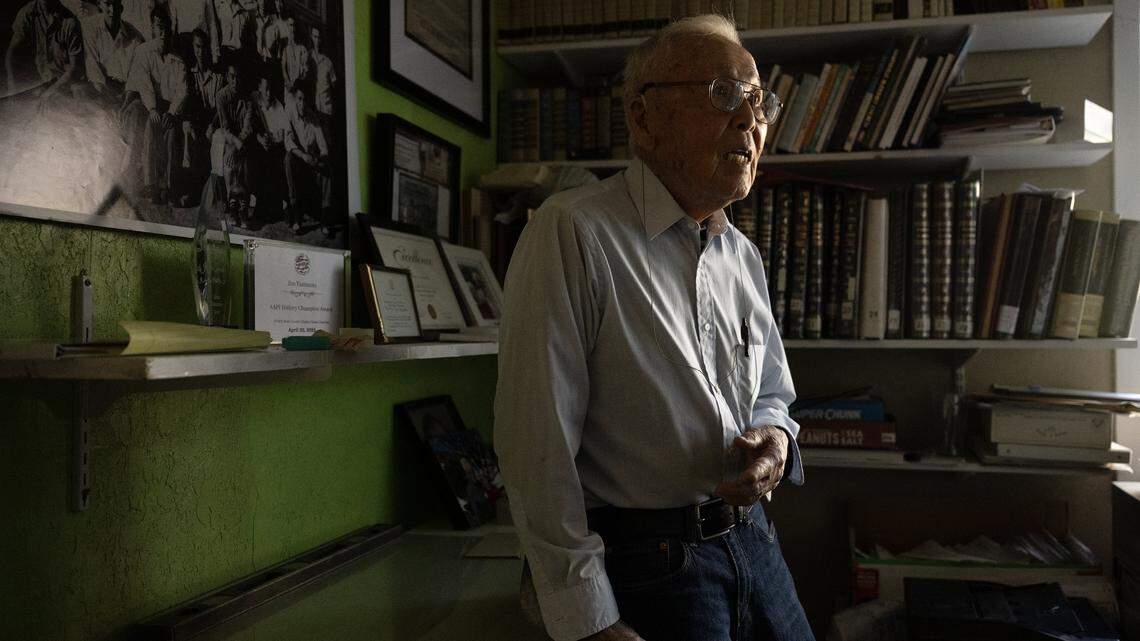
Jim Tanimoto, 102, the last surviving member of the Block 42 resistors, stands in front of a historic photograph of the group that hangs in his home in Gridley earlier this month. The men were transferred to the Tule Lake internment camp for refusing to answer a “loyalty questionnaire” that implied they had maintained allegiance to Japan. JOSÉ LUIS VILLEGAS jvillegas@sacbee.com
Japanese American men stand on the steps of a mess hall at the Tule Lake internment camp in Siskiyou County in 1943, including Jim Tanimoto, second from right in the front row. The men became known as the Block 42 resisters after refusing to answer two questions on a government loyalty questionnaire, leading to their transfer to a separate facility at Camp Tule Lake. Courtesy of James Tanimoto
That photograph captured the faces of what became known as the Block 42 resisters, a collection of Japanese Americans who refused to answer questions on a “loyalty questionnaire” that implied they, while incarcerated, had maintained allegiance to Japan.
That was 1943, near the peak of World War II and partway through the forced confinement of nearly 120,000 people of Japanese descent, the majority of whom were American citizens. Located at the farthest reaches of Northern California in Siskiyou County, Tule Lake was the most populated and, by many historical accounts, the harshest of the internment camps.
Fewer internment survivors remain each year. Tanimoto, as the last living Block 42 resister, carries a singular piece of that history — a controversy and act of resistance within the walls of confinement that illustrated the dilemma faced by people imprisoned by their own country without accusation of a crime.
“You know, I’m an American citizen. I didn’t do anything. The only problem was I have Japanese blood in my body,” Tanimoto said. “My ancestors are Japanese. That’s my crime, is my ancestry. Other than that I did nothing to be treated like this.”
The breaking point came when the young men of Block 42 were asked to agree to fight for the government that was incarcerating them and their families, and to accept the implication that they had ever been loyal to a foreign country to which they had no connection apart from ancestry.
“Do you oppose the government because it’s violating the Constitution, or do you be, quote-unquote, ‘a good citizen,’ go in the Army and do what’s expected of good citizens and serve?” said Richard Arent, an executive committee member of the Marysville chapter of the Japanese American Citizens League.
Their refusal to affirm what those questions asked of them resulted in their transfer to a separate nearby facility called Camp Tulelake, and earned them the moniker “no-no boys,” for their responses to those two loyalty questions.
As the last survivor of the Block 42 resisters, Tanimoto has kept awareness of that complicated, defiant chapter of Japanese American history alive by sharing his story, including at a Day of Remembrance event taking place at noon Saturday at the Sutter County Museum in Yuba City.
Jim Tanimoto, the 102-year-old survivor of the Tule Lake internment camp in Northern California, at home in Gridley earlier this month. JOSÉ LUIS VILLEGAS jvillegas@sacbee.com Before and after Dec. 7, 1941
The Tanimoto boys were pruning their family’s peach trees in Gridley on Dec. 7, 1941, the Sunday that Japanese warplanes attacked Pearl Harbor.
Tanimoto’s father, who grew up in Hiroshima — the Japanese city later devastated by the first atomic bomb — immigrated to Hawaii before raising his family in Northern California and had recently retired from farming.
Tanimoto and his brothers, five in all, returned home for lunch to find their father listening intently to the radio.
“He said Japan bombed Pearl Harbor,” Tanimoto said.
He and his brothers did not believe it, nor did they know what to make of it.
“We were just like everybody else, we didn’t believe that something like this could happen,” he said. “But it did happen. Then things kept getting worse.”
Before that day, the Tanimotos and the other Japanese families living near Gridley faced little discrimination. Other than occasionally not being allowed to swim in the city pool, Tanimoto said, they were treated like anybody else.
“When we grew up we were just another person, no discrimination,” Tanimoto said. “Once the bomb was dropped, I became an enemy.”
Life for the Tanimotos changed. They received hostile glances from familiar neighbors. Others avoided them. Some businesses refused to serve them.
“I didn’t know what was going on, but when you went into town the next day, Dec. 8, Monday morning, you knew something was wrong,” Tanimoto said. “Nobody would talk to you. Everybody would turn around.”
The Sutter County Museum holds a collection of correspondence to and from the Japanese American Citizens League before and after World War II. The documents show the strong shift of uncertainty its members faced in the weeks and months after Pearl Harbor was attacked and the U.S. declared war against Japan.
The relatively quaint pre-war talks of proclaiming a “Nisei Day” to recognize the burgeoning second generation of Japanese Americans and purchasing trees to plant along Ellis Lake in Marysville grew more urgent.
Jim Tanimoto, the 102-year-old survivor of the Tule Lake internment camp in Northern California, at home in Gridley earlier this month. JOSÉ LUIS VILLEGAS jvillegas@sacbee.com
The organization’s leaders expressed support for the U.S. as it entered World War II while also helping interpret escalating restrictions on Japanese Americans: curfews, travel bans, documentation requirements and, ultimately, forced evacuation to internment camps.
“If you look at where the relocation camps were built, a lot of them were on land close to reservations for Native Americans,” Arent said. “So, Tule Lake, there was not much up there, and still not much up there. They put the relocation camps in areas that were isolated.”
Executive order 9066, signed Feb. 19, 1942, by President Franklin D. Roosevelt, allowed the U.S. to effectively imprison thousands of people of Japanese descent, the majority of whom were American citizens, in remote outposts plagued by cramped and low-quality living conditions.
“We didn’t do anything, you know. We were innocent,” Tanimoto said. “We didn’t break any laws. We paid our taxes. We did everything that a good citizen would do. And yet we were enemies after the first bomb (of Pearl Harbor).”
The Tanimoto family boarded a train at the Gridley depot July 9, 1942, leaving behind a full peach harvest that went uncollected. They arrived at Tule Lake the next day, assigned to Block 42.
Loyalty and the Block 42 resisters
As with many American families, the Tanimoto brothers were all different.
The oldest brother lived a hard life and died relatively young. By comparison, Tanimoto is the last of his seven siblings, and the second to have become a centenarian. The photograph of the Block 42 resisters on Tanimoto’s wall shows two of his brothers, who also refused to cooperate with the loyalty test.
Meanwhile, another brother, Jack, was serving in the military, embedded with a group of Marines in the Pacific Theater.
Tanimoto said he himself had enlisted for the draft, but saw his classification drop after Pearl Harbor was attacked, effectively rendering him ineligible to serve. That struck him as hypocritical when about a year later, while incarcerated against his will, the same military demanded his willingness to serve, likely in the segregated unit of Japanese American soldiers called the 442nd Regimental Combat Team.
Jim Tanimoto, the 102-year-old survivor of the Tule Lake internment camp in Northern California, at home in Gridley earlier this month. JOSÉ LUIS VILLEGAS jvillegas@sacbee.com
“They want me, they don’t want me, now they’ve got me behind the barbed wire fence, and they want you to volunteer,” he said. “Now they want you. So what do you do? Your government don’t want you, they want you. So I go, ‘You don’t know what you’re saying here. You’re talking to the same person.’”
Government officials put the loyalty test before the military-age, often second-generation Japanese Americans and asked them two questions that caused rebuke.
Question 27 asked if they were willing to serve the military wherever ordered. Question 28 asked if they would pledge loyalty to the United States and renounce any allegiance to the Emperor of Japan.
“Because we’re American citizens, that Question 28 is insulting,” Tanimoto said. “You’re talking to American citizens. So we had nothing to do with having anything to do with the Emperor of Japan, or Japan. So we said, ‘We’re not signing the loyalty paper.’”
Tanimoto said his beliefs were, and still are, consistent with deeply American principles of constitutionally-protected freedoms for citizens. By taking those liberties from citizens on the basis of ancestry, the government’s application of the constitution, in the eyes of the resisters, was inconsistent with those fundamental principles and inalienable rights.
Accordingly, internment camp authorities sent the resisters to local jails outside the camp, then transferred them to Tulelake Camp, a Civilian Conservation Corps camp repurposed to jail the men who rejected the loyalty questionnaire.
The resisters were transferred from a prison camp to a more restrictive jail, Tulelake Camp, located more than 10 miles away, said Ron Nakano, with the Marysville JACL, noting that the two camps are distinct but often confused.
That imprisonment lasted about a month, before Tanimoto and the others from his block returned to the rest of the internment camp population. Tule Lake transitioned from a relocation center, like the other camps, to a segregation center, for those deemed disloyal.
It was after their release, bonded by defiance — but missing a handful of other resisters sent to another camp — that the photograph on Tanimoto’s wall was taken.
Returning to American life
Tanimoto does not remember why he was released from Tule Lake when he was.
He returned home with his family Feb. 26, 1944 — earlier than many others — while the war was still being fought in Europe and the Pacific.
Jim Tanimoto, the 102-year-old survivor of the Tule Lake internment camp in Northern California, at home in Gridley earlier this month. JOSÉ LUIS VILLEGAS jvillegas@sacbee.com
Tule Lake closed in March 1946. Before its closure, Tanimoto returned to the camp to marry Alice Takeshita, who would become his wife of 53 years. It would be one of several returns to the desolate camp, the others coming much later, as organized pilgrimages.
The internment camps marked a formative and disruptive time in the lives of those trapped within their barbed-wire perimeters. But they have since faded in history, as a footnote to World War II, and one of many tragedies reckoned with in the war’s aftermath.
The Japanese American community waited more than 40 years before the federal government in 1988 issued a formal apology for the internment camps and offered $20,000 to each survivor affected by the executive action of 1942.
It took Tanimoto about 50 years to open up about his personal history with Tule Lake and the loyalty questionnaire. He began by talking to young students at the elementary school down the road from the Gridley home he and his family were evacuated from, the home where he still lives. He hasn’t stopped talking since.
The question he fields most often, and his answer to it, shows the lasting relevance of the last no-no boy’s story, and the importance of keeping it alive.
“The one question they always ask after the speech: Do you think it will happen again? And I said I hope not, but I’m sure it’s going to happen again,” Tanimoto said. “And I don’t know what nationality or what ancestry is going to be involved, but I think it’s going to happen again.”
This story was originally published February 19, 2026 at 11:00 AM.
Related Stories from Sacramento Bee
The Sacramento Bee
Jake Goodrick covers Sutter County for The Sacramento Bee as part of the California Local News Fellowship Program through UC Berkeley. He previously reported and edited for the Gillette News Record in northeast Wyoming.