
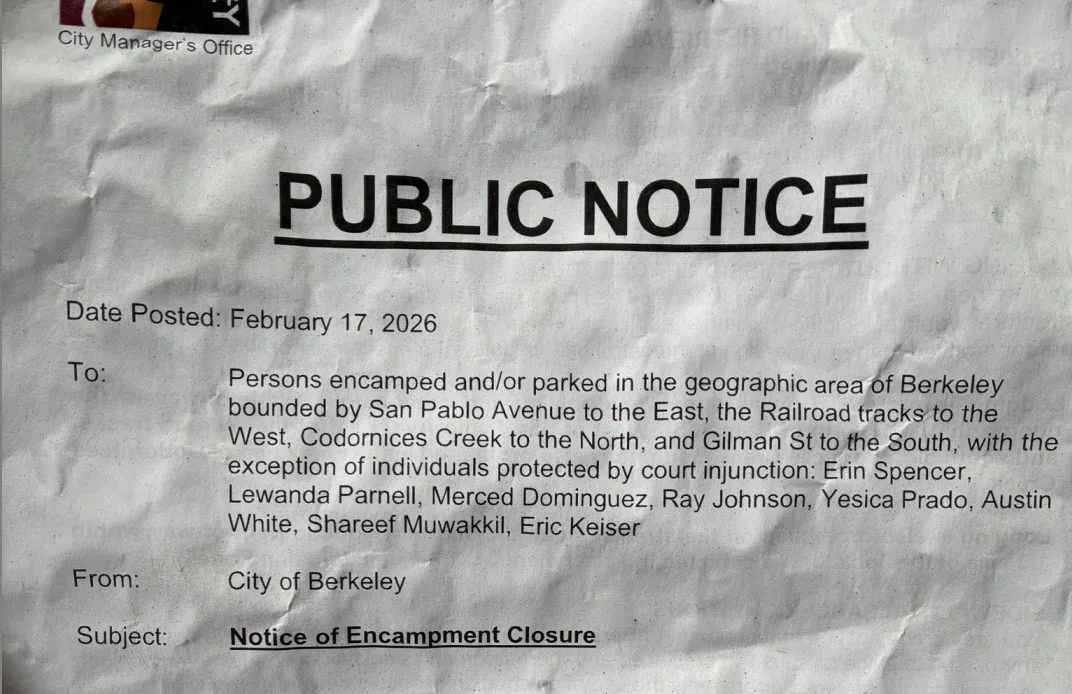
BERKELEY, Calif. — The City of Berkeley has ordered the closure of an encampment in West Berkeley, citing public health concerns related to leptospirosis and declaring a broad surrounding area a no-lodging zone, prompting sharp criticism from advocates and residents.
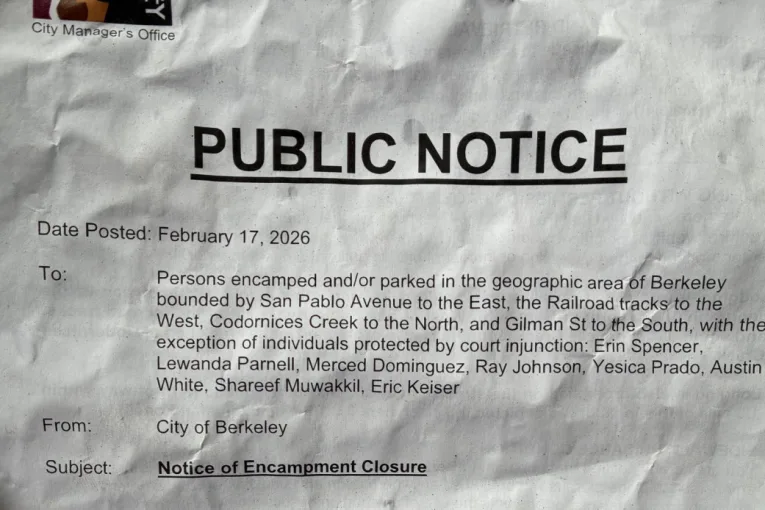
In a public notice dated Feb. 17, 2026, the city informed “Persons encamped and/or parked in the geographic area of Berkeley bounded by San Pablo Avenue to the East, the Railroad tracks to the West, Codornices Creek to the North, and Gilman St to the South” that the area is subject to a “Notice of Encampment Closure.”
The notice states that the location “is within a no-lodging area and Temporary Non-Commercial Item (TNC) Prohibited Area” and adds, “You are not permitted to lodge here or store personal property here, pursuant to California Penal Code Section 647(e) and City of Berkeley Administrative Regulation 10.2.”
The city further wrote that its public health officer has advised that “no new encampments, including vehicular encampments, should be established within 1/3 mile due to the presence of Leptospirosis and the need for rodent abatement to prevent further spread of the disease.” The notice continues, “As such, the streets, sidewalk, and other public right-of-way within a 1/3 mile radius from this location is declared a no-lodging area as depicted in Attachment 3 (‘1/3-Mile Exclusion Zone’).”
Residents are ordered to vacate by Feb. 24, 2026. “Please vacate the TNC Prohibited Area by or before February 24, 2026,” the city wrote. The notice states that “All personal property in the above location will be subject to removal on or after this date.”
The city also indicated that temporary no-parking signage would be placed in the area to enable cleaning and rodent abatement, citing California Vehicle Code Section 22651(l) and Berkeley Municipal Code 14.36.030G. “All vehicles remaining in the above location on or after February 24, 2026, in violation of posted signage, are subject to immediate tow and impound,” the notice states. “Failure to comply with this notice may result in citation or arrest.”
The notice names eight individuals protected by court injunction — Erin Spencer, Lewanda Parnell, Merced Dominguez, Ray Johnson, Yesica Prado, Austin White, Shareef Muwakkil and Eric Keiser — and specifies that the relocation requirement and no-lodging designation “does not apply to the individuals protected by court injunction, as listed above, for as long as the injunction is in effect.”
The city has linked its action to the presence of leptospirosis, a bacterial disease commonly spread through contact with water or soil contaminated by infected animal urine, often associated with rodents. According to advocates, the first confirmed case connected with the encampment occurred in November 2025.
In a Feb. 20, 2026 press release titled “City of Berkeley Exacerbates Bacteria Risk, Uses Results of Their Own Inaction as Excuse to Sweep Homeless Encampment,” advocacy group Where Do We Go? criticized the city’s approach and timeline.
The release states that the city’s notice gave residents at Eighth and Harrison streets one week to move “or risk citation and arrest on or after February 24th, 2026.”
Catherine Lewis, identified in the release as a Where Do We Go? organizer and leader in food distribution, said, “The city of Berkeley is unrelenting in its harassment and criminalization of the unhoused community. Rather than supporting the community at 8th & Harrison with sanitation including ongoing trash pickup, the COB is using the Lepto outbreak to justify sweeping the most marginalized among us. Many of us have been begging the COB for sanitation support for months and months. Where is that support? Not until two months after the ‘outbreak of Lepto’ did the City choose to act. Their solution is displacement and intensifying trauma. Exactly where are people supposed to go? Where?”
The press release states that in accordance with a Jan. 13 order by U.S. District Judge Edward Chen in Case 3:25-cv-01414-EMC, individuals covered by a lawsuit are exempt from the impending sweep. It asserts that the Federal District Court’s order requires the city to identify “at least three specific, nearby locations where those affected could lawfully move,” or explain why doing so would be unreasonable.
The release further states that the court ordered the city to explain why it is sweeping the entire area rather than distributing personal protective equipment and to describe whether providing non-congregate, ADA-compliant relocation options would impose a fundamental burden on the government.
Merced Dominguez, described in the release as a resident who has been in the community for 12 years, said, “Why would you close down a campsite knowing people have nowhere else to go? That’s the City’s responsibility.”
Stefan Kaiter, who the release says builds and operates a Warming Hut that provides relief from cold and rain at the site, also criticized the sweep. “This is a perfect opportunity for the City to see the amazing idea that has been brought to it time and time again: giving people a safe place or RV park to move to, where they can find some semblance of stability and be located by homeless services, and be provided trash disposal, clean bathrooms, food support. All of those things can get people back into housing. The City could use this opportunity to pursue something new, rather than continuing the cycle of displacement and it’s really disappointing to see,” he said.
The advocacy release contends that the city failed to provide adequate solid waste removal or sanitation infrastructure before and after the first confirmed leptospirosis case. It states that concerns about trash collection at Berkeley encampments were raised in a meeting with Mayor Adena Ishii on Sept. 24, 2025, and that conditions did not change.
The release also references a Jan. 13 leptospirosis outreach event, which it says advertised information about symptoms and vaccine vouchers.
The city’s public notice and the subsequent advocacy response highlight the ongoing tension in Berkeley over how to balance public health concerns, court-ordered protections and the needs of unhoused residents.
The public notice makes clear that after Feb. 24, personal property may be removed and vehicles towed, and that noncompliance may result in citation or arrest. At the same time, the listed individuals covered by court injunction remain exempt “for as long as the injunction is in effect.”
As the Feb. 24 deadline approaches, the dispute centers not only on disease mitigation but also on relocation, available shelter beds and compliance with federal court directives — questions that may determine whether the sweep proceeds as planned and under what conditions.
Follow the Vanguard on Social Media – X, Instagram and Facebook. Subscribe the Vanguard News letters. To make a tax-deductible donation, please visit davisvanguard.org/donate or give directly through ActBlue. Your support will ensure that the vital work of the Vanguard continues.
Categories: Breaking News Homelessness Sacramento Region Tags: berkeley City of Berkeley Court Injunction Encampment Sweep homeless encampment Leptospirosis Public Health Where Do We Go?