
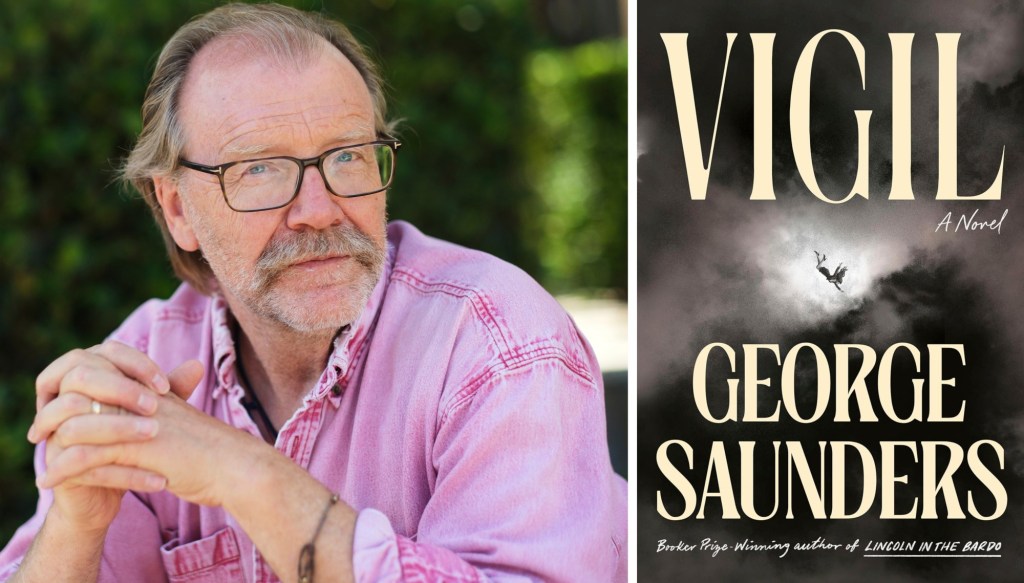
Editor’s Note: The author of this review, Dean Nelson, will interview George Saunders in person as part of his 31st annual Writer’s Symposium by the Sea this week at Point Loma Nazarene University in San Diego.
Let’s just say that George Saunders sees things the rest of us don’t see. Or maybe he just sees things more clearly. Or maybe he sees what we see and he reveals the absurdity of it.
Or maybe he sees what we see, highlights the absurdity and goes past it to reveal compassion.
Take his latest novel, “Vigil,” for example. It is mostly a death-bed scene.
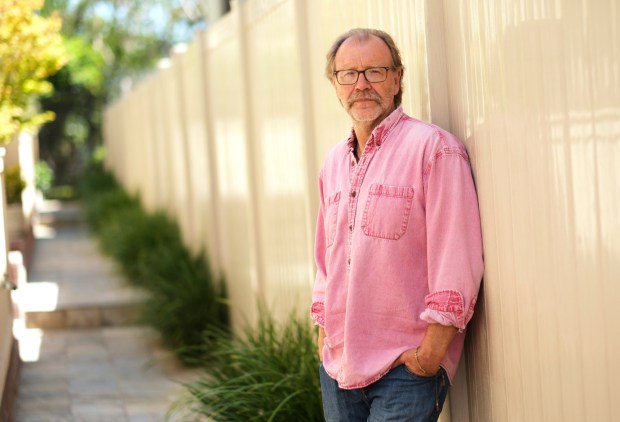 Author George Saunders poses for a portrait on Wednesday, Aug. 20, 2025, in Santa Monica. He will discuss his latest book “Vigil” at the 31st Writer’s Symposium by the Sea in San Diego on Feb. 27. (AP)
If you’ve ever been near a person when they are about to pass from this world into the next (I know what I’m talking about here), it is usually just you (or a hospice worker, or a medical person) and that person who is about to depart, in the room. Ultimately it is a lonely journey the dying person must take.
In “Vigil’s” death-bed scene, there is a revolving door of characters — both from this world and from “out there” (wherever that is), and we get to eavesdrop on what they see, say, do and think. Including the dying man, K.J. Boone, himself.
Boone is not a likable guy. He is repugnant, actually. He reminded me of some of the business moguls and politicians that I have come to despise. And we, the readers, might expect that he has some regrets, some desire for redemption, for his bad behavior. We expect him to be restored to his original goodness. We hope he asks for forgiveness. We hope he apologizes for the damage he has done. We think that’s how a just world works.
Boone does not do these things. In fact, he doubles down.
That’s not the story, though. The story is about all of the forces — the humans and the spirits — that surround him during those final moments. What do they want?
The main character is a spirit named Jill who crashes to earth to help usher Boone into the afterlife. She has done this 343 times with others after she was blown up in her car by her husband’s enemy. She has a job to do, but she keeps getting interrupted by other spirits who want to settle scores with Boone. One in particular wants him to confront the damage he has done to the world, the people who have suffered because of his greed. This spirit wants to make sure that Boone’s lies, subsidized “science,” and purposeful misinformation have consequences.
There are other visitors, too, like the scientists who had gone before him, now encouraging him to stick to his lies, with lines like, “Doesn’t every idea, even those judged by some standards to be fallacious or those which have been disproven outright, deserve to be honored with the public’s attention?” That’s how democracy is served, one of them says.
She is also interrupted by the sounds coming from next door – a wedding party – where there is joy and a future unfolding, while she is trying to bring her present assignment to an end. Life and death are next-door neighbors in Saunders’ world.
This spirit of Jill enters into the spirit of Boone and she experiences what made him become the way he was. She concludes that there was an inevitability to his behavior, his arrogance, his lies.
In his last hours he is visited by his daughter, who is still alive, who declares her love for him despite all of the things people are saying he did wrong and the damning documentary about him that her roommate made her watch. That exchange felt so authentic to me. Somehow, when you love someone, you realize that they may be a dirtbag, but that’s not all they are. They’re your dirtbag, and you love them anyway.
And finally the spirit herself is confronted by a force that is greater than regret or love or reconciliation or truth. She is confronted by the inevitability of it all, and then the response to that revelation:
“Comfort.
“Comfort, for all else is futility.”
She can at least do that.
And so can we.
Dean Nelson is the founder and director of the journalism program at Point Loma Nazarene University, and the founder and host of the annual Writer’s Symposium By The Sea. His two new books are “Talking to Writers: The Craft of Fiction” and “Talking to Writers: The Craft of Nonfiction,” published by Bloomsbury.
“Vigil by George Saunders (Random House, 2026; 192 pages)
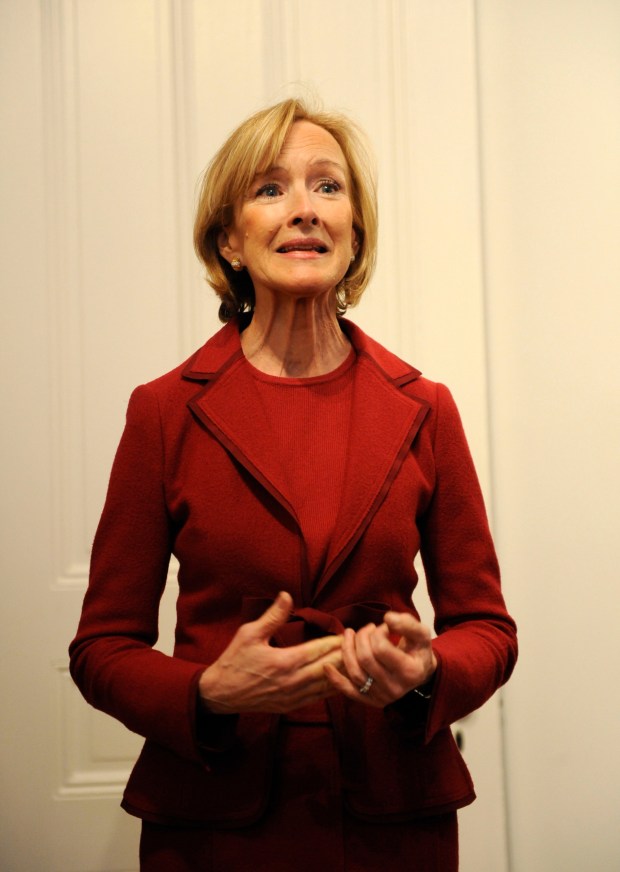 Broadcast journalist and author Judy Woodruff will discuss her work at the 31st Writer’s Symposium by the Sea in San Diego on Feb. 25. (Children’s Press Line)
The 31st Writer’s Symposium by the Sea
Lomaland Student Short Film Festival – 7 p.m. Monday at Crill Performance Hall
Dean Nelson interviews Judy Woodruff – 7 p.m. Wednesday at Brown Chapel
Dean Nelson interviews Jamaica Kinkaid – 7 p.m. Thursday at Crill Performance Hall
Dean Nelson interiews George Saunders – 7 p.m. Friday at Brown Chapel
Where: Point Loma Nazarene University, 3900 Lomaland Drive, San Diego
Tickets: Author interview tickets range from $2.99 to $55.37. Film festival is free.
Online: pointloma.edu/events/31st-annual-writers-symposium-sea
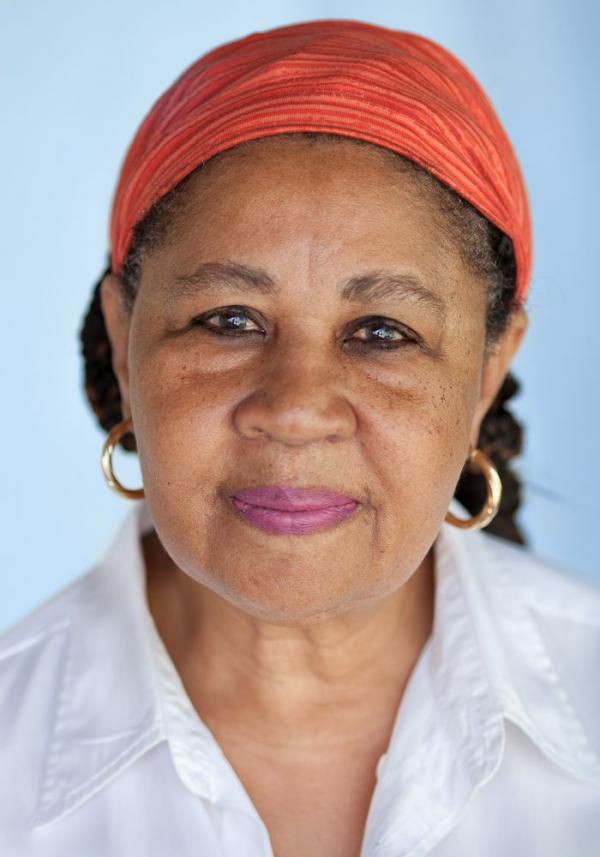 Author Jamaica Kinkaid will be interviewed by Dean Nelson on Thursday, Feb. 26, at the Writer’s Symposium by the Sea at Point Loma Nazarene University. (Jamaica Kinkaid)