
Fresno City College students have made efforts to bring change to the State Center of California Community Colleges (SCCCD) Immigration Control Enforcement (ICE) protocol. A petition to stop staff compliance to this protocol has collected the signatures of more than 50 students.
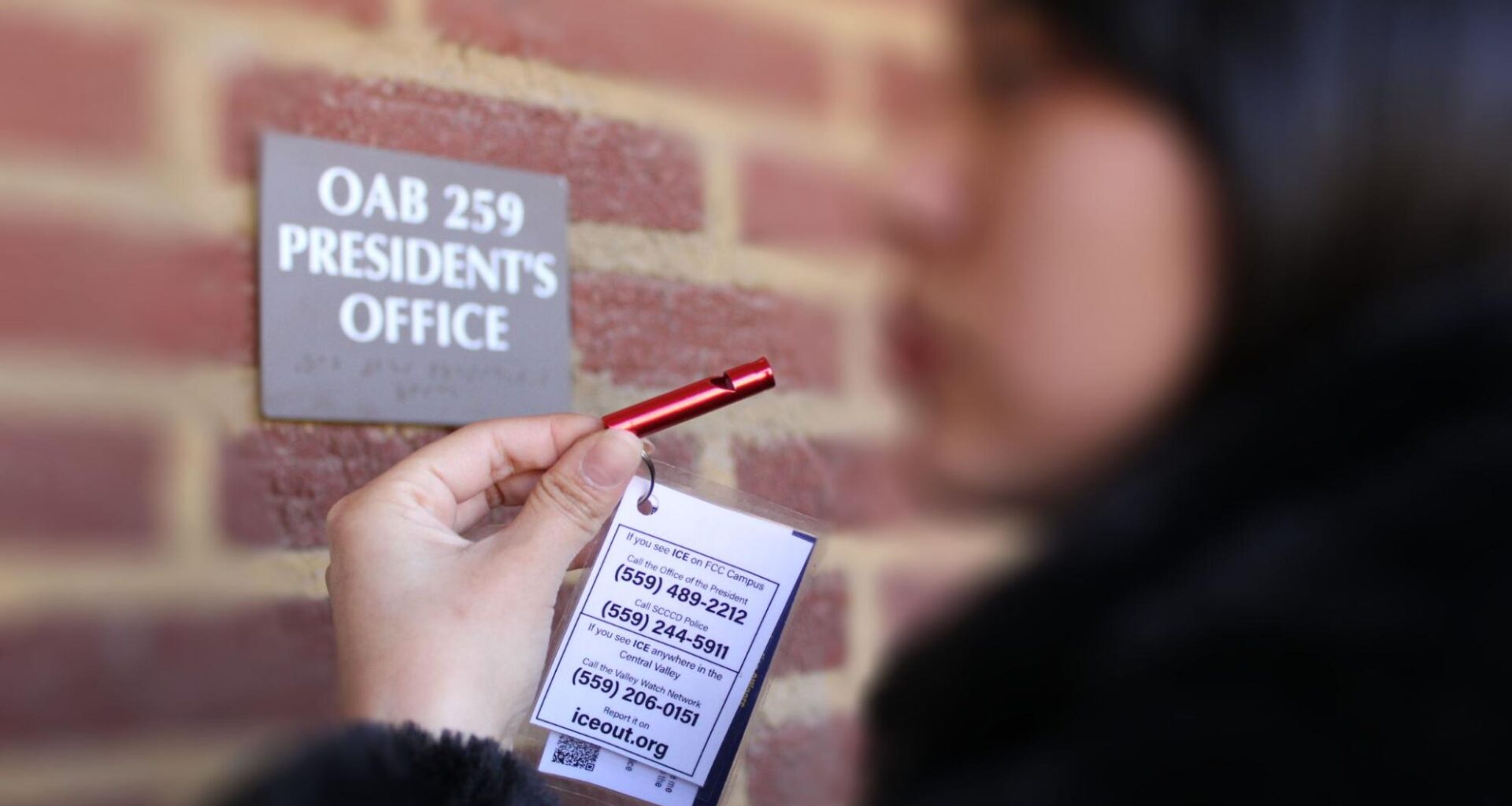
The protocol that is being referenced is the general instruction if ICE is spotted on the college campus. The process is to notify the president’s office at (559) 489-2212, then call the SCCCD Police Department at (559) 244-5911.
Students and faculty are instructed by the district not to give any information about students or staff in the event that they are approached by someone asking for their information. If the individuals identify themselves as ICE, then the procedure is to direct them to the president’s office and the SCCCD PD. They encourage politeness and professionalism.
The ICE protocol has been instructed to students, faculty and staff through multiple ICE trainings. Information is also given on the FCC website under immigration resources.
Rigoberto Garcia Santa Rosa, an ethnic studies instructor and a club advisor for MEChA (Chicano Student Movement of Aztlán), a student organization advocating political education for Chicano Latino students, said the college president is meant to act as mediator between ICE and whatever activity is happening on campus, according to his understanding of the information given by a legal representative of the district during an ICE training.
After attempts to talk to an administrator, we were not able to get a statement from the college in time for publication.
Brianna Gonzalez and Fern Shirley are two of the three students who have organized an “ICE Out of FCC” petition to gather signatures of students and staff that wish to revert the FCC policy.
Gonzalez said the petition was created to change the protocol in response to ICE, so that students and staff members feel safe on campus by not cooperating with ICE even if they have a warrant.
The goal for petitioning is to gather enough student and staff signatures to bring to the president’s office and the Board of Trustees to negotiate demand for change, according to Gonzalez.
The petition has been circulated on campus through support of students and staff passing along the papers to sign.
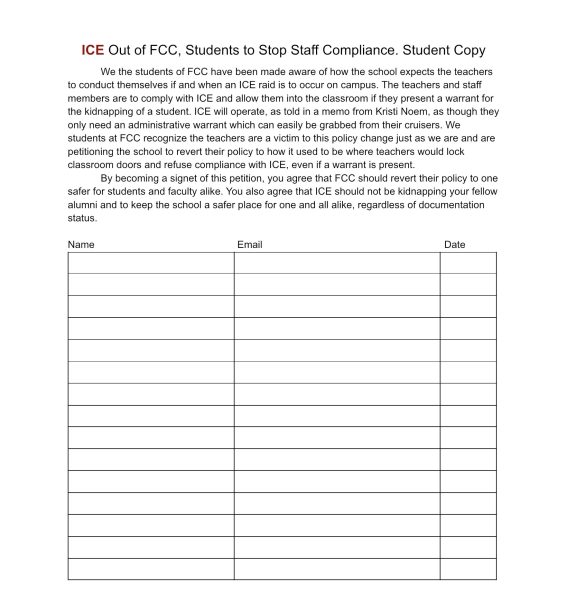 (Document courtesy of Brianna Gonzalez and Fern Shirley) The petition that Shirley and Gonzalez are trying to get signatures for.
Both Gonzalez and Shirley have expressed that they do not believe faculty should comply with ICE, but “lock classroom doors and refuse compliance with ICE,” according to the petition.
“We just felt like sitting ducks, so we wanted to have some sort of actionable change,” Gonzalez said.
In the instance that ICE agents do have a warrant and they are wanting to enter a space, Santa Rosa said instructors were unsure of what they would do if they hadn’t talked to the president, except strongly encouraging them to do so.
“They (the district) were a little fuzzy on that, but the idea was that ICE would not be on campus unless they had already gotten permission from both the administration and the campus police. And so it was advised that we weren’t there to read warrants, and that it was going to be the president or the campus police that would be the ones to read the warrants,” said Santa Rosa.
Instructors were also notified that classrooms are non-public spaces, so they could hypothetically deny access to them if they didn’t have a judicial warrant, according to Santa Rosa.
Non-public spaces on campus are designated areas that are only offered to students and faculty, acting as a safe space in the case ICE is on campus, according to FCC’s Associated Student Government’s Instagram.
Signage on doors of these non-public spaces have been put up by the campus with pressure from both community members, faculty and students, but Santa Rosa said that not all non-public spaces are indicated with signage.
Shirley believes that this policy is confusing because the locations in which this is enforced are not clear.
“The only buildings that are included are the new science and old science buildings, and then also the Applied Technologies buildings,” Shirley said.
“You could be most places on campus, because most people have classes that are either GE or they’re going for specific things, trying to get a little bit of credits for an associate degree or something like that. And they’re not going to be protected by those non-public area signs, to my knowledge,” Shirley said.
Separate from the petition, the MEChA club has vocalized their student demands through surveying students regarding their stance on the ICE protocol.
“We believe that whatever change could be made on behalf of students must be agreed upon among students, we as a club, don’t have a complete answer for how that should look, but we do want policy to be more proactive in protecting students and to have zero tolerance for this violence from ICE,” Arion Grajeda, a MEChA member, said.
This survey was conducted to gauge the level of awareness students have on the protocol and if they feel it’s effective for their safety.
In their survey result slides, MEChA prefaced that the responses reflect the “discontent with the protocol and the recognition of the irresponsibility of the district’s request for compliance.”
In a voluntary response survey they conducted across the campus, 122 people responded. Concerning the topic of ICE, they asked students if they felt safe on campus, to which 71.3% of people responded yes while 28.7% responded no.
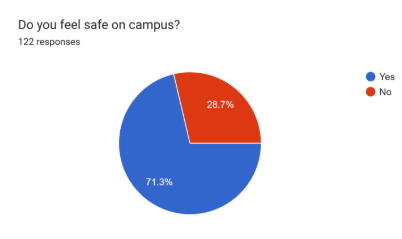 (Graph provided from MEChA’s research survey)
In another question that asked if students would feel protected by the campus police department in the event of an ICE altercation, 71.3% of people responded no and 28.7% responded yes.
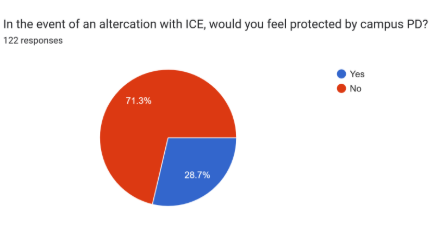 (Graph provided from MEChA’s research survey)
In their slides, MEChA breaks down this response by explaining “a protocol which hinges on student’s trust of law enforcement cannot function if that trust is not there to begin with.”
“In the event of an interaction with ICE, there would be no chance for anybody to hit the emergency call button, or for a student or faculty member to be able to pull out their phones, because as we’re seeing, you can’t do that without being slammed on the floor,” Grajeda said.
MEChA approaches creating effective change by encouraging self-education on the protocol and ICE activity, and student outreach as it “builds power amongst those who are oppressed,” according to Grajeda.
“In our case, it’s you know, students here on campus who will be most affected by the Trump administration and its agenda of violence through ICE,” Grajeda said.
Oscar Claro-Ramos, another MEChA member, encouraged community involvement.
“If they’re trying to break our communities apart, then we should be working on the opposite. We should be building community. We should be building connections between students. We should be less unfamiliar with each other,” Claro-Ramos said.
Many of the students in the survey had misconceptions regarding what the ICE protocol is, and some assumed that the campus will be proactive in safeguarding them, according to Ramos.
“A lot of people who came up and talked to us were like, ‘Wait, I thought the Central Valley was like a sanctuary for immigrants,’ and that ain’t the case,” Claro-Ramos said. “That’s dangerous, because if there’s no sense of danger, there’s no sense of urgency, and then there’s no sense of like a plan, if this, when this, inevitably does happen.”
Based on the survey results, MEChA will be offering teach-ins to inform students about ICE enforcement and agencies with the goal of building community and voice frustration or concerns.
Their first teach-in will be on-campus Feb. 26 in room LI-107. Another teach-in will be off campus on Feb. 26 at St. Dulce 1445 N. Van Ness Ave. Both are from 2-5 p.m.
Many students and staff members have expressed that the campus needs to develop stronger protocols considering the diversity of the campus.
“I think the school should have a stronger position because we have a lot of people from a lot of different backgrounds and vulnerable statuses, and I think that it doesn’t make sense for the school, the campus, to open itself up to that type of enforcement, especially dragnet enforcement when it doesn’t need to,” Santa Rosa said.
Shirley ultimately wants clarity from the college for the sake of students and instructors.
“A lot of instructors are also confused about this, because they don’t want to be complicit with ICE, but they’re scared of losing their jobs, their finances, all of that they could lose,” Shirley said.