
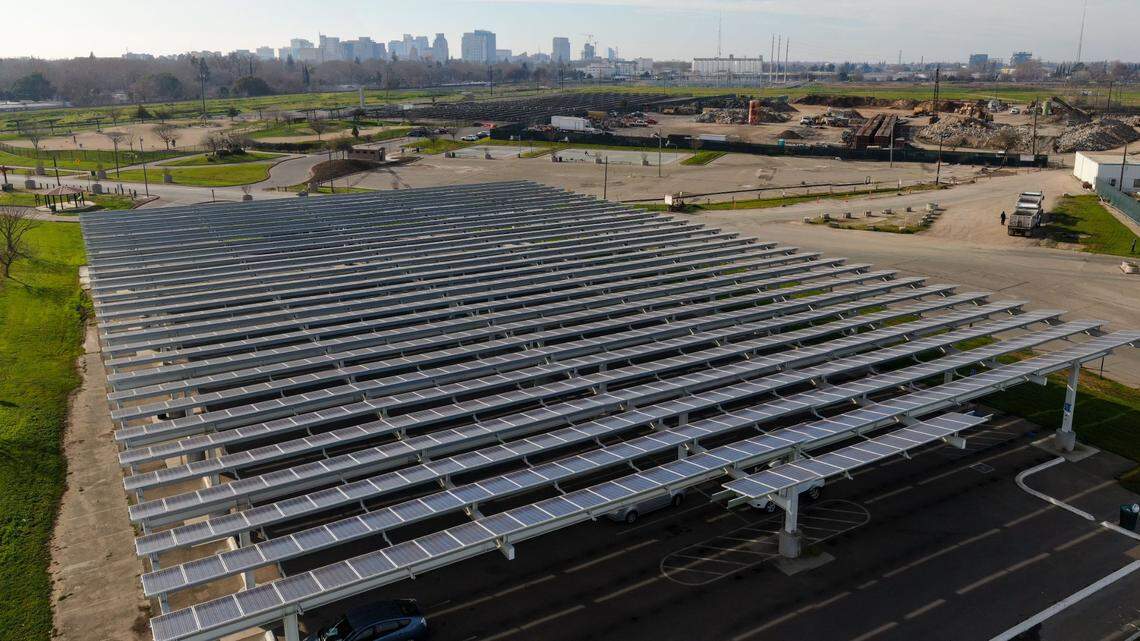
Elimination of import tariffs could reduce the cost of solar panels. This is a solar panel-covered parking lot at Sutters Landing Park as seen in January 2022.
Xavier Mascareñas
xmascarenas@sacbee.com
Following a Supreme Court ruling striking down tariffs imposed by the Trump administration, the Sacramento Municipal Utility District said it is “evaluating the potential impacts” of the decision.
“It’s a complex situation, and at this stage, we don’t yet have clear answers on specific outcomes,” Gamaliel Ortiz, a spokesperson for SMUD told The Sacramento Bee in an email, adding “Regardless of how federal policies or tariffs evolve, SMUD remains fully committed to our 2030 Zero Carbon Plan.”
On Friday, the Supreme Court struck down a pillar of President Donald Trump’s tariff agenda, ruling that his sweeping “reciprocal” duties on imports were unlawful and undercutting a policy he had cast as essential to protecting U.S. producers from foreign competitors. The unprecedented tariff push by the administration injected new uncertainty into the clean energy transition by adding another layer of duties on top of existing equipment tariffs.
Andrew Campbell, executive director of UC Berkeley’s Energy Institute at Haas, said that while reciprocal tariffs were not the biggest driver of energy bills, they had been a “significant contributor” to higher costs for large-scale clean energy projects in California. Striking them down, he explained, should make new solar projects somewhat cheaper and provide a modest, “cumulative” benefit on customers’ bills over the next decade.
“If the tariffs remain gone, then that would cause a little bit of a reduction in the cost of new solar projects, and I would expect that that cost savings would generally come to consumers in California,” Campbell said.
“California has been maintaining very aggressive clean energy goals. There are going to be more solar, wind and battery projects built in California year after year, so each one of those will be cheaper without the tariffs in place.”
Last year, Trump also moved to increase Section 232 tariffs on imported steel and aluminum, raising rates on both metals to 50% under the Trade Expansion Act of 1962. Because Friday’s ruling does not apply to tariffs imposed on steel and aluminum, Campbell said, they remain a major driver of energy costs.
“A large number of things in the utility system involve steel and aluminum, so those tariffs have a widespread impact,” Campbell said.
He noted that the two metals also add to clean energy costs, because solar, wind and battery projects depend on steel and aluminum-heavy infrastructure such as transmission lines, towers and other grid equipment.
“Those are the ones that probably have the biggest impact on energy bills,” he continued.
Meanwhile, Trump pushed back against the court’s ruling, pledging just hours after the decision to sign an executive order imposing a new 10% global tariff on imports.
This story was originally published February 20, 2026 at 2:45 PM.
Related Stories from Sacramento Bee

The Sacramento Bee
Chaewon Chung covers climate and environmental issues for The Sacramento Bee. Before joining The Bee, she worked as a climate and environment reporter for the Winston-Salem Journal in North Carolina.