
As Super Bowl LV approached earlier this month, Fanatics dealt with another swarm of criticism on social media over the lack of New England Patriots and Seattle Seahawks merchandise.
“We want you to know that we’re listening,” the company that has become the dominant force in licensed sports merchandise and trading card markets in recent years said in a Feb. 2 statement.
While Fanatics has avoided scrutiny from lawmakers and regulators even as multiple lawsuits have portrayed the sports e-commerce giant as a monopoly, fans haven’t held back. Days before the Super Bowl, it became clear that the person most responsible for #EndFanatics to trend on X caught the attention of Fanatics founder and Chief Executive Officer Michael Rubin — and the visibility led to more than just an apology.
“Michael messaged me and asked if I had time for a quick call,” said Patriots megafan Brian Babikian, whose persistent posts inspired both the #EndFanatics hashtag and the account, @End_Fanatics.
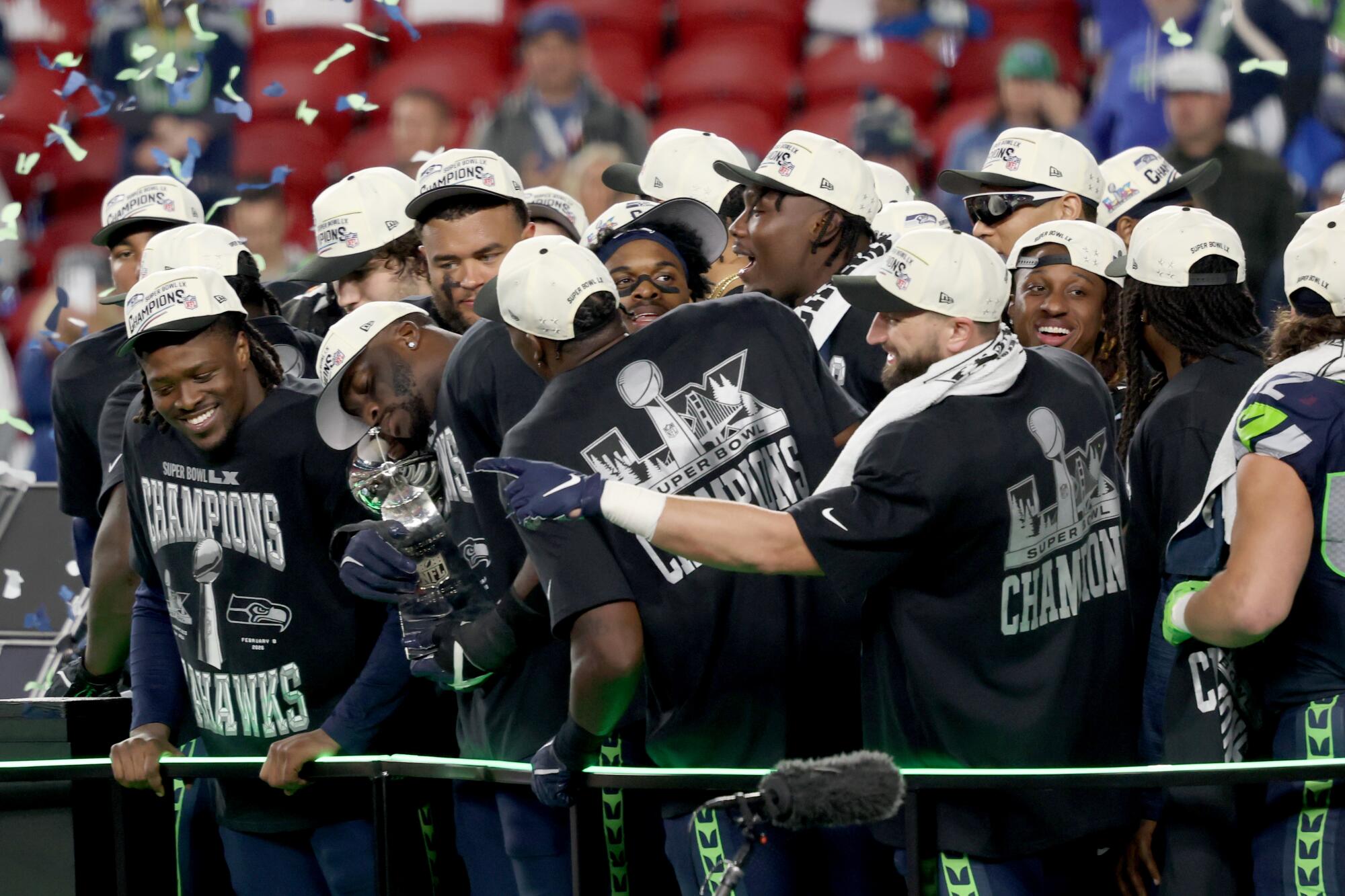
The Seattle Seahawks wear Fanatics T-shirts while celebrate beating the Patriots to win the Super Bowl on Feb. 8 in Santa Clara.
(Eric Thayer/Los Angeles Times)
Babikian and Rubin FaceTimed and a meeting at Fanatics’ New York headquarters was set up for this week.
“I don’t wanna be bought off,” Babikian said. “I am not going to stop talking bad about Fanatics because they gave me free stuff. I told Michael on the call that I don’t want to blame everything on him. I want to learn where I should be pointing the finger because there needs to be accountability.”
Fanatics has held hundreds of meetings in recent years with some of their most vociferous critics, so it came to no shock to insiders when Babikian took to X last week to announce the meeting. Fanatics uses these gatherings not to bribe or threaten their detractors into silence, but to educate them on the business.
“We live in a relatively divided world, but sports brings everyone together — and we sit at the epicenter of a lot of things in sports,” Rubin told The Times. “We have a big responsibility to the fans. They have high expectations and we appreciate that.”
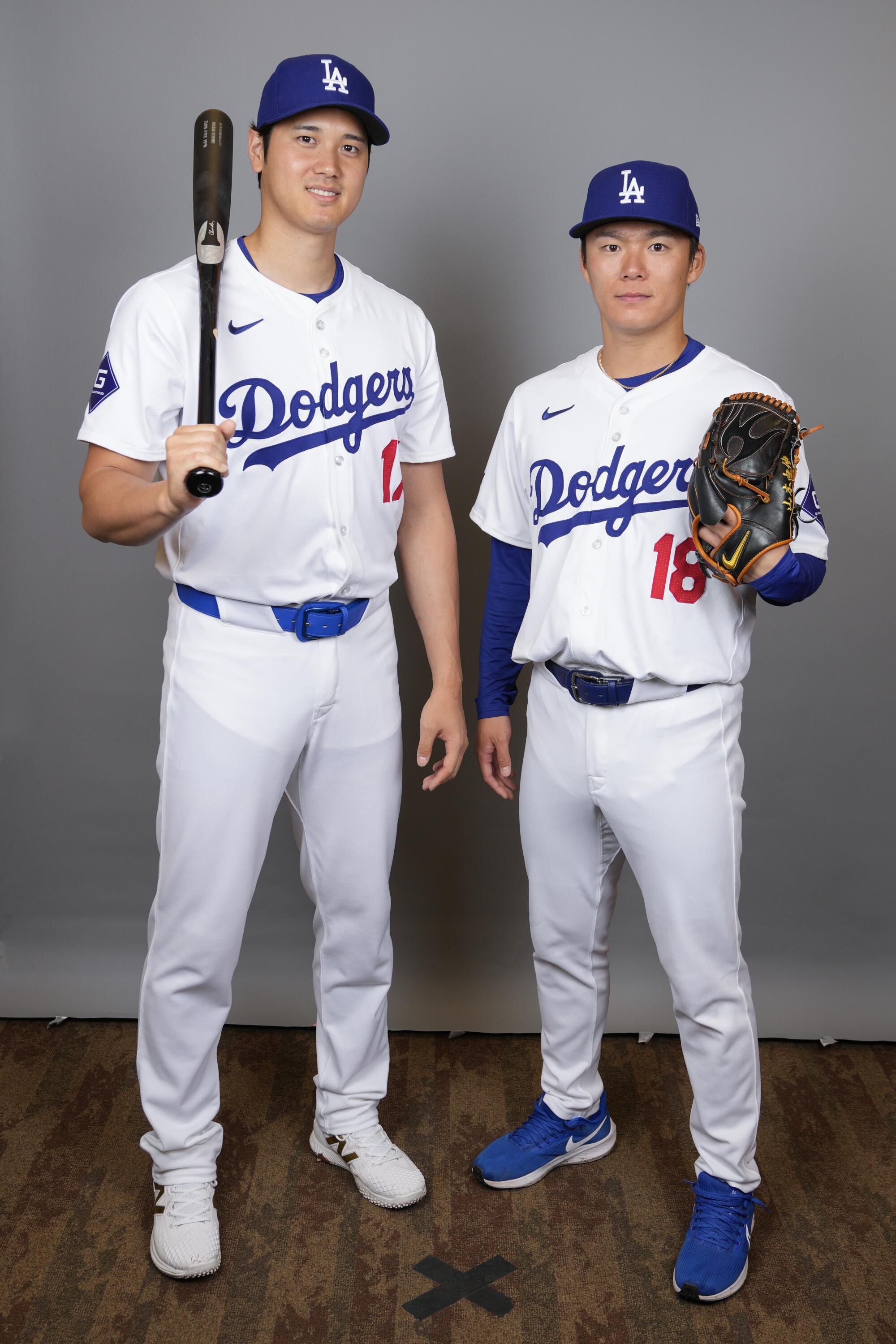
Dodgers stars Shohei Ohtani and Yoshinobu Yamamoto pose for a photo that highlighted sheer uniforms on Feb. 21
(Ashley Landis / Associated Press)
Under Rubin, Fanatics has gone from a mom-and-pop operation into a company that employs 22,000 people and is valued between $25 billion and $30 billion. As Fanatics’ scale and valuation grew, so did Rubin’s estimated wealth that Forbes currently pins at $9.6 billion, and his property holdings include Ronald Reagan’s former home in the Hollywood Hills he purchased for $70 million in 2022.
And during Fanatics’ growth spurt with exclusive deals with every major sports league in North America, criticism of the company swelled. That included blame for issues ranging from pricing to workmanship — even when Fanatics wasn’t the cause.
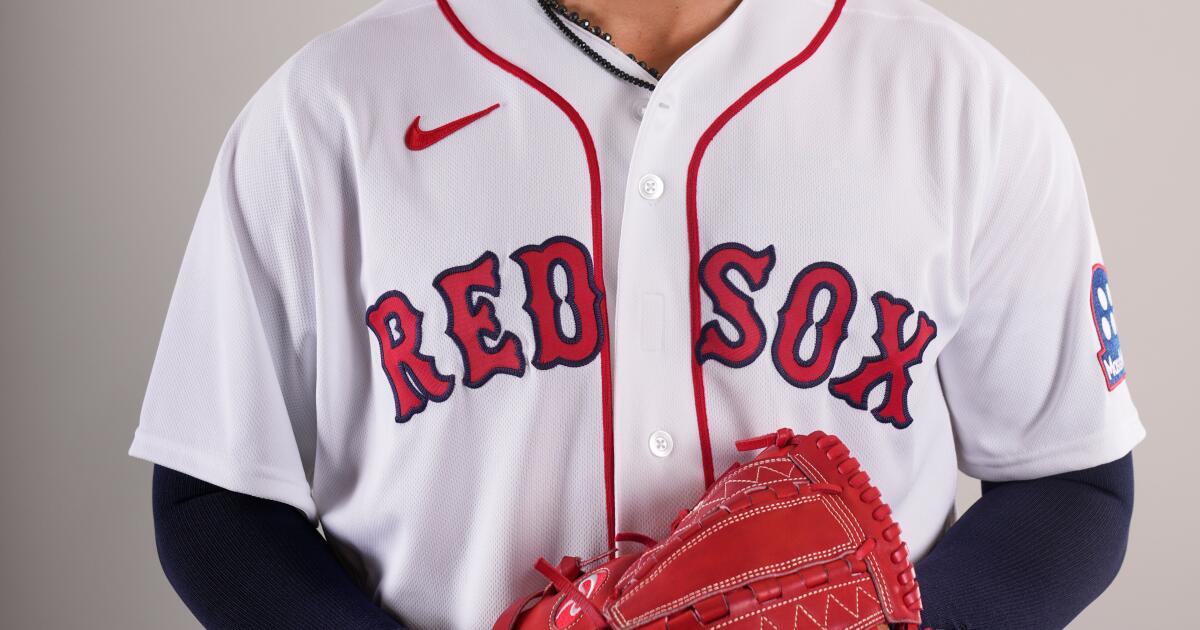
Weeks after the Super Bowl, during which Fanatics got heat for prices at the NFL’s on-site stores that were set and run by an entirely different company (Legends), the Boston Red Sox gave the haters more fodder on Wednesday after fans voiced dissatisfaction over the new home white jerseys. Initially, the Red Sox attempted to avoid blame in its original statement. As the backlash against Fanatics picked up steam, the Red Sox deleted its original statement from X and posted multiple clarifications.
“Fanatics executed to our specifications and has been an outstanding partner throughout,” the Red Sox’s final statement on the matter read. “They deserve no blame and we are grateful to them for making the new jerseys in time for Opening Day.”
The Red Sox picked the design of the new home jerseys from multiple options before they were made at Fanatics’ Pennsylvania plant that has produced MLB jerseys for decades. Those involved in turning the mockup into a finished product informed the Red Sox on multiple occasions that the piping down the middle of the jerseys was too close to the “Red Sox” lettering, a person familiar with the conversations who is not authorized to discuss it publicly told The Times.
The Red Sox’s jersey situation played out much quicker than the MLB’s see-through pants controversy two years ago. For several weeks, Fanatics took blame for the construction of the new uniforms before MLB and Nike took responsibility for the design and specs of the uniform. Fanatics, just as it did with the Red Sox jersey, also flagged the paper-thin look of uniforms during the design and manufacturing process.
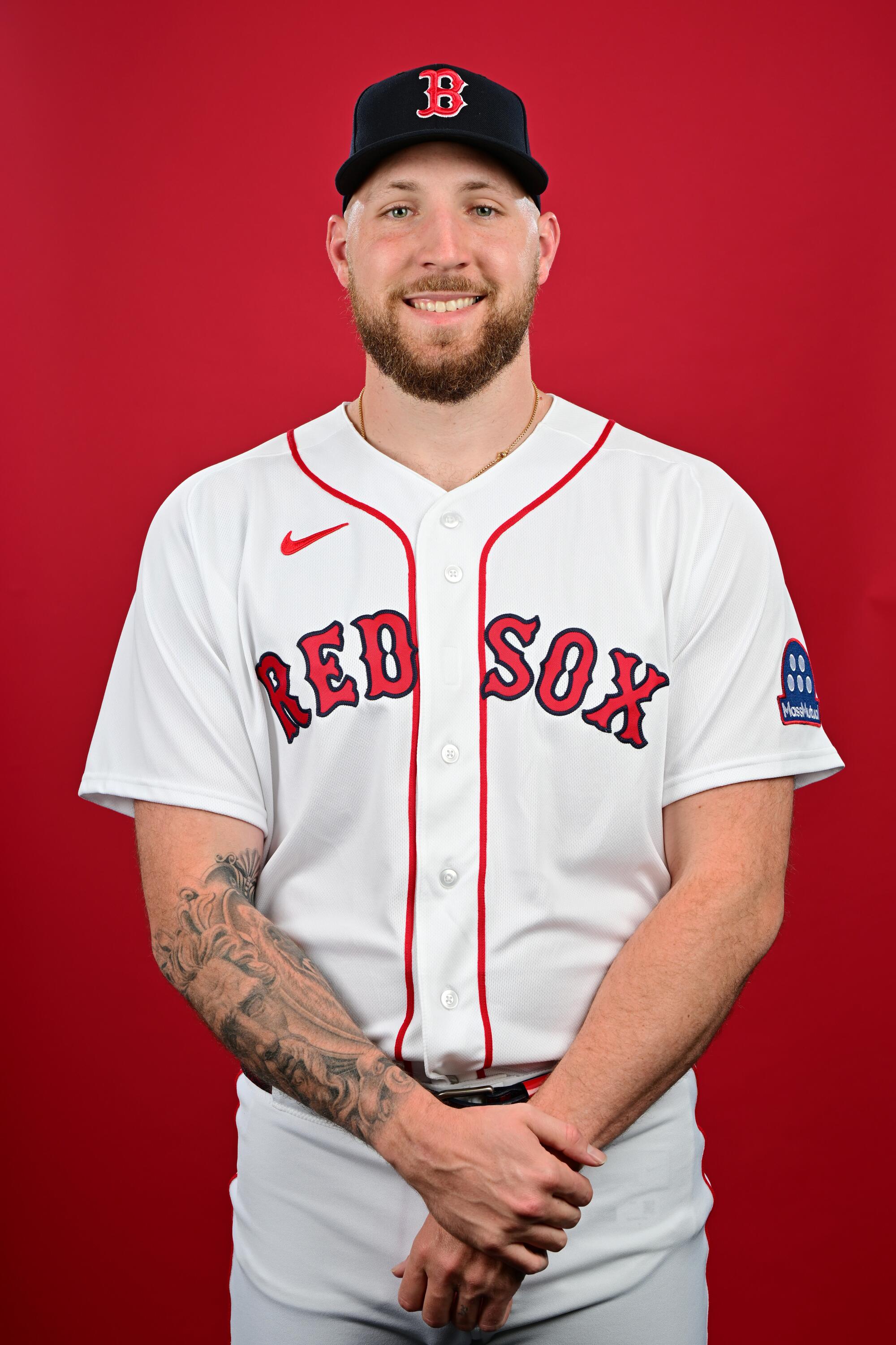
Boston pitcher Garrett Crochet’s jersey features the Red Sox logo running into red piping on his uniform.
(Julio Aguilar / Getty Images)
“It really hits Michael deeply, particularly in the world of social media when he gets blamed for things that are out of his control,”said a longtime e-commerce executive familiar with Fanatics’ inner workings who is not authorized to speak publicly.
Like with MLB, Fanatics became not only the exclusive online retailer for the leagues, but also the exclusive manufacturer of uniforms in some cases. To secure the long-term deals, Fanatics offered equity in the company to both leagues and player unions. The NFL has invested more than $400 million in Fanatics over the last decade to become the largest league investor and holds about 3% of the company. Combined with the NFL’s stake, MLB, the NBA, NHL, MLS and multiple player unions own roughly 10% of Fanatics.
Critics allege that the leagues’ close financial ties to Fanatics have blunted their criticism, but there’s another explanation: Overall, they are satisfied with the Fanatics both in its responsiveness and, the much bigger part, the revenues generated by Fanatics’ platform. There’s an understanding among the leagues that given Fanatics ships around 100-million items per year, an error or defect rate of just 1% would result in hundreds of thousands of upset customers.
“They have done a great job building cultural capital and financial relationships at the league level across these leagues,” said a former NFL team executive who was granted anonymity to discuss the club-level dealings with Fanatics. “And while there may be a customer service issue here and there, when you look at the scale of Fanatics, consumers have acclimated to the level of service.”
And as Fanatics has grown in licensed team merchandise space — including stores run by the company at several venues, including LAFC and the upcoming LA28 Summer Olympics — it has entered new markets, including online sports betting, experiences and collectibles. Panini America alleged in a 2023 lawsuit that Fanatics used its “monopoly power” to jeopardize its trading card business. The case remains ongoing.
“It’s not just that Fanatics’ deals run up to 20 years with the leagues and unions, but those leagues and unions own part of Fanatics,” said Katherine Van Dyck, a senior legal fellow at the American Economic Liberties Project, a nonpartisan think tank. “That’s even more problematic and has an adverse impact on Fanatics’ competitors and fans. I think [the lawsuits brought by Panini and others] raise legitimate and serious questions as to whether Fanatics is using anti-competitive and illegal tactics to build a monopoly that violates the Sherman Act.”
Marc Edelman, a law professor at Baruch College, wrote in a submission to the Federal Trade Commission in 2022 that Fanatics’ $500-million acquisition of The Topps Company earlier that year meant Fanatics “possesses monopoly power” over the card industry.
“From my perspective, these Fanatics deals as well as the agreements between the teams to exclusively licensed rights to Fanatics are so problematic because they’re anti-free markets and against the natural progression of capitalism,” Edelman said. “Instead of having various companies competing to make the best products for the lowest price, there is one company that has secured all of these rights from all of the major leagues and most major players association for a generation.”
Fanatics has countered that its $8 billion in revenue in 2025 comprises only a small fraction of the global licensed sports merchandise market estimated to be around $37.5 billion, according to Straits Research. In the U.S., Fanatics share of the same market is around 35% — roughly the same size as Amazon’s share of the total e-commerce market in the U.S.
But, so far, Fanatics hasn’t faced much scrutiny either by federal regulators or in Congress, and the company hasn’t hit any major setbacks in the cases in which it’s accused of monopolistic practices. On social media, however, Fanatics and Rubin remain targets of fans’ ire.
Before Babikian got the #EndFanatics movement going on X, the account @FanaticsSucks was the clearinghouse for disgruntled Fanatics customers. But days after Rubin tweeted @FanaticsSucksin in November 2023 that he appreciated the feedback, the account morphed into @GearGoneWrong and it cut back on the venom directed at Fanatics and Rubin. The account @End_Fanatics created just weeks ago has filled that void.
“I will never change the account to become a mouthpiece for Fanatics or Rubin,” the person behind @End_Fanatics told The Times. “I want to give the average consumer, like a father buying his son a jersey, a voice to share their experience and frustration with this monopoly that we’re dealing with. I have seen nothing but problems with defects, errors in logos and numbers being heat pressed and just false promises of shipping dates/not even having items in stock for months leading up to a big game like the Super Bowl.”
Since Babikian went public with his upcoming meeting with Rubin, his replies are filled with people worried that Babikian could change his tune.
“I already told Rubin that the movement is bigger than me now,” Babikian said. “You can’t shut it down.”