
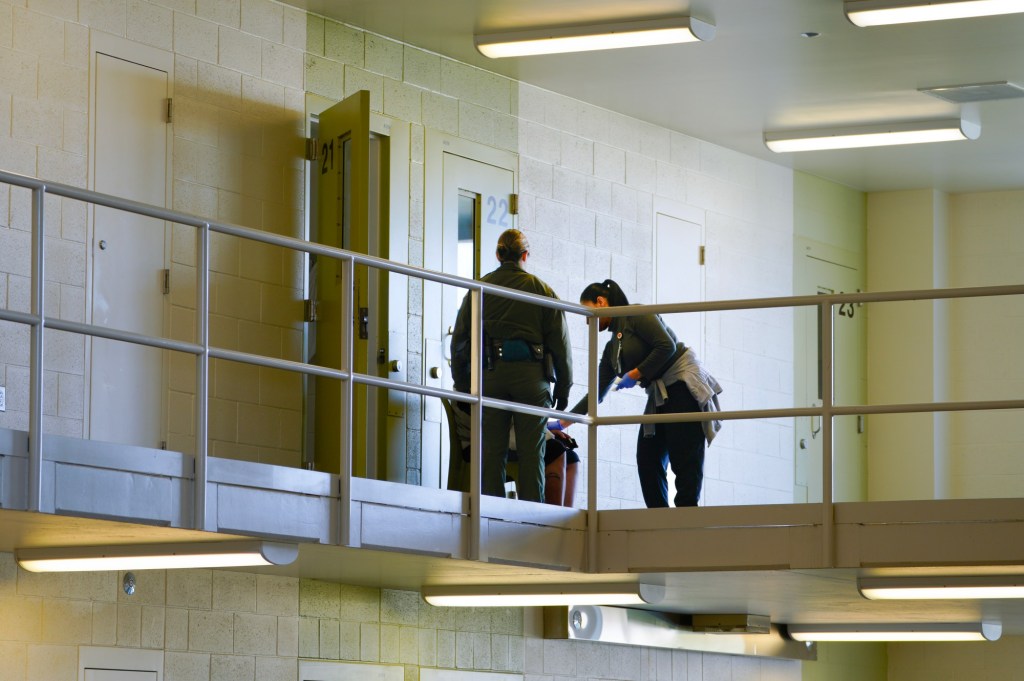
On the day Lester Daniel Marroquin died inside a San Diego County jail, the mental health clinician responsible for his care had no idea he’d been moved from the jail’s psychiatric observation unit into an isolation cell.
Jennifer Alonso had met with Marroquin repeatedly while he was on suicide watch and believed he needed close monitoring. But on her day off, custody staff transferred him into administrative separation.
Hours later, he died by suicide.
“I still cry when I think about what happened to Mr. Marroquin; he should not have died,” Alonso later wrote in a sworn declaration.
That declaration became a cornerstone of a federal class-action lawsuit alleging systemic failures in how San Diego County jails treat people with mental illness. It helped drive a sweeping settlement announced earlier this month.
When Alonso learned of that settlement, she said she felt relief and emotion. She’d worked as a clinician in the jails for three years before leaving. She loved her job but had grown increasingly frustrated over her inability to protect patients she believed were being harmed by jail practices.
“Obviously there’s more work to be done,” she said in an interview last week, “but it sounds like they’re trying to commit to make things better, which is amazing.”
Once fully implemented, the agreement will fundamentally reshape how mentally ill people are evaluated, housed and treated in the county’s seven jails, where nearly half of the roughly 4,100 people in custody take medication for a psychiatric condition.
Under the settlement, sworn staff will no longer be allowed to routinely override decisions made by psychiatrists, psychologists and other mental health professionals — something Alonso said happened frequently during her time working inside the jails.
Instead, every person booked into custody must be evaluated to determine their mental health needs and assigned a specific level of care. That classification will dictate where they are housed and what treatment they receive, including therapy, clinical monitoring and medication.
The changes also target one of the jail system’s most criticized practices: placing mentally ill people in isolation cells — known as administrative separation, or “ad sep” — sometimes for weeks or months, with limited treatment and little privacy when care is provided.
The San Diego County medical examiner ruled the March 2022 death of Lonnie Rupard in an administrative separation cell a homicide. Rupard, who had schizophrenia, died of pneumonia, malnutrition and dehydration after his health deteriorated dramatically in custody.
“While elements of self-neglect were present, ultimately this decedent was dependent upon others for his care; therefore, the manner of death is classified as homicide,” the medical examiner concluded.
Just five months later, on Aug. 16, 2022, Matthew Settles died by suicide in an administrative separation cell.
Jail officials had placed him there “due to a propensity for violence and a failure to adhere to minimum jail standards,” records show. But a note from a homicide investigator indicated that by the time of his death, Settles “had exhibited no negative behavior since 7/15/22.”
Settles had a history of self-harm. Records show he was rarely out of his cell and nearly all of his mental health care was conducted through the cell door, with a deputy present.
One of the settlement’s most important safeguards, attorneys for plaintiffs say, is that decisions about whether to place a person in ad sep must be based on their current clinical condition — not their charges, housing history or prior classification.
If custody staff disagree with a clinician’s recommendation, the decision must be documented and reviewed by supervisors.
“Not only does mental health supervisory and custody supervisory need to look at it, but then they also need to provide the right level of care and placement within 24 hours,” said Aaron Fischer, one of the plaintiffs’ attorneys.
Alonso said that kind of clinical oversight was often absent when she worked inside the Central Jail.
“There would be many times where I’d come into work and I would say, where is this person?” she said. “And they’d say, ‘Oh, they put him in ad-seg overnight.’ And I’m like, how do they get to decide that without the clinician being here?”
In her declaration, Alonso described carrying a caseload of more than 150 patients — far too many to treat effectively.
The settlement directly addresses clinician workloads. It requires the Sheriff’s Office to conduct a comprehensive staffing and needs assessment to determine how many clinicians, treatment beds and specialized housing units are necessary to provide adequate care.
It also calls for expanding outpatient step-down units — specialized housing designed for people with serious mental illness who require structured treatment but not full psychiatric hospitalization.
Currently, the Sheriff’s Office operates outpatient step-down units at the Rock Mountain Detention Facility for men and Las Colinas Detention and Reentry Facility for women, with a combined 224 beds. Under the settlement, the county plans to add 68 more beds at Rock Mountain by March 2027, depending on patient need.
 The San Diego County Sheriff’s George Bailey Detention Facility in the Otay Mesa area on Thursday, May 25, 2023 in San Diego. (Eduardo Contreras / The San Diego Union-Tribune)
Clinicians say access to those beds — and appropriate care — had for too long been limited.
Aseel Ross, a former jail mental health clinician who worked at George Bailey Detention Facility through September 2023, testified in a deposition taken as part of the class-action lawsuit that some patients were excluded from the outpatient step-down unit despite showing serious psychiatric symptoms.
Ross also testified that a lack of structured treatment planning further undermined care.
“Everybody should have a treatment plan,” she testified.
She said she had proposed implementing structured treatment plans and daily therapeutic programming for mentally ill patients, including those in administrative separation. While her immediate supervisors supported the idea, she said jail leadership never approved it before she left her position.
The settlement requires individualized treatment planning and expanded access to therapeutic programs for mentally ill people.
Sheriff’s officials said they are committed to implementing the agreement’s terms.
“The Sheriff’s Office takes the settlement terms very seriously, and we will be working diligently to be sure the terms are being adhered to,” Sheriff’s Lt. David Collins said.
Collins said the agreement formalizes improvements already underway, while also acknowledging past deficiencies.
“Many of the changes and improvements were already identified, requested, in process or being worked upon,” Collins said. “However, we are grateful the settlement brought some deficiencies to our attention.”
The agreement follows years of deaths involving people with severe mental illness, many of whom deteriorated while in isolation or without adequate treatment.
Just last summer, a 43-year-old schizophrenic man named Corey Dean died in jail after he was left alone in an isolation cell, despite pleas for help from other men in the jail.
Two weeks later, Karim Talib, an 82-year-old suffering from dementia, was found dead in his Central Jail cell. Again people in nearby cells said their pleas to deputies and jail medical staff to help him went unanswered.
Both families are now suing San Diego County.
The settlement is part of a broader class-action case filed in 2020 by a formerly jailed man named Darryl Dunsmore, who initially represented himself before civil rights attorneys expanded the lawsuit into a sweeping challenge to jail conditions.
The case alleged widespread failures in mental health care, medical treatment, disability access and basic safety.
Last year, in a separate partial settlement, the county agreed to separate reforms aimed at improving treatment for people with disabilities, including facility upgrades and greater access to assistive devices.
But the class-action case known as Dunsmore v. San Diego County must still resolve complaints over a host of other jail practices, including medical treatment, dental services, safety and security, environmental health, access to lawyers and racial discrimination.
No trial date has been scheduled on those issues, but the parties continue to discuss potential remedies.
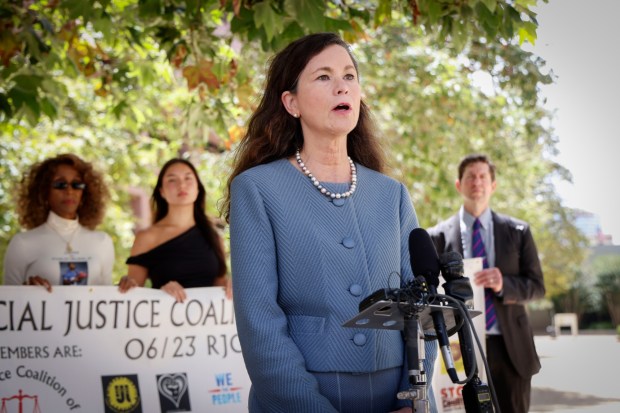 Attorney Gay Grunfeld speaks at a press conference outside the federal courthouse in downtown San Diego on Thursday, July 24, 2025. (Sandy Huffaker for The San Diego Union-Tribune)
The new mental health settlement imposes sweeping new requirements but stops short of dictating exactly how the Sheriff’s Office must restructure its system.
Instead, it establishes enforceable standards for clinical evaluations, housing decisions and treatment access, while giving plaintiffs’ attorneys and a court-appointed neutral expert the authority to monitor compliance.
The neutral expert will have access to jail facilities, records and staff, and will issue public reports evaluating the county’s progress.
“We can also submit concerns directly to mental health staff, and they have to respond within 10 days,” Fischer said. “That is a useful way to identify inefficiencies, but also to identify people who are in the wrong place.”
The agreement’s level-of-care system closely resembles reforms proposed years earlier by jail psychiatrist Dr. Christine Evans, who left her position after her recommendations were repeatedly rejected.
In 2017, Evans developed a plan to establish a structured system for evaluating mental health needs and assigning appropriate treatment levels.
“To my dismay and disappointment, the jail’s command staff declined to implement the proposal,” she later wrote in a sworn declaration.
Evans ultimately resigned in 2021 after what she described as repeated failures to address serious deficiencies in staffing and patient care.
The following year, the California State Auditor released a scathing report that found San Diego County jails had the highest mortality rate among the state’s large jail systems.
Sheriff Bill Gore announced his mid-term retirement three weeks before the audit’s release.
The audit identified major failures in how staff monitored and cared for people experiencing medical and mental health crises.
That same year, 19 people died in custody — the highest number on record — and a 20th person died in the hospital shortly after being granted a compassionate release.
Plaintiffs’ attorneys say the new settlement represents a long-overdue acknowledgment of those systemic failures and an opportunity to prevent future deaths.
Gay Grunfeld, the lead attorney for the plaintiffs, believes county officials are committed to change but emphasized that meaningful reform will depend on implementation.
“I think they are sincere. I think they want change,” she said. “We are going to take them at their word. If they are not serious, we will know in a year or so, and we will be right there in court. I’m hopeful.”