

Patricia “Patti” and Myron Monroe of Poway were surprised recently when they received new medical cards in the mail, printed with the names of doctors they had never met.
They were stunned to see that these new doctors worked for medical groups outside UC San Diego Health and, as they began to read the accompanying paperwork, a feeling of déjà vu descended.
This notice informed them that their Medicare Advantage health plan from SCAN, the not-for-profit Senior Care Action Network, would no longer include UCSD primary care doctors as of March 1. It was a lot like the letter they received in the fall of 2023 when Scripps Health notified about 32,000 patients that they would need to find new doctors because its popular coastal and clinic medical groups were leaving Medicare Advantage in 2024.
The news was devastating, especially as the couple has been more than satisfied with the medical home they have found. Both husband and wife say that new doctors have helped them resolve long-standing medical issues, getting off some medications and leaving them feeling healthy as Patricia’s 77th birthday arrived last week.
“I really like my primary doctor right now, the one that I have at UCSD, and I certainly don’t want to change,” Patricia Monroe said. “I’ve liked all of the specialists I’ve seen, and I’ve liked the facilities. I wanted a doctor who understands me, and I found that person.
“She’s young, she’s nice, and now she’s not going to be my doctor anymore.”
This is the current struggle of about 4,000 SCAN members with UCSD primary care doctors who find themselves looking through the health plan’s list of contracted physicians in groups outside UC San Diego Health.
And there are strong indications that this is not a localized situation. The health care industry publication Becker’s Hospital Review has published lists of health systems that have pulled out of at least one Medicare Advantage plan for three years running. While these lists are not comprehensive, and there does appear to be some duplication from year to year, more than 40 systems nationwide have been listed since 2024.
Medicare Advantage plans, which make up 53% of all policies in San Diego County, have a private health insurance company manage enrollees’ Medicare benefits. Those age 65 and older can also opt to stay with original Medicare, which does not cover about 20% of medical services received or prescription drugs.
Choice is the big advantage of original Medicare. Beneficiaries can see any doctor who accepts Medicare. But staying with original Medicare generally costs more on a month-to-month basis due to the need for supplemental health insurance policies. Medicare Advantage may cost less month to month and offer additional benefits such as vision, dental and hearing benefits, but choice is limited. Plans require members to see only their network of contracted providers.
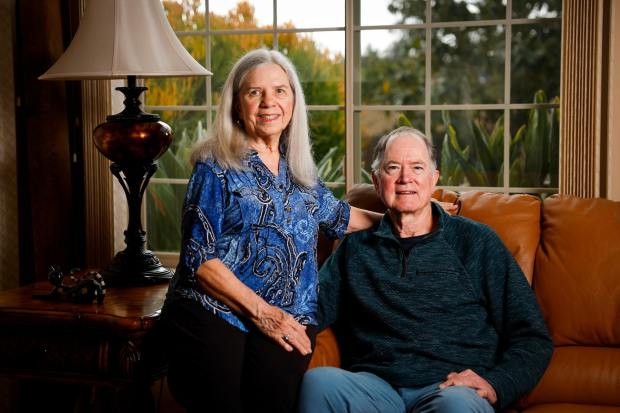 Patti and Myron Monroe pose for a photo inside their home on Wednesday, Feb. 18, 2026 in Poway, California. (Meg McLaughlin / The San Diego Union-Tribune)
As Scripps did in 2023, many health care systems that have exited Medicare Advantage have complained about reimbursements not covering costs. They have also cited cumbersome prior authorization processes that force investment in endless appeals between providers and insurers, not only increasing overhead but also delaying care for patients.
Is this trend evidence that the nation’s most-sought-after medical providers are becoming out of reach for those who cannot afford to pay more?
Rachel Schmidt, a professor who specializes in Medicare policy at Georgetown University’s McCourt School of Public Policy, said that it certainly looks that way, especially as the federal government gradually cuts back on incentive payments paid to providers who participate in the Medicare Advantage program.
“I think that we’re definitely seeing more discussions and more tension between plans and providers, especially these big-name providers that have more clout and more bargaining power,” Schmidt said.
The doctor churn that patients are experiencing, she added, comes in a broader context of federal action around the “risk adjustments” that plans get for treating patients with more severe medical conditions.
UnitedHealth Group, for example, has come under federal scrutiny for appearing to make the patients it serves look sicker than they really are in order to justify higher levels of reimbursement from the Medicare Advantage program. And there are simultaneously concerns about denying care in order to increase profitability.
As a result, Schmidt noted, insurance companies face changes to the risk adjustment payments and quality bonuses that they have received, generally putting pressure on overall income.
“As you can imagine, they’re asking themselves, how do I manage with less revenue coming in?” Schmidt said. “So, of course, they’re going to look to the terms and conditions that they negotiate with providers for payment rates.
“We’ve seen a trend, actually, with some Medicare Advantage plans of denying payment for services that have already been provided, particularly to hospitals, if a plan does not agree with the medical need,” Schmidt said.
Those 4,000 San Diego County residents who are directly affected, and probably the 331,208 local residents in Medicare Advantage plans, may ask themselves: why is this happening?
The origins of this particular situation are complex.
UC San Diego Health confirmed in an email that it capped enrollment by SCAN members in its primary care clinic in 2025. This action was taken, UCSD said, so that its primary care doctors “could continue caring for the large number of complex patients who transitioned to us after the changes with Scripps Health.”
Why couldn’t SCAN simply allow these folks to continue using UCSD Health primary doctors?
“This (annual enrollment period), we saw plan and provider disruptions like never before,” SCAN said in an email. “And, while we are not immune to such challenges, our approach is to prioritize keeping benefit plans affordable for members and (Medicare Advantage) sustainable.
“With the rising cost of medical care and prescription drugs, the cost of diverse benefit offerings and the funding we receive from Medicare, we have to sometimes make the decision to make changes to our provider network. In the case of UCSD, we made the difficult decision to pare down the UCSD network to allow us to focus on the UCSD clinically integrated network to allow for (Medicare Advantage) sustainability.”
At the same time, the only other Medicare Advantage plans that offered access to the main UCSD Health network, such as UnitedHealthcare, Blue Shield and Humana, also stopped offering those plans in the San Diego market.
Though it said that it did not have a role in those other plans pulling out, UCSD did say that reimbursement is part of the issue.
“More broadly, Medicare Advantage HMO plans often do not cover the full cost of caring for medically complex populations,” UCSD said. “These financial challenges are driving health plans and providers nationwide to reassess participation in certain Medicare Advantage products.”
Reacting to the situation on the ground in San Diego, SCAN created a new “select” Medicare Advantage plan that retains in-network access to UCSD specialists, hospitals and urgent care centers. But members will have to get their primary care from outside the UC San Diego Health medical group that staffs the university health system’s 12 branded family medicine locations.
An analysis by San Diego’s Health Insurance Counseling and Advocacy Program, a nonprofit that assists Medicare beneficiaries, found that SCAN’s select plan includes doctors in the UC San Diego Health Physician Network and charges $75 per month per person. Several other plans have access to Regal Medical Group in San Diego County. Both groups have access to UCSD specialists, though HICAP found that existing referrals will be maintained with select, but must be re-established on other plans. SCAN did not confirm the referral information on Friday.
Some may be surprised that one group of doctors that bears the UCSD name is still included, given the removal of the UC San Diego Health medical group.
Though their names are similar, these two groups are very different. The physician network is an affiliation program that allows independent doctors, usually working in offices not owned by the university health system, to maintain a connection with UCSD. By comparison, the UCSD Health medical group is run by UCSD Health, which employs its doctors, all of whom are members of the university medical school faculty.
But it’s even more complicated than that. The physician network itself includes several different medical groups, including Pearlman Clinic, a large primary care provider with offices in 21 San Diego County locations, and One Medical with locations in Carlsbad, downtown San Diego and University Towne Center.
The Monroes and others affected by the change technically have the right to buy a “Medigap” supplemental insurance plan that would allow them to safely rejoin original Medicare, which would allow them to choose any doctors they wish. But doing so would mean hundreds in additional monthly premiums, including a stand-alone prescription drug plan. This option is often out of reach of many seniors on fixed incomes, but the Monroes said they could probably swing the cost.
Why not go original? The couple says they enjoy the fringe benefits, such as a covered gym membership, that come along with Medicare Advantage. For now, the couple said they believe they have found options that should work.
“We spent hours looking, and we have come up with doctors that we think we will like outside the direct UCSD facilities. I’m hoping it will work, but I’m just disappointed and angry that they would switch us,” Patti Monroe said.
“We’ll see how it goes,” Myron Monroe added. “You know that, next open enrollment, it might change.
“Hopefully they don’t kick us out again.”