
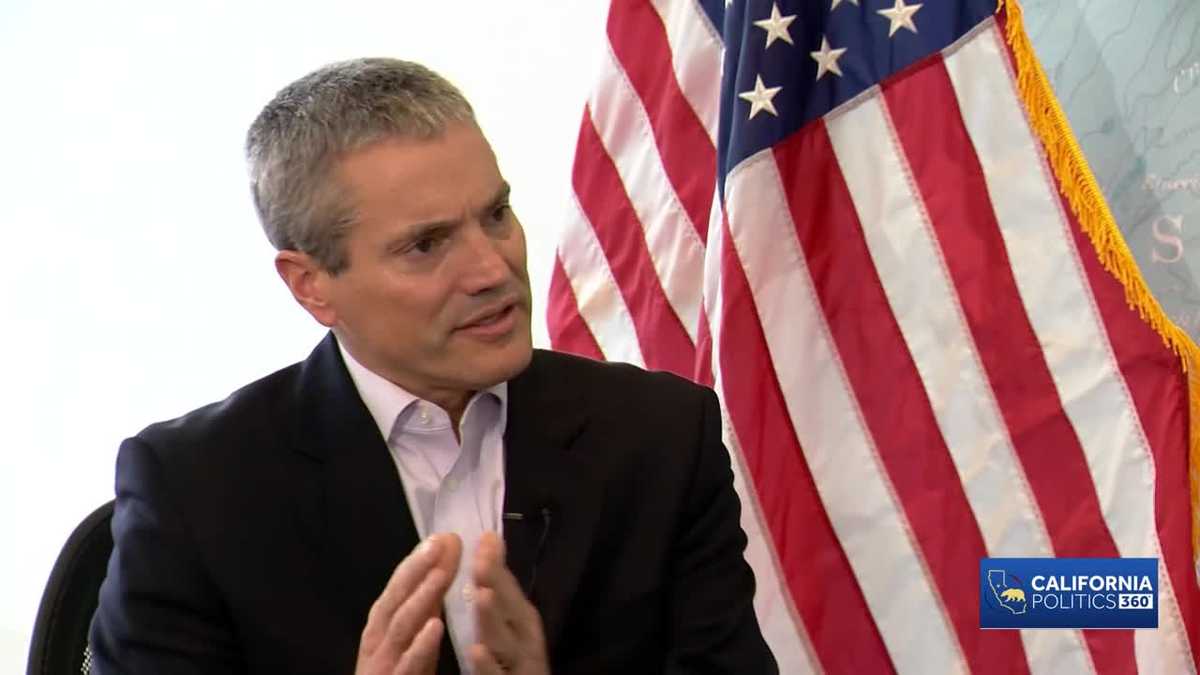
California’s top environmental official explains the conundrum over the Colorado River | California Poilitcs 360
Joining us now is California Natural Resources Secretary Wade Crowfoot. Mr. Secretary, thank you so much for making time. Great to be here. So with this deadline that was apparently missed last week, what is the risk right now for California? Well, I’ll, I’ll share that the Colorado River is really important for California and 6 other states and *** portion of Mexico. 40 million Americans get at least some of their water supply from the Colorado River basin. Half of those 40 million live in California. *** large portion of agriculture in the Southwest is also fed by this river. Now the challenge is that when water rights and allocations were made *** century ago, the hydrology was very different. *** lot more rain and *** lot more snow. And what we’re seeing with climate change is reduced water supply. So the big challenge is how do we split up *** smaller pie across 7 states and Mexico, and that’s very, very difficult because each of our states could make an argument to protect our status quo allocations, but we can’t because we have to make do with the shrinking supply. So you mentioned this challenge that the 7 states are having coming together on *** consensus plan. It’s true we haven’t found *** common pathway to manage the basin. And in the absence of *** shared approach among 7 states, it’s really the federal agencies that are going to determine how the water supplies get allocated. Just to take *** step back, how much of California’s water supply depends on the Colorado River? So Southern California, the 20 million people who live in Southern California get their water from really three areas the Colorado River, the Sierra Nevada coming from the north through the Delta, and the LA Aqueduct, the Eastern Sierra. And you could say roughly it’s about 1/3, 1/3, 1/3. So you can think about about 50% of Californians depend on them for about 1/3 of their water in *** given year on the Colorado River. So it’s really important, and I’ll say that the southeastern portion of California, the Imperial County, depends wholly on the Colorado River, not only for the agriculture, but all the communities. So it ends up being really important, this Colorado River water for California. It seems like this tension among States isn’t based on political party but more so region. I mean what is the hold up? What’s the sticking point? Well, it’s refreshing that there isn’t *** political polarization by party. That’s really the challenge. The challenge is that the compact, the agreement that allocated water to each of us, called for *** lot more water across the basin. And so each state could make *** legal argument for more water than it can use at this point, right? The fact is from our perspective, we all have to make sacrifices and contribute and keep water in these reservoirs. So in California we’re really proud that we over time have used less Colorado River water. And we’re using less Colorado River water this year than I think we have in decades, and we’ve done that through conservation, through infrastructure like water recycling and desalination. And our point and the point that we make with Arizona and Nevada, where the lower basin states, is we all have to contribute. So right now the breakdown is between the lower basin, California, Arizona, Nevada, sort of with an aligned vision, and then the upper basin, Colorado, Utah, Wyoming, and New Mexico. And the good news is that all the governors understand that *** shared pathway is much better than conflict and litigation, which is just going to breed uncertainty. The challenge is really from my perspective, you know, getting enough of the contribution from each state to have it be truly *** shared pathway. OK, I mean, it seems like the Trump administration could step in here. I mean, is that something that would be helpful or what do you anticipate with that? So the reservoirs in the Colorado River basin are largely managed by the Bureau of Reclamation, which is *** federal agency in the Department of the Interior, and frankly they’ve been very good partners through this process. The federal agencies are really driving the states to identify our own pathway, so they haven’t said it’s our way or the highway. To the contrary, they say we need you to find *** pathway, but in the absence of that, They have to manage those reservoirs and stabilize those reservoirs again, the water supply for 40 million people. So where we’re at right now is there’s *** diminishing window of opportunity to come to this shared agreement across 7 states, and in the absence of that, it will really be the Bureau of Reclamation and the Department of the Interior that establish the path forward. And so in California we’re going to make sure Plan *** is that seven-state agreement, but Plan B is working with the federal agencies, so whatever actions they take, you don’t unnecessarily injure California, and I can share that California and Arizona and Nevada, we’ve already proposed to contribute it’s called 1.5 million acre feet. So consider it *** lot of water. It’s *** 27% cut in Arizona, 10% cut in California. So we’ve already put real water on the table, and I presume that our water users would continue. To offer up that conservation or something comparable under *** federal pathway as well, but is there *** risk of the Bureau of Reclamation taking this over just given obviously the political friction between the Trump administration and this state at least and some of the others politically too? Well, these are strange times and we in so many ways, *** lot of my job is reacting to defunding from the federal government, attacks on our policy or regulatory authority. So I’ll share that you know from our perspective, the pathway that involves states coming together to define their own pathway is ultimately the best way forward. That being said, we have had really strong federal partnerships on this topic, OK. And just on the state’s general broad water supply, what is California doing right now? You mentioned it’s been cutting reliance on the Colorado River. What is it doing to advance those efforts to catch every drop of water that’s come in from *** storm like we saw this week, for example? Well, over the last several. For years we’ve been urgently focused on adjusting to this new hydrology, meaning we’re going to have droughts and in many cases they will be longer and more severe, but we’re also getting *** lot of precipitation, but it’s coming in more intense episodes like the storms we just experienced. The challenge is we have infrastructure that we built over the last century that anticipated *** much different scenario snow coming into the Sierras in *** fairly stable way, then slowly melting into our rim reservoirs and coming through. The challenge is we have to actually adjust to capturing *** lot more of this precipitation when it comes in warmer, more intense storms. So we’re doing *** couple of important things. One is we have completely reformed the way that we’re recharging groundwater basins. About *** third of our water supply in *** given year comes out of our groundwater aquifers, and those have been depleted over time. So part of the answer is when it does rain and we have big flood flows into the river, how do we get that water back underground into the aquifers more quickly and frankly without bureaucracy? It’s been an overly wrought permit process to actually enable the recharge. So one is streamlining, cutting the red tape to get more water underground. And then it’s also updating infrastructure, so Governor Newsom and legislative leaders and federal leaders are really focused on building sites reservoir, which would be the first new reservoir in *** generation. It would be located off the Sacramento River, and when we get big storms like the one that we’re having now, we could divert water into the reservoir, not only for communities and agriculture, but also environmental water that we could manage through those dry periods. So it’s infrastructure solutions and it’s modernizing our management to actually adjust to these changes we’re experiencing. I know the Newsom administration is coming to an end, but is there an ETA on sites reservoir? We are very focused on getting through this process by the end of the year. You know, Governor Newsom has said it publicly and he certainly says it privately. We are running through the tape, so we have certain projects that are really important to California’s future that we’re intensely focused on getting done, and Ses Reservoir is one of them. Getting the permitting done, getting the permitting done, and yes, ultimately getting to groundbreaking just as quickly as we can. All right, Mr. Secretary, we really appreciate your time. Thank you very much.
California’s top environmental official explains the conundrum over the Colorado River | California Poilitcs 360

Updated: 8:25 AM PST Feb 22, 2026
The seven Western states that rely on the Colorado River for water supply have yet to reach an agreement on how to share the shrinking resource. States failed the meet a deadline earlier this month to establish a plan to confront what experts have said is the result of climate change. In an interview on California Politics 360, California Natural Resources Secretary Wade Crowfoot noted about a third of California’s water supply relies on the Colorado River. “The big challenge is, how do we split up a smaller pie across seven states and Mexico? And that’s very, very difficult,” Crowfoot said. “Each of our states could make an argument to protect our status quo allocations, but we can’t.” Crowfoot noted that because states have yet to figure out how to share, the issue will likely be up to the federal government. The disagreement between states has nothing to do with political affiliation and is based on region. Crowfoot said the breakdown is between lower basin states California, Arizona and Nevada versus the upper basin states of Colorado, Utah, Wyoming and New Mexico. “It’s refreshing there isn’t political polarization that’s the challenge,” Crowfoot said. “The fact is, from our perspective, we all have to make sacrifices and contribute to keep water in these reservoirs.” Watch the full interview with Wade Crowfoot in the video above. KCRA 3 Political Director Ashley Zavala reports in-depth coverage of top California politics and policy issues. She is also the host of “California Politics 360.” Get informed each Sunday at 8:30 a.m. on KCRA 3.
The seven Western states that rely on the Colorado River for water supply have yet to reach an agreement on how to share the shrinking resource.
States failed the meet a deadline earlier this month to establish a plan to confront what experts have said is the result of climate change.
In an interview on California Politics 360, California Natural Resources Secretary Wade Crowfoot noted about a third of California’s water supply relies on the Colorado River.
“The big challenge is, how do we split up a smaller pie across seven states and Mexico? And that’s very, very difficult,” Crowfoot said. “Each of our states could make an argument to protect our status quo allocations, but we can’t.”
Crowfoot noted that because states have yet to figure out how to share, the issue will likely be up to the federal government.
The disagreement between states has nothing to do with political affiliation and is based on region. Crowfoot said the breakdown is between lower basin states California, Arizona and Nevada versus the upper basin states of Colorado, Utah, Wyoming and New Mexico.
“It’s refreshing there isn’t political polarization that’s the challenge,” Crowfoot said. “The fact is, from our perspective, we all have to make sacrifices and contribute to keep water in these reservoirs.”
Watch the full interview with Wade Crowfoot in the video above.
KCRA 3 Political Director Ashley Zavala reports in-depth coverage of top California politics and policy issues. She is also the host of “California Politics 360.” Get informed each Sunday at 8:30 a.m. on KCRA 3.