
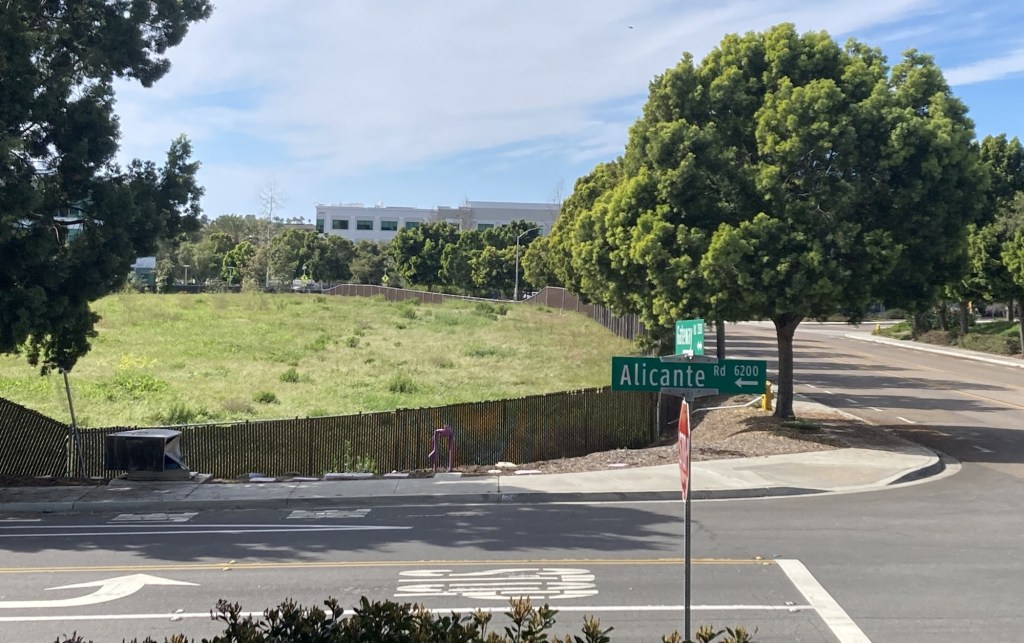
A developer is asking Carlsbad to change the zoning from industrial to residential on 7 acres sandwiched between the Viasat campus and a neighborhood of single-family homes in the Bressi Ranch community.
If approved by the Carlsbad City Council, the change would allow Toll Brothers to build a gated community of 111 luxury, three-story townhomes with a total of 252 parking spaces on the parcel surrounded by Gateway, Alicante and Town Garden roads. The entrance and exit would be on Gateway Road.
The vacant property is adjacent to a small commercial center and the Viasat campus, a wireless communications company sprawled across both sides of El Camino Real south of Palomar Airport Road.
A majority of the Carlsbad Planning Commission recommended Wednesday that later this year the City Council allow Toll Brothers to begin work with city staffers on the zoning and plan amendments needed for the project to proceed.
“We estimate a 12- to 24-month processing time for that,” said Assistant Director of Community Development Eric Lardy in a presentation to the Planning Commission.
During that time, the developer and the city would address community concerns, update environmental documents, and address other issues raised by the proposal.
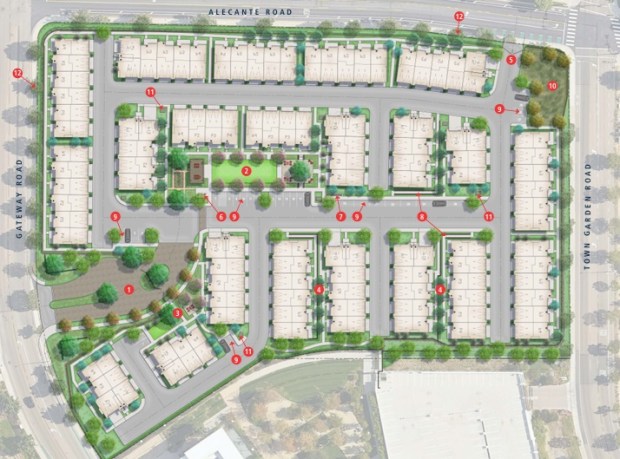 A map of the 111 townhomes proposed for Bressi Ranch.
“This was to be Phase 5 of the Viasat campus,” said Andrew Cohn of Levine Investments, the Phoenix-based company that has owned the parcel as part of the Viasat property for 25 years.
His real estate management company understands the many issues involved in transitioning the property to residential uses, Cohn said, and, “All we are asking is to be able to process this application.”
Toll Brothers has built other residential communities in Carlsbad and elsewhere in North County.
Current plans, which are subject to change, call for townhomes ranging from 1,459 to 2,271 square feet each with attached garages in a series of three-story, five-plex buildings, said Eric Everhart, senior land entitlement manager for Toll Brothers.
“We want to build a gated enclave, perfect for young professionals and families wanting to reside in Carlsbad,” Everhart said.
Residential development would attract “stable, long-term owners” and enhance property values in the surrounding community, he said. If developed under the current zoning as industrial, he said, it could become a warehouse site that would lower property values.
Bruce Bandemer, a resident of Bressi Ranch since 2010 and president of the community’s homeowners association, opposed the plan.
More businesses are needed nearby to improve the “live-work” balance, he said. They help residents avoid long commutes, he said, while more homes will add to the traffic that’s already a problem.
“I caution you about continuing to erode the business corridor that we’ve established,” Bandemer said.
The only commission member who voted against the project, Kiley Fitzgerald, said the change would adversely affect nearby neighborhoods.
“These plans (the general plan and master plan) were made for a reason,” Fitzgerald said. “There are studies behind them, and there’s a lot of effort behind those.”
Other commissioners said it’s too soon to consider issues such as traffic and that the developer should be allowed to pursue the project.
“Housing is always a benefit to a community,” said Commissioner Alicia Lafferty. “We are in a housing crisis, so residential is what we need.”
Lafferty said the proposal for 111 townhomes on 7 aces is relatively low density, and that there should be more homes on the site.
Carlsbad requires a minimum of 15% of the units be reserved as affordable housing in all new developments. The minimum increases to 20% for developer-initiated zone changes, Lardy said, adding that Toll Brothers is aware of the requirement.
“The questions being brought up are good reasons to allow them to make that application and make their case,” said Commissioner Peter Merz.
Carlsbad’s City Council approved the Bressi Ranch Master Plan in 2003 allowing for the development of 623 residential units, according to a city staff report. It was most recently updated on Jan. 30, 2024, to allow the development of 248 additional units on two vacant sites.