
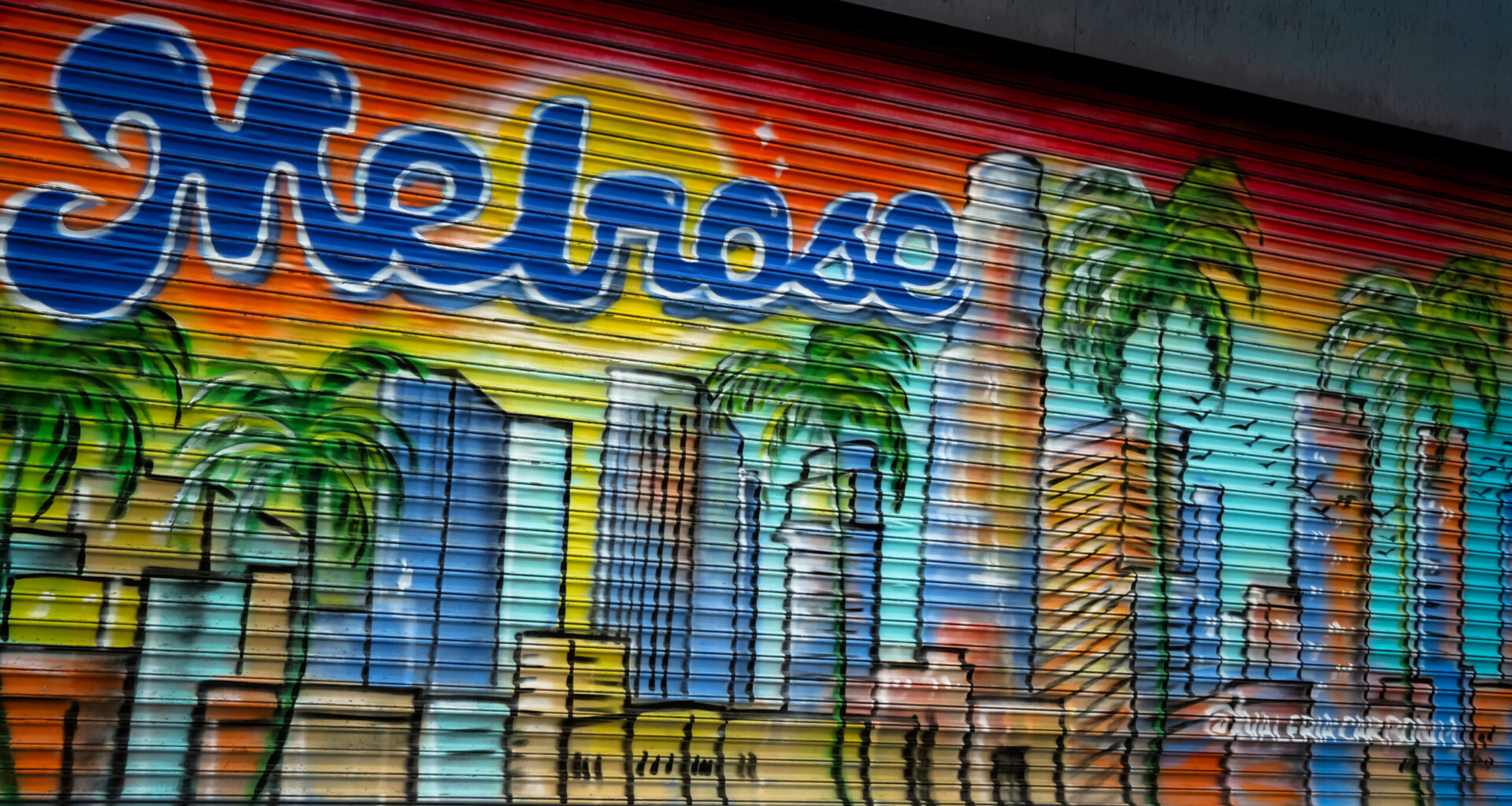
On Melrose Avenue, between Fairfax Avenue and La Brea, art does not wait for permission.
Once a countercultural corridor and now a globalized retail strip, the Melrose Arts District absorbs Los Angeles’ contradictions in real time. Its murals emerged not through city planning or arts funding, but through informal agreements, artist initiative and the steady churn of storefront turnover.
What developed was not a sanctioned district, but a living record of who had access to walls, time and visibility at any given moment along a few dense blocks of storefronts and service alleys. It climbs roll-up gates, wraps cinderblock walls and spills into alleys where delivery trucks idle and tourists drift between photo ops.
Long before the phrase “open-air gallery” became marketing shorthand, Melrose functioned as one. Over time, its murals grew into something larger than decoration or backdrop, shaped by the artists who paint them, maintain them, repaint them and sometimes watch them disappear overnight.
To walk Melrose today is to move through a constantly shifting ecosystem. Walls rotate. Storefronts change hands. Murals are tagged, buffed, restored or quietly replaced. What remains consistent is the labor behind them: artists working outside institutional spaces, negotiating directly with shop owners, property managers and the street itself.
The result is a visual archive that is never finished, never fully owned and always in motion.
Murals along Melrose are often photographed as if they are permanent landmarks, but permanence has never been the point. Their power comes from fragility. Each piece exists with the understanding that it may be temporary, subject to weather, vandalism, commerce or redevelopment. That impermanence gives the district its pulse.
A Public Practice, Lived on the Wall
For muralist Corie Mattie, Melrose’s constant negotiation is not a flaw. It is the point.
Scroll to continue reading
Known in Los Angeles art circles as the “LA Hope Dealer,” Mattie approaches public walls as sites of direct exchange rather than display. The name is not branding shorthand so much as a mission statement. Her work treats hope as something that circulates through participation, not proclamation, especially in neighborhoods shaped by visibility, commerce and constant turnover. Her work often centers on affirmation, access and participation, offering optimism without ignoring the realities of the street. Hope, in this context, is not decorative. It is active.
Mattie, who paints and helps curate rotating walls like The Fame Yard, describes public murals as a way to bypass institutional gatekeeping and speak directly to the city.
“You don’t really need approval from anyone,” she says. “You only need the approval of, basically, the wall owner.”
That access reshapes both audience and intention. Working in public space collapses the distance between art and everyday life. The work meets people where they already are.
“It’s not just certain people going to an art gallery,” Mattie says. “Everyone is seeing the message or the imagery.”
Nowhere is that philosophy more visible than at The Fame Yard, the stretch behind storefronts near Fairfax that has become one of Los Angeles’ most recognizable mural destinations. Its walls host large-scale works that rotate frequently, often without formal announcement. Artists paint over previous pieces not as erasure, but as continuation.
The wall remembers even when the image changes.
What distinguishes The Fame Yard is not just scale, but density. Multiple murals coexist in close quarters, layered by time and intention. A hyper-polished portrait might sit beside a rougher, more experimental piece. Styles clash and converse without hierarchy. No plaque explains what belongs there. The context is the street.
That openness also demands vulnerability. Public murals invite praise, criticism, indifference and reinterpretation, often all at once. Mattie accepts that risk as part of the practice.
“That’s why it’s in the public,” she says. “It comes with the positivity, and it comes with the negativity.”
Her work often includes QR codes linking to fundraising efforts or educational resources, a way to turn viewing into participation rather than passive consumption. The gesture aligns with her Hope Dealer identity, turning attention into action.
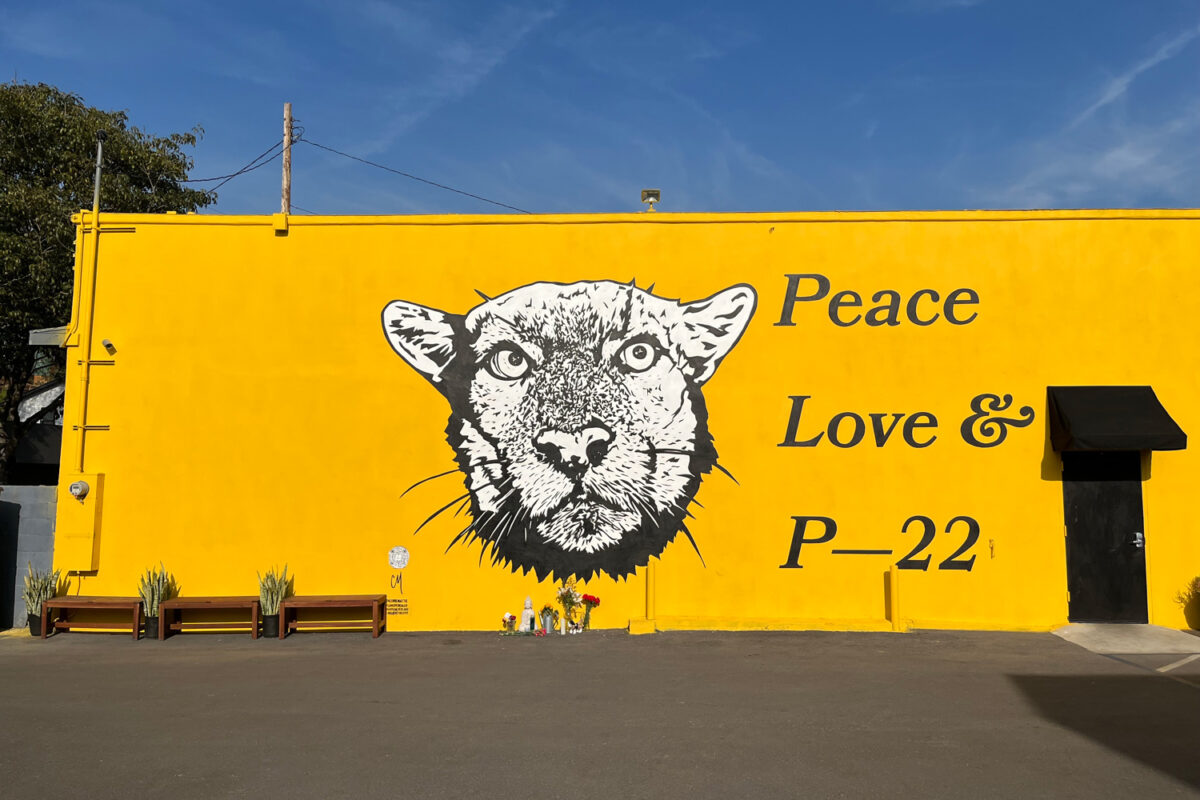 Artist Corie Mattie’s mural in Silver LakeCredit: (Photo by Christopher Hughes.
“Good art makes you think,” she says. “But great art makes you do.”
The labor behind that work is rarely visible. Painting at scale means navigating limited access, tight time windows and basic infrastructure gaps. Water and electricity are not guaranteed, making improvisation part of the process.
“Artists are problem solvers, especially in the public space,” Mattie says.
That problem-solving extends beyond logistics into community dynamics. Melrose sits at the intersection of graffiti, street art, commerce and tourism. Informal rules still matter. Respect remains essential.
“There’s enough walls and enough art for us to create together,” Mattie says.
Beyond high-traffic sites like The Fame Yard, Melrose’s mural life stretches into quieter territory: behind boutiques, in service alleys and along parallel streets. Away from crowds and constant documentation, the work can breathe.
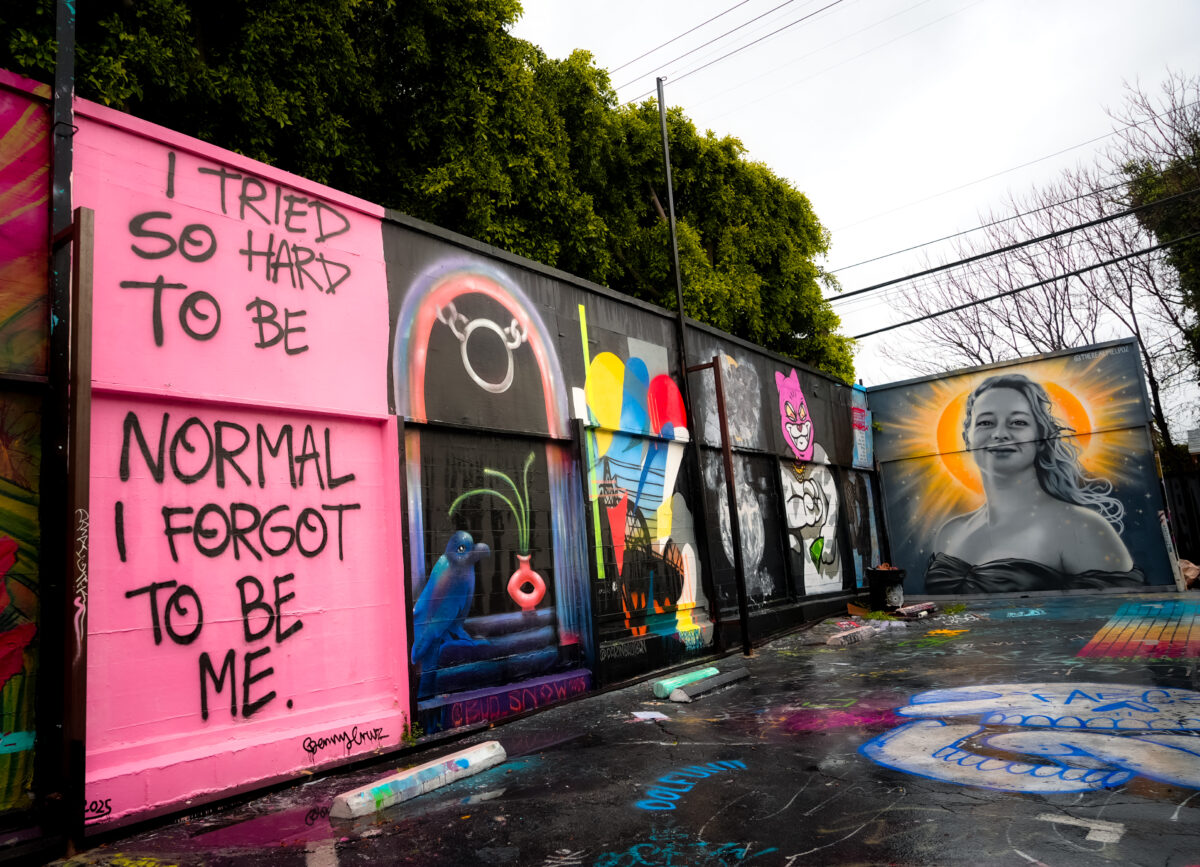 Murals in The Fame Yard- Melrose Ave. Credit: (Image via Carah Chafin)
Despite the instability, Mattie continues to return to public walls with a simple goal. “To leave this place better than I found it,” she says.
That sentiment mirrors the district itself. Melrose does not promise permanence. It offers presence.
Melrose, Negotiated in Real Time
For many muralists, Melrose occupies a rare middle ground. It is public without being municipal and visible without being institutional. No single body determines what qualifies as art. Each wall reflects a negotiation between artist and owner, expression and commerce.
That negotiation is ongoing. Murals bring foot traffic and help shape neighborhood identity, but they come with few guarantees. A piece that takes days to complete can be erased overnight by a lease change, a remodel or a branding decision.
This tension has long defined Melrose. The corridor has always existed at the intersection of subculture and retail. Streetwear shops, vintage stores, luxury brands, graffiti traditions, fine art techniques and political imagery overlap block by block. Murals reflect that layering. Some are commissioned. Others emerge from informal agreements or long-standing relationships. All are contingent.
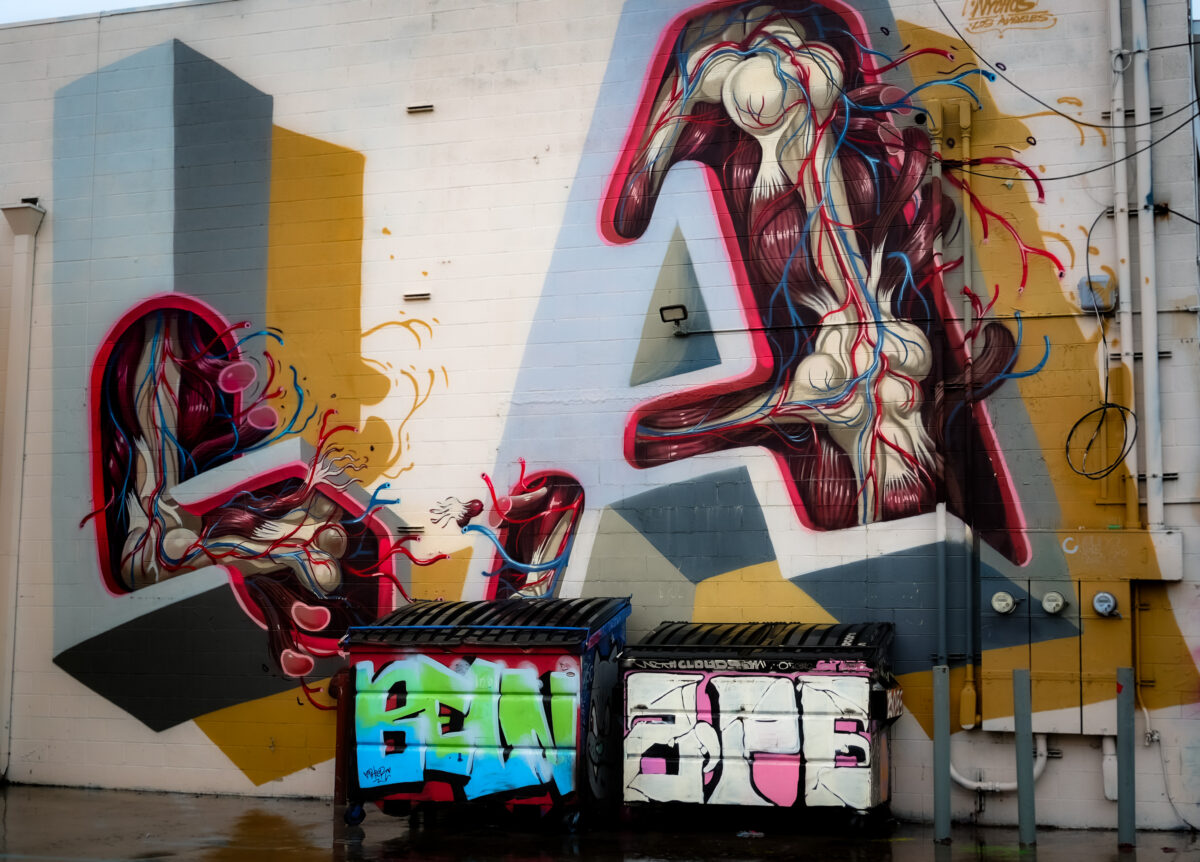 Nychos Alleyway Mural – Melrose Ave.Credit: (Image via Carah Chafin)
What unites them is presence. These works are meant to be encountered, not framed. They are seen while unloading inventory, walking dogs, grabbing coffee or locking up for the night. They weather sun, cracks, tags and touch.
Artists who return to maintain or repaint their work treat upkeep as part of authorship. A mural is not finished when the paint dries. It evolves, or it disappears.
The absence of institutional oversight also allows risk. Walls become testing grounds for scale, color and composition. Failure is visible. So is growth. An artist’s evolution can be traced across blocks rather than through résumés.
Tourism has added another layer. Social media has turned certain walls into destinations, sometimes flattening them into backdrops. But familiarity invites replacement. Popularity accelerates change. New images emerge to interrupt what has become too recognizable.
What distinguishes Melrose from more curated mural districts is turnover. Here, impermanence is not treated as loss. It is understood as momentum. Some of the most compelling work appears away from the crowds, behind storefronts and in service alleys where artists operate with fewer eyes and greater freedom.
Calling Melrose an open-air gallery only goes so far. It is more accurate to see it as a negotiated space where economic, cultural and personal forces meet on every wall. The agreements are informal and surfaces are temporary.
That instability is not a weakness. It is the engine. Murals will fade, change or vanish, but the practice continues. The street remembers, even when the images do not.