
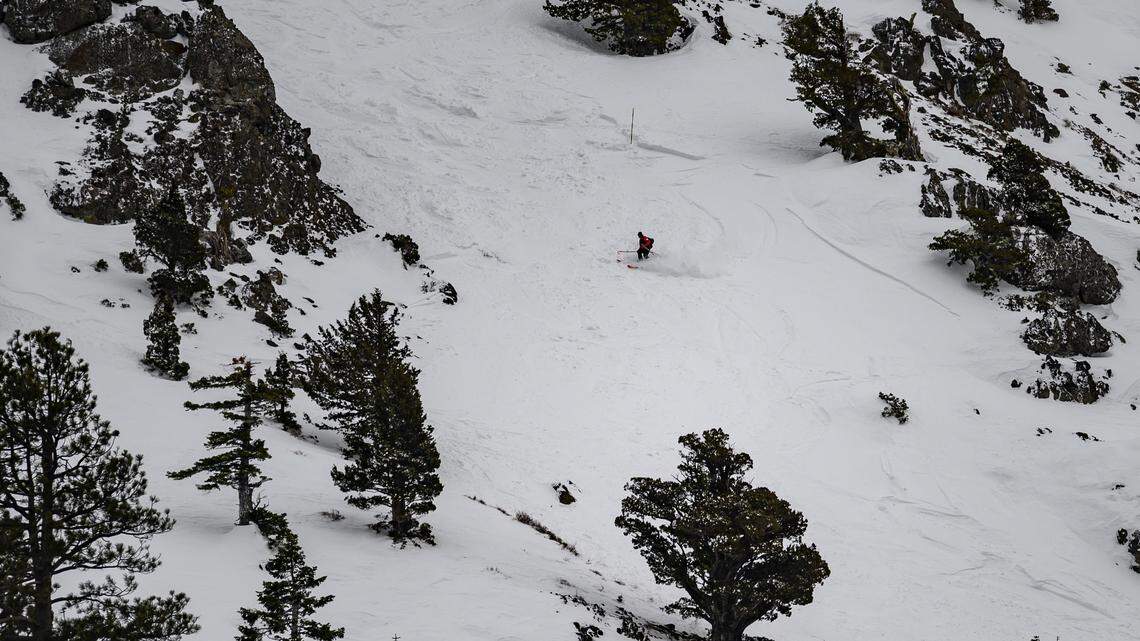
At least eight backcountry skiers are dead after a group of 15 were swept away by an avalanche Tuesday near Castle Peak in the Lake Tahoe area, The Sacramento Bee reported. Six were rescued and the search continues for one missing skier, who is presumed dead.
It is the deadliest avalanche on record in California and among the worst in the U.S.
Here’s what to know about avalanches and avalanche safety:
What is an avalanche? What is avalanche-prone terrain?
An avalanche is a rapid flow of snow down a hill or mountainside, according to the National Weather Service.
Avalanches can reach speeds of up to 100 mph and vary in destructive potential, ranging from harmless slides to ones that can destroy forests or flatten villages, the American Avalanche Association said.
It said avalanches are possible on any slope steeper than 30 degrees and occur most frequently at 35 to 50 degrees. The Avalanche Association also said recent avalanches, rapid melting, heavy snowfall or rain, and cracking or collapsing snow can all mean the terrain is prone to an avalanche.
What causes avalanches?
Skiers, snowmobilers and hikers can set off an avalanche when a layer of snow collapses and starts to slide down the slope. In the U.S., avalanches are most common from December to April, but they can happen at any time if the conditions are right, National Geographic reported.
“Avalanches are based on the storms that come into the area and the existing snowpack structure,” Steve Reynaud, a forecaster at the Sierra Avalanche Center, told The Sacramento Bee.
The heavy amounts of snow can then roll down a nearby slope, such as a hill or mountain, Reynaud said.
“Avalanches can also be caused from existing snow, the snow that comes in, or avalanches that occur down deeper in the snow,” Reynaud said.
About 90% of avalanches involving humans are human-caused, the Utah Avalanche Center said.
Contrary to popular belief, loud noises don’t cause avalanches, unless they are extremely loud, like the sound of an explosion.
The KT-22 Express ski lift is empty after an avalanche at Palisades Tahoe on Thursday, Jan. 11, 2024 in Placer County. A skier died after an avalanche on Wednesday, January 10, 2024 at Palisades Tahoe. Avalanche-prone terrain is not exclusive to deep, wooded areas of the mountain. Paul Kitagaki Jr. pkitagaki@sacbee.com How deadly are avalanches?
About 40 people die in avalanches each year in North America, the American Avalanche Association said.
California averages one avalanche fatality per year, according to the Colorado Avalanche Information Center.
Before Tuesday’s avalanche, at least six people in the U.S. had died in avalanches this season, according to the center. That includes two earlier deaths in California: a snowmobiler who was killed near Castle Peak on Jan. 5 and a ski patroller killed near Mammoth Lakes on Dec. 26.
How can I prepare if I’m going to an avalanche-prone area?
Wendy Antibus, education manager for the Sierra Avalanche Center, said accident prevention is “the tool that you want to rely on.”
“In terms of accident prevention, looking at the avalanche forecast and tracking the weather in the snow pack, and understanding where avalanches can happen, and then avoiding that terrain is really critical,” Antibus said.
Local avalanche centers, such as the Sierra Avalanche Center, have professional avalanche forecasters monitoring snow conditions.
The Sierra Avalanche Center provides a detailed two-day avalanche danger forecast on its website.
The American Avalanche Association offers courses to provide education and training on safely exploring backcountry terrain and rescuing people from being swept under an avalanche.
The National Avalanche Center has a list of course providers endorsed by the association.
What should I pack?
There are various pieces of gear designed for skiing in adverse avalanche conditions, Antibus said.
“Having all of your rescue equipment — so your avalanche transceiver, your shovel and your probe — and then going with a group that’s properly trained in avalanche rescue is really important,” she said. “Making sure that yourself and your partners are all familiar with avalanche rescue techniques and have practiced it recently, and can actually do something in the event that an avalanche happens.”
An avalanche beacon or transceiver is a radio transmitter that can send a signal locating a person buried in the snow. The avalanche probe, which is a tent rod-like collapsible fiberglass pole, is useful for marking where a person may be buried and how deep they are.
A shovel is important for digging a person out from the snow.
“The reason you need that type of gear, and should know how to use it, is that if you get buried in an avalanche, you can’t get out without it,” Trautman previously told The Bee.
The National Avalanche Center encourages riders to wear an inflatable airbag pack in case of slides. Avalanche airbags can be part of a backpack and can be manually deployed in an avalanche situation, and can reduce the risk of mortality when overtaken by a slide.
A properly deployed airbag makes the wearer larger than other debris in the flowing avalanche. Larger objects in an avalanche tend to stay near the snow’s surface, while smaller bits of debris get buried.
How to safely traverse avalanche-prone snow
According to the National Avalanche Center, it’s vital to bring a partner into avalanche conditions, as one person may not be able to dig themself out from underneath a mass of snow.
Antibus said in an interview with The Bee it is best to avoid terrain that may be avalanche-prone.
“If your group does need to go across an avalanche path, or move through terrain where avalanches could happen, (expose) a few people at once to that terrain,” she said. “Going one at a time when you’re skiing down the slope is like standard practice for people who are skiing in the back country, and that eliminates the risk of your whole group getting caught.”
Loading…
How to survive being caught in an avalanche
If an avalanche breaks out, it’s best to move diagonal to the avalanche to an edge, Trautman said in a U.S. Department of Agriculture post.
“First, try to get out of the way. Do everything you can not to get caught in the slide,” he said. “Being in an avalanche is like being caught in a fast-flowing river. The most common advice is to move diagonal to the avalanche or try to make your way to the edge, where the slide is not moving as fast and where you’re not likely to be buried as deep.”
He also advised people to try to orient their feet downhill or curl into a ball to try to protect their head as they are swept along by an avalanche.
“And once you finally come to rest, you should relax because you know your partners are trained, and they are coming to get you,” Trautman said.
Antibus said survivors have advice for getting back to the surface.
“People that (have been) caught in avalanches say that trying to fight to swim your way to the surface is the best technique to escaping if you’re caught in an avalanche,” she said.
The Utah Avalanche Center said you want to do that before the loose snow sets.
“As the avalanche finally slows down and just before it comes to rest, try and clear an air space in front of your mouth,” the center said. “This helps delay the buildup of carbon dioxide in the snow around your mouth, which allows you to live longer under the snow.”
Try to push a hand upward out of the snow to help your friends locate you, the center advised.
Related Stories from Sacramento Bee
The Sacramento Bee
Don Sweeney has been a newspaper reporter and editor in California for more than 35 years. He is a service reporter based at The Sacramento Bee.

The Sacramento Bee
Camila Pedrosa is a service journalism reporter at The Sacramento Bee. She previously worked as a summer reporting intern for The Bee and reported in Phoenix and Washington, D.C. She graduated from Arizona State University with a master’s degree in mass communication.