
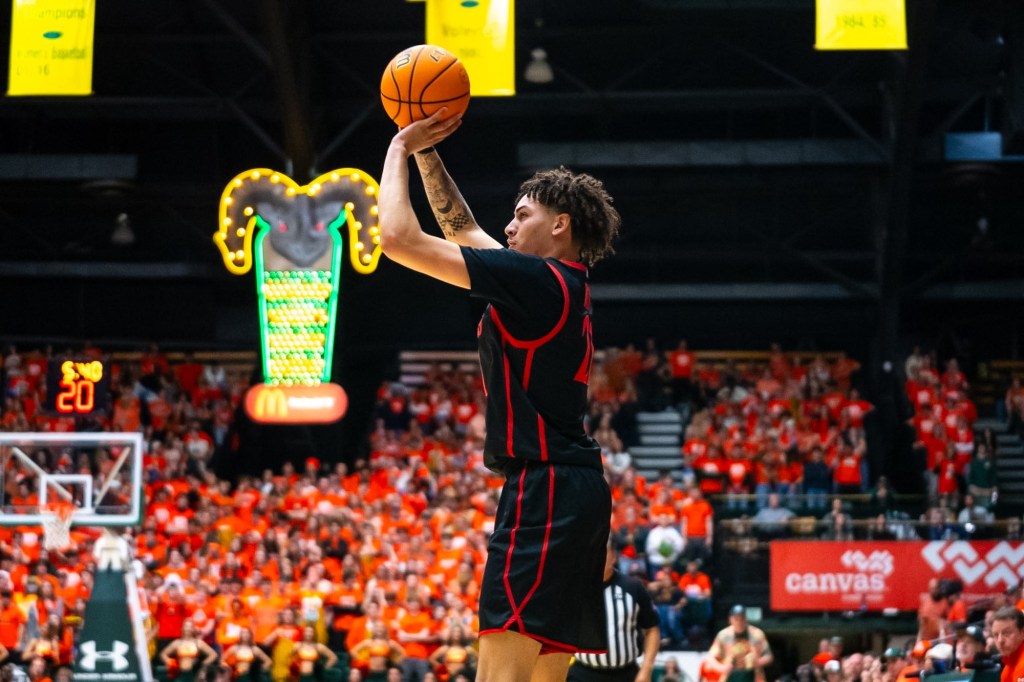
FORT COLLINS, Colo. — Three thoughts on San Diego State’s 83-74 loss at Colorado State on Saturday afternoon:
1. The impending exodus
Let’s just blurt it out:
It’s hard to play basketball when you have one foot out the door.
The uncomfortable reality of college basketball in 2026 is that your entire roster is on one-year contracts in a sport with no salary cap, and as the season winds to a close everyone is looking for a chair before the music stops.
The transfer portal doesn’t open until April 7 this year. You’re incredibly naïve if you think those conversations — and decisions — aren’t happening now, as programs try to retain players and other programs try to poach them and agents in the middle start counting their money.
The Aztecs have largely avoided the anxiety of major roster reconstruction, returning eight players from the previous year, an almost unfathomable number these days. They rank ninth in Division I in minutes continuity at 54.4%, well above the national average of 25%. A decade ago, the national average was double that.
But that is about to change on Montezuma Mesa — or at least all indications are it is.
There are three seniors on the current roster: Reese Dixon-Waters, Jeremiah Oden and Sean Newman Jr.
Three players figure to return: freshman forward Tae Simmons, little-used center Thokbor Majak and redshirt guard Latrell Davis.
And everyone else? Miles Byrd, Magoon Gwath, BJ Davis, Taj DeGourville, Pharaoh Compton, Elzie Harrington, Miles Heide?
Most of them, even all of them, could be gone, either by their choice or the program’s nudge.
That makes for an unsettling February, a month when the Aztecs have traditionally been rock solid. Last week’s loss against Grand Canyon ended a 21-game home win streak in the month. The last time they lost back-to-back games in February was 2018.
And it’s not just that they lost but how: a lack of energy, a lack of focus, a lack of fight. Almost as if their minds were elsewhere.
How else to explain being ranked No. 1 nationally in defensive efficiency since Jan. 1 at 90 points per 100 possessions and allowing 123 against CSU? Or losing by nine after beating the Rams by 23 less than a month ago?
“They all have agents, they all have different things going on,” coach Brian Dutcher said. “But that’s part of my task, to keep them focused on when it’s time to focus on Aztecs basketball, getting themselves better, getting this team better.
“It’s winning or losing. There are teams that are on long winning streaks that have guys who are entertaining other things. That’s just the new era of college basketball.”
It’s probably not a coincidence that the Aztecs played some of their best basketball without Gwath and Harrington, not because they’re bad players but because it trimmed the rotation from 11 to a more manageable nine.
It went to 10 when Gwath returned Tuesday against Grand Canyon.
It went to 11 when Harrington returned against Colorado State.
Shifts were shorter, faces were longer. The body language on the bench Saturday night was dour at best.
“This is where the depth hurts us to a degree,” Dutcher conceded. “You might think you’re playing good and you might run into a night where you play six or seven minutes, and then you’re frustrated by that and then the talk of leaving (starts).
“It all multiplies.”
2. Whither Magoon?
The Gwath conundrum continues.
He had 13 points and five blocks in 14 minutes a week earlier against Nevada, his first game back after missing six with a hip issue.
The next game: four points, five rebounds, four turnovers in 20 minutes against Grand Canyon.
The next: one point, no rebounds in a mere 4:54 against CSU.
His first shift was for 3:13. His second was for 1:41 late in the first half, getting yanked after turning his back on the play to argue with an official and then switching late onto a shooter to give up a 3. He never returned and looked visibly frustrated sitting at the far end of the bench during the second half.
“He played great against Nevada,” Dutcher said. “He competed against Grand Canyon, but then he basically missed two days of practice. His knee was sore and his back tightened up. I told him after the game, ‘Goon, I feel awful for you, but if you can’t get through a practice, it’s hard to demand that you play great, quality minutes in a game.’”
This, supposedly, was why he was shut down for a month, to heal the residual bumps and bruises that prevented him from playing at full capacity. Two games back, and he’s already banged up again.
It raises questions, sadly, tragically, about his viability for the remainder of this season and perhaps for the remainder of his career. If he can’t survive a 30-game season of 40-minute games, what’s going to happen when it’s an 82-game NBA season of 48-minute games?
He was injured in his senior year of high school, sat out his first year at SDSU after ankle surgery, suffered a knee injury last year that led to offseason surgery, and has been limited by knee, hip, back and everything else problems ever since.
Dutcher has called Gwath “a special player” and “a difference maker.” But the old sports adage about the best ability being availability also applies.
“I value Goon, I love what he brings to the team,” Dutcher said. “I told him, ‘As soon as you can feel good enough to go harder in practice, then your minutes will grow in the games.’ It’s nothing that he doesn’t want to do, it’s just that his body won’t allow him to do it.”
3. Don’t sleep on USD
The University of San Diego last went to the NCAA Tournament in 2008. Since then, SDSU has been 12 times, including four Sweet 16s and a trip to the national championship game.
The Toreros have been better than 200 in the Kenpom metric only once in the last seven seasons, and that was 195. SDSU has been outside the top 50 only once, and that was 51.
Crowds at the 5,100-seat Jenny Craig Pavilion number in the hundreds on many nights. SDSU regularly fills 12,414-seat Viejas Arena.
The two programs, though, might not be as far apart as you think.
USD fired Steve Lavin on Wednesday after four uninspiring seasons and is searching for its fourth head coach since Dutcher took over at SDSU less than a decade ago. But the way things work now, that gap can close quickly. Overnight, even.
You need two things: a competent coach, and money.
USD athletic director Kimya Massey seems to know what he’s doing and has been quietly (and diligently) considering his coaching options for months. There are also indications that the program’s finances could increase significantly.
Several times in his statement announcing Lavin’s dismissal, Massey referenced “embracing NIL and revenue-sharing opportunities.”
USD is uniquely positioned in this new landscape, too. It’s a private school, able to dump money into athletics without public budget scrutiny at a time when state universities are bleeding red ink. And it doesn’t have scholarship football to soak up resources that otherwise can be diverted to basketball.
And, starting next year, USD is no longer in a conference with Gonzaga. Hire a good coach and give him $3 million-plus in revenue-sharing, and you might have something.