
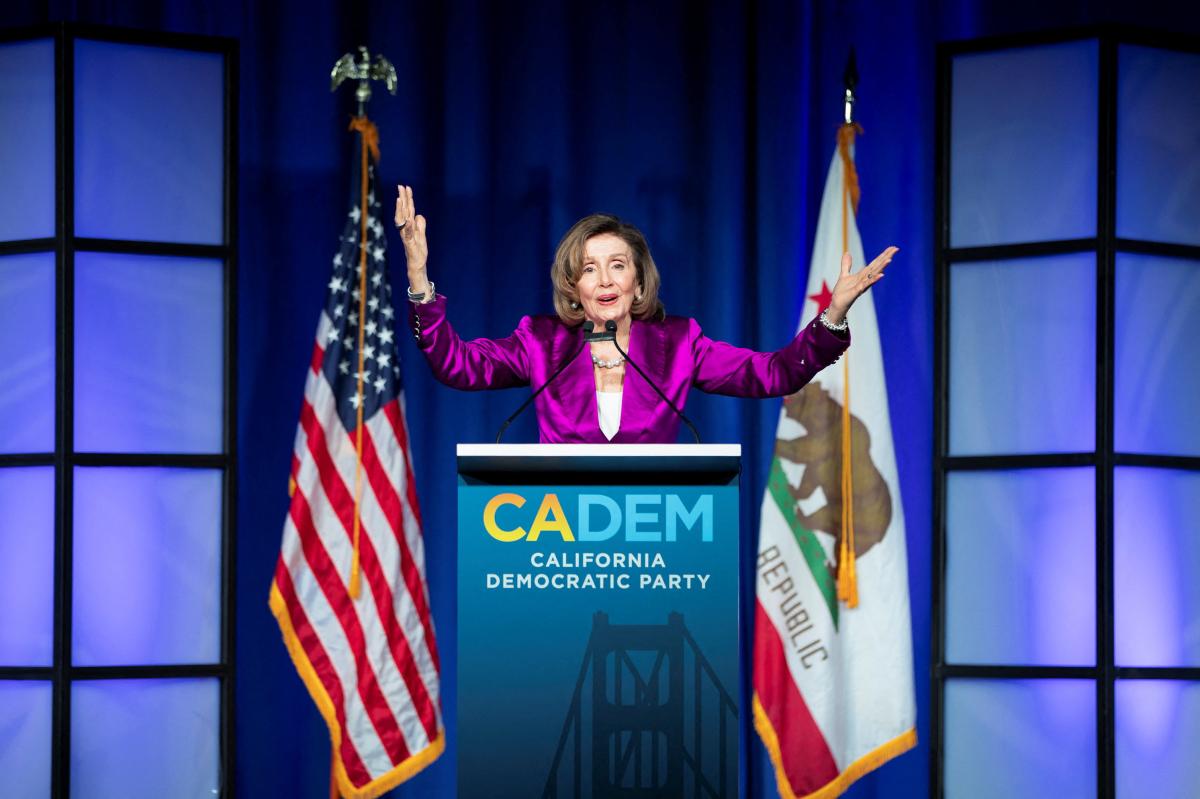
It was fitting that the California Democratic Party gathered in San Francisco to talk about “affordability.” They created the problem.
The Democratic Party governing model that has shaped this state for decades — high taxes, heavy regulation, climate mandates layered on labor mandates, and public employee unions at the center — is the key culprit in high costs.
And yet affordability was the word of the weekend.
Artists perform during the California Democratic Convention in San Francisco. REUTERS
Speaker after speaker promised to make housing cheaper and lower costs for working families, in a hall filled with activists who helped build the policy structure that made California one of the most expensive places in America to live, build, hire, or start a business.
For a generation, Democrats have controlled the legislature, every statewide office, and the governor’s mansion. During that time, California’s top income tax rate became the highest in the country, gas taxes climbed near the top, regulations multiplied, and the state budget swelled past $300 billion.
Yet the solution offered was not course correction but more “investment,” more revenue, and more state direction of housing and health care.
Several candidates again embraced single-payer ideas, and nearly all pledged deeper intervention in the housing market.
Billionaire Tom Steyer called for taxing people like himself even more, and delegates applauded.
Tom Steyer speaking at the California Democratic Convention. REUTERS
What you did not hear was a serious discussion of whether decades of policy layering contributed to the cost structure now labeled a crisis.
And the governor whose policies shaped this landscape did not even show up. Gavin Newsom did not attend the convention or address delegates.
Instead, he was on a national book tour — including stops in Tennessee, Georgia, and South Carolina — promoting his memoir and raising his national profile.
As Democrats wrestled with affordability, budget strain, and a fractured field, their governor was traveling through early presidential territory.
When a governor skips his own state convention to tour early primary states, it tells you where his priorities now lie.
Nine Democrats are running to replace Newsom, and eight of the major candidates made their formal pitch during the Saturday endorsement session.
San Jose Mayor Matt Mahan was not included because he entered too late to qualify for the vote. No one came close to the 60 percent needed among roughly 3,500 delegates.
Eric Swalwell led with 24 percent, Betty Yee followed with 17 percent, Tom Steyer received 13 percent, and Katie Porter landed at 9 percent.
Eric Swalwell speaking at the California Democratic Convention. REUTERS
The fragmentation is obvious and reflects a field that has yet to produce a dominant figure capable of unifying activists and primary voters alike. The activist base that dominates conventions does not perfectly mirror voters statewide, and candidates polling in low single digits can still perform well in a room full of engaged delegates.
The weekend often felt less like a governing debate and more like auditions. Donald Trump was invoked repeatedly, and applause lines were tested. The most talked-about moment came when Porter held up a sign that read “F*** Trump,” a move that thrilled the room but does little to consolidate a fractured field.
Talk privately to delegates and one worry surfaces quickly: a Democratic lockout in November. California’s June Top Two Election offers no guarantees, and with nine Democrats splitting the vote while two Republicans — Steve Hilton and Chad Bianco — consolidate theirs, the math unsettles some activists.
It is still an unlikely scenario, but the concern itself is telling.
The California Post is here. Sign up for Morning Report.
Get the perfect blend of news, sports and entertainment delivered to your inbox every day.
Thanks for signing up!
Conventions do not decide elections. The real force in California politics remains organized labor, and the California Teachers Association and SEIU will not sit back if the field remains splintered.
If necessary, they will spend heavily to elevate a preferred Democrat and shape the general election matchup.
What the convention revealed is that Democrats have not coalesced around a dominant figure, and party leaders remain neutral. That raises the question of whether someone with greater stature steps in before June.
Download The California Post App, follow us on social, and subscribe to our newsletters
California Post News: Facebook, Instagram, TikTok, X, YouTube, WhatsApp, LinkedIn
California Post Sports Facebook, Instagram, TikTok, YouTube, X
California Post Opinion
California Post Newsletters: Sign up here!
California Post App: Download here!
Home delivery: Sign up here!
Page Six Hollywood: Sign up here!
The next governor faces a structural deficit, a housing shortage, business flight, and a tax base that swings with the fortunes of a narrow slice of high earners. None of that disappears because a billionaire volunteers to pay more or because someone promises to “fight Washington.”
Conventions are theater. Democrats rallied around affordability without confronting the policies that made California expensive, and they showcased nine candidates without producing a unifying figure.
The governor whose record defines the moment did not even attend.
If no heavyweight enters, this race will be shaped by union spending, vote fragmentation, and turnout math in the June “top-two” Election, where the top two vote-winners advance, regardless of party.
Meanwhile, Newsom is operating as a national political figure while leaving behind a structural deficit and a cost-of-living crisis that he is effectively dumping on his successor.
Then again, given the record that produced this moment, Californians may reasonably wonder whether we are better off with his attention directed elsewhere.
Jon Fleischman, a longtime strategist in California politics, writes at SoDoesItMatter.com.