
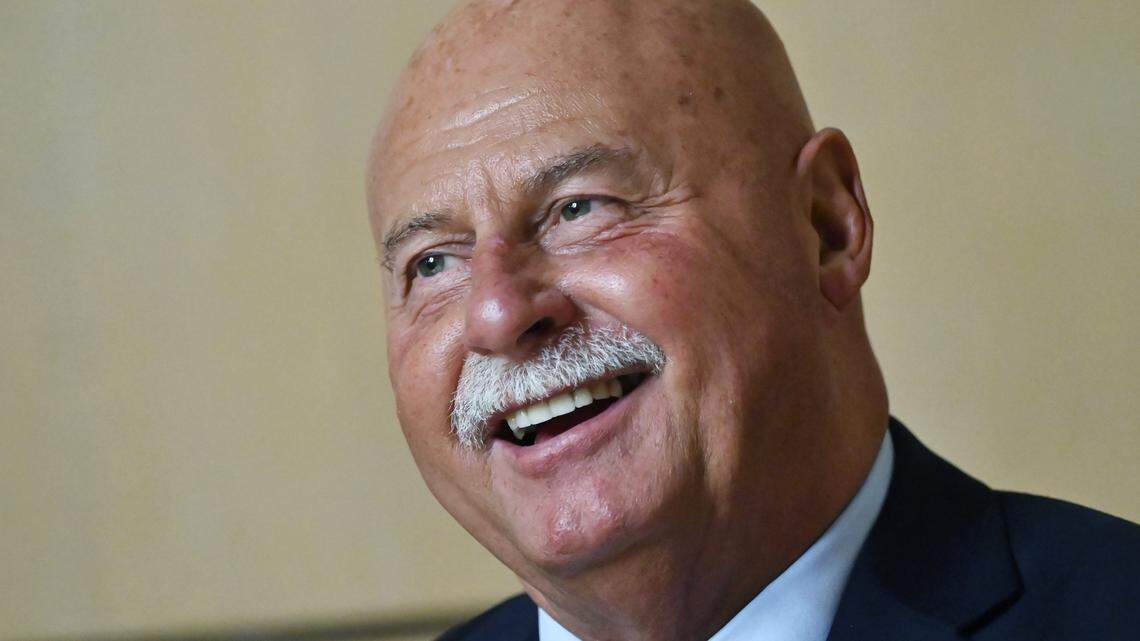
Fresno Mayor Jerry Dyer has several ambitious goals for the remainder of his second term.
The Fresno Bee recently sat down with the mayor for a 40-minute interview to discuss his accomplishments and challenges as mayor. From local issues such as the Southeast Development Area to housing and homelessness to downtown revitalization, Dyer shared his thoughts on many high-priority issues facing Fresno, such as negotiations to renew the 30-year transportation tax, Measure C. He is throwing his support behind the citizen-led initiative.
“People don’t get to see how hands-on I am as a mayor,” he said.
Dyer and his team are busy preparing next fiscal year’s budget — “another tight year” — and he meets weekly with the city housing czar.
“There’s a lot more to me than just being a guy that attends events, cuts ribbons and turns dirt,” he said.
Dyer highlighted major milestones — such as opening the $20 million city-run animal shelter in 2022 and the recent $150 million Fresno Yosemite International Airport renovation — as well as his passion projects, such as the One Fresno Youth Jobs Corps program that has employed 575 “hard to employ” youth.
And while he wouldn’t confirm whether he planned to pursue any higher office after his term ends, Dyer said he’s still “full of energy.”
Fresno mayor Jerry Dyer addresses a wide range of topics during a Q&A session with Bee reporter Melissa Montalvo Monday, Feb. 9, 2026 at City Hall in Fresno. ERIC PAUL ZAMORA ezamora@fresnobee.com
Read on to hear about the Dyer administration’s efforts and a look towards future goals, edited for length and clarity.
Question: We’re entering budget season. How are you preparing for that, and how are things looking this year?
Answer: We started our budget preparation in late December, early January, and it’s going to be another tight year. There’s no question we’re going to see sales tax ticking up, property tax continually growing, but what we’re going to see is that our expenditures are again exceeding our revenues. And whenever that happens, we have to go through exercises that either hold vacancies and/or cut departments. And so we’re early on in the process. Last week, we had a meeting that really talked about where we’re at during the mid-year, and what the revenues look like and the expenditure projection, so … it’s going to be another tough budget year. I fully anticipate maintaining our attrition rates, vacancy rates, which we had at 6.18%. I anticipate that, so as we get into probably March and April, we’ll have a better feeling of where we truly are. The good thing is we got all of our labor contracts done, except for one. We’re still finalizing that, so we know exactly where we are going into this coming fiscal year.
Some of the contracts were one-year, some were two-year, some were actually longer than that, and we staggered them this time so that we would not have to have 12 different labor groups negotiating at one time. The reason the last time we did all of them as one-year was that we were uncertain about the economy.
You’ve talked a little bit in the past about a potential public safety tax, is that still something on the table?
I actually have not had any discussions on any type of tax other than what we’ve talked about for Measure C. I don’t think that there is an appetite in our community. I do believe, in Fresno, people feel like they’re being taxed enough. It’s hard enough to make ends meet with energy costs that are going up and inflation and housing costs. I don’t think the timing for an additional tax beyond what we have with Measure C would be appropriate now. As we move further into the end of my administration, and we get to see where we are within terms of revenues, we’ll make that decision, but I don’t see anything in the near future.
Speaking of Measure C, I understand you’ve been pretty instrumental in those conversations and negotiations. How are you feeling about that? And how is it looking right now?
I felt really good about the process of Measure C. I never knew I would spend that many hours on the Measure C renewal, but I spent hundreds and hundreds of hours working with not just the (California Association of Councils of Governments) but other mayors and community groups, hoping that we could get Measure C on the ballot, traditionally, to go through the various cities and have them approve and then go through the (Fresno County) Board of Supervisors. But as you know, that did not happen. It fell short. (
I’m thankful that a citizens group has picked that up and is willing to pursue a citizen-led initiative, and I support that initiative.
I hope that there’s not two initiatives, because I think it will ultimately cause people out in the community maybe just to vote no on both. And if that happens, we’re going to be put in a position as a city and throughout the county of having to live with some of the streets that are in rapid decay. And none of us want that.
One of your big initiatives has been repairing the roads throughout the city. How is that going? And how would Measure C potentially impact that?
Fortunately, we were able to pass locally a “Pave more now, pay later” initiative for $100 million. That initiative allows us to spend a minimum of 75% of that, so $75 million on fixing our streets, fixing our sidewalks, and so that entire $100 million will be utilized for that. So that will take us through probably three years of spending. And so if this (Measure C) initiative does not pass, we have that to fall back on, but it won’t last long. The goal for us is to get our Pavement Condition Index on an average at 70% or better. And so we have some work to do. … We still have about $1.2 billion in deferred road maintenance and about another $300 million in deferred maintenance on sidewalks. We need that, whether it’s a Measure C renewal or a new citizen-led initiative. We definitely need those funds, not only for roads, but to continue with transit operations, as well.
The city of Fresno was awarded $250 million from the state for infrastructure improvements. How is that going?
From the onset, when we applied for the infrastructure money, that was designed to accelerate housing. That was a goal at the state level: What can cities do to allow their downtowns to be shovel-ready?
So we were really very close to being shovel-ready because of all the work that had been done prior to my administration, opening up Fulton Street, the changing of the environmental (review requirements) that was completed that would allow for housing to occur downtown. Much of that work was done, but what we really needed was infrastructure. We didn’t have enough parking. We didn’t have the infrastructure in place, like water and sewer mains, to allow for that housing to occur. We didn’t have the capacity, and that was shared with me early on in my administration by my Department of Public Utilities director. So that was kind of the basis: Were we shovel-ready and how much money would we need?
I honestly had no idea that we’d be able to get $250 million from the state, but that’s what I asked for. I have a relationship with (Gov. Gavin Newsom), a good one. I have a good relationship with the legislature, and we were able to convince them that Fresno should be given $250 million.
And as you know, we received $150 million of that now. And then we also applied for a grant, which is an IIGC grant, and we were awarded, that was competitive, and we were awarded $43.7 million.
So we also knew that once we received the funding, we needed to move fast on the projects, and we have. All of the water main, sewer main infrastructure is being put in downtown and Chinatown. Next month, we will be starting the North Fulton water main, sewer main underground, so it’ll be a lot of construction. We already broke ground on a 603-stall parking structure on Fulton and Tuolumne streets, and that’s moving forward.
And then, we’re through the design phase, and we’ll be breaking ground in May on another 900-stall parking garage across from Chukchansi. We also went through a process negotiating and purchasing the land for that to occur from The Baker Group. We demolished a warehouse that was there on H and Inyo streets; we also purchased two properties in Chinatown, including the Bow on Tong, and that’s going to be for housing.
So there’s been a lot of work done. And then we also initiated the revolving loan fund out of that for gap financing for developers so that they can build some housing downtown, convert some of the existing buildings.
Many mayors in Fresno have considered downtown revitalization, though have had mixed results. What do you think your administration is doing differently to further along that growth? What is your administration doing to make sure there are policies incentivizing growth and development in downtown?
I think we have momentum that perhaps other mayors did not have, and we have funding that other mayors did not have. We are in a very good position as a result of the momentum and the funding and the fact that people believe, starting to believe in downtown more than ever. That’s what we have going for us. The policies that have been put in place, and I’ll just say, the planning and the policies that have been in place, which allows for accelerated housing development to occur downtown because it’s already gone through the California Environmental Quality Act. And so we can build downtown relatively quickly. We don’t have to go through any type of CEQA (project environmental review). It’s all been done. And we can build up to I think it’s 15 stories. So we’re ready to go. The momentum is there.
What would you describe as your accomplishments so far, and what are you hoping to accomplish during the remainder of your term?
When I came into office, I had established mayoral initiatives. One of those is obviously public safety. It’s foundational to everything. We’ve added 92 police officers and 70 firefighters on the fire department. We created medical squads to free up firefighters and apparatus to be more available for fires. On the police side, we’ve achieved a 51-year low on homicides, and we’re much safer city than we’ve than we’ve ever been. In my estimation, shootings have been reduced. So people are safer in Fresno, sometimes the perception of crime takes a while to catch up, but I do believe we are much safer city, and we’re much cleaner city. We launched Beautify Fresno. It’s something I’m very proud of as the mayor, because it has been sustained now for five years, and we have volunteer cleanups every weekend in our city and during the week.
We have about 150 cleanups that occur during the course of the year, about 9,000 volunteers come out to clean up neighborhoods – most of those neighborhoods they’ve never been in before. And so I’m very proud of the momentum we’ve gained there, plus we created what’s called quadrant crews. There’s about 40 city employees who go out and clean up our city every single day, removing couches and refrigerators and appliances from alleyways and on the streets . So we’re a safer city. We’re a cleaner city, and then the area that was probably the number one thing that I tackled was housing and homelessness when I first became the mayor. When I first became the mayor, we did not have one single emergency shelter bed in the city. So thanks to a partnership with the state under Project Homekey [a pandemic-era state funding program to help cities purchase and convert motels into emergency shelters and affordable housing] and in partnership with Fresno Housing Authority, and with support of this council, we purchased five hotels – we did, the city – and then we partnered on four additional ones with the housing authority. We’ve since purchased more on Blackstone Avenue. We went from zero beds to 870 beds, and now we have 830 emergency shelter beds in the city.
We also receive funding from the state for services, and that’s important. And we have 40 outreach workers that we fund. They go out every single day in our city to reach the homeless. So beyond our police officers, we have outreach workers, and we partner with the Poverello House on that. So what are the results in five years, collectively, as a city that’s with all of our partners, we’ve housed over 11,000 people in emergency shelter, and 54% of those have gone on to what we call a safe exit. That means they’ve gone back to live with family, gone into a program, or they’ve been placed in permanent housing. And of the people that have been placed in permanent housing. This is something I’m very proud of, 73% of them still live in that permanent housing two years later. So we’re making tremendous strides.
Fresno mayor Jerry Dyer addresses a wide range of topics during a Q&A session with Bee reporter Melissa Montalvo Monday, Feb. 9, 2026 at City Hall in Fresno. ERIC PAUL ZAMORA ezamora@fresnobee.com
Can you talk about what your administration has done on affordable housing?
When I first became the mayor, the year before, the city was involved in 88 affordable housing projects units, which was why we’re in the housing crisis that we’re in today. And so this last year, we were involved in 645 affordable housing units, and we’ve been building incrementally each year.
Over the next two years, we’ll be involved in about 1,300 affordable housing units between 2026 and 2027. Over a three-year period, there will be about 1,900 affordable housing units. The reason I said “involved in” is that we don’t build, but we do offer up land, city land, we subsidize, we pursue it. When I first became mayor, we didn’t have a housing unit, housing division in the city. We now have 16 people under Phil Skei that do housing, and we need that. That allows us to pursue more funding opportunities, allows us to facilitate more housing in our city, and we’ve partnered with nonprofits, and we partner with Fresno Housing, and that’s how we’re getting things done. One thing I’ve learned, if you don’t have housing, you can’t solve affordable housing. You can’t solve your homeless issue in your city. You got to have a place for those people to go to from shelter.
What about when those shelters are turned into housing? Are you thinking about when those emergency beds are taken away?
When we entered Project Homekey, we knew that we had to transition those shelters into permanent, affordable housing, and we are working towards that now. With the partnership with Fresno Housing, two of those have already been converted. We just went to council to get two more properties over to the Cesar Chavez Foundation – they’ll be developing those. So we have a plan over the next four years to transition those hotels into permanent housing. That’s a good thing. But we also have to be mindful of the fact that we’re still going to need some shelter beds, and that’s the reason why we’ve been having joint meetings with the county. As funding begins to lessen for the cities, we’re going to need more help from the counties who have the social service funding and the behavioral health funding, and so that’s the purpose of us having those meetings. Ultimately, we’ll have an agreement in place that allows for us to know who’s going to do what and who’s going to pay for what.
What’s something that’s keeping you up at night? What’s something you want to achieve during the rest of your time as mayor?
So there are a number of things that I hope to achieve before I leave here. Number one, we do need a transportation measure passed. That is something that I think will help the city of Fresno for decades to come long after I’m gone, whether that’s citizen-led or Measure C renewal. If we don’t have that, we’re not going to be able to provide the quality streets in our city or quality transportation for people in our city, for more public transportation that more and more people are starting to rely upon, so we need to provide that.
The other thing that I want to achieve is — it doesn’t keep me up at night, but I certainly have a goal to get it through — is having professional soccer in downtown Fresno, and to be able to build a professional soccer stadium and to have men and women’s professional soccer. I’m confident that’s going to happen. We have a lot of work to do over the next two years.
I want to see us get our senior center completed. That’s $42 million-plus center that has taken a tremendous amount of effort to get to where it is, and I’ve partnered with Councilmember (Tyler) Maxwell on that.
And SEDA we’ve already talked about. Although there would be zero development in SEDA, South SEDA during my time as a mayor, I know how important it is to the future of the city in terms of providing good paying jobs and housing opportunities for people. And I would be negligent as a mayor if I didn’t pursue that with a vengeance. And then the other thing that I really need to get completed is we have not had a water rate increase or a sewer wastewater increase for well over a decade, and we are now starting to see both on the water and wastewater a significant deficit where we’re going to be in the red within the next 12 to 18 months. So we need to pursue that increase and to do it in an incremental way over a five-year period, to where it doesn’t have a tremendous impact on people.
I don’t know when we’re going to bring it before the council, but we will be bringing something before the council probably within 2026. We have a lot of due diligence to do before that.
Fresno mayor Jerry Dyer addresses a wide range of topics during a Q&A session with Bee reporter Melissa Montalvo Monday, Feb. 9, 2026 at City Hall in Fresno. ERIC PAUL ZAMORA ezamora@fresnobee.com
This story was originally published February 22, 2026 at 9:41 AM.
Related Stories from Fresno Bee
The Fresno Bee
Melissa Montalvo is The Fresno Bee’s accountability reporter. Prior to this role, she covered Latino communities for The Fresno Bee as the part of the Central Valley News Collaborative. She also reported on labor, economy and poverty through newsroom partnerships between The Fresno Bee, Fresnoland and CalMatters as a Report for America Corps member.