

State Sen. Scott Wiener thinks we should see other utilities. Easier said than done.
Over the past decade, there has been ample talk of San Franciscans wanting to break up with Pacific Gas & Electric over its astronomical rate hikes and repeated blackouts.
But any attempt to split with the investor-owned utility and start a publicly owned one requires the city to go through a gatekeeper known as the California Public Utilities Commission. The regulator oversees the legal process of eminent domain — the government’s mechanism to force the sale of private property for public use.
A bill from Wiener, introduced Monday, aims to narrow the CPUC’s power.
The CPUC essentially plays the role of referee during the initial phases of any eminent domain dispute and allows for private utilities to contest any claim on the grounds of their business interests and valuation of assets. Critics say this allows utilities to significantly delay or stall the process, which would likely still be subject to years of litigation. By the time this phase with the state body is complete, the fear is, public interest dies or the elected officials behind the effort are no longer in office.
SB 875 would lower the burden of proof for cities to justify that converting a private utility is in the public interest; narrow the scope of how employee impacts (job transfers, pensions) are evaluated; and enforce deadlines so that cases don’t drag on indefinitely.
“For decades, utilities like PG&E, run by big investors, have rigged our regulatory system
to block cities’ attempts to break up with them and form public utilities,” Wiener said. “Good governance is about setting clear rules and expectations, not allowing for a handful of small interests to dictate the terms.”
A spokesperson said PG&E does not believe “that a government takeover of parts of our grid is the right solution for customers” and cited the utility’s efforts to reduce costs, claiming that prices are 11% lower than they were at the beginning of 2024.
Specific to San Francisco, the spokesperson added that the city would have to acquire two electric power systems and pay for new construction to restore service to PG&E customers who would not be covered by the newly formed public utility. Furthermore, the city would have to pay PG&E additional business severance charges to ensure the takeover does not shift costs to the utility’s remaining customers.
A spokesperson previously told The Standard that the city had failed to “specifically identify” assets it wanted to take and adequately explain a takeover plan to regulators. That comment was in reference to City Hall and the San Francisco Public Utilities Commission’s 2019 effort to take over the city’s share of the PG&E grid. When the company filed for bankruptcy that year, former Mayor London Breed and former City Attorney Dennis Herrera offered to buy the grid for $2.5 billion (opens in new tab); they followed this with another proposal in 2020. The utility declined both offers.
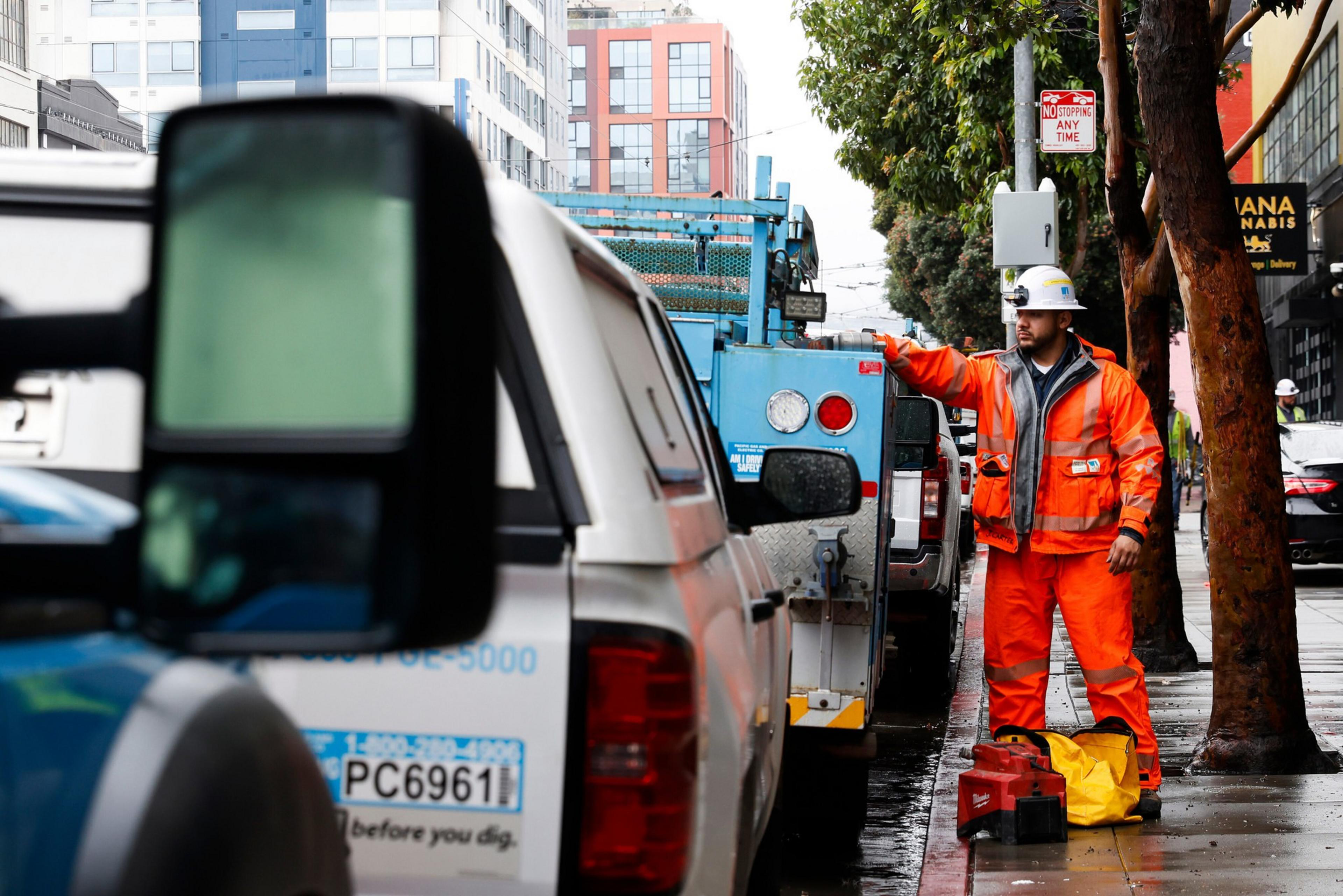 Damage to a substation at 8th and Mission caused power outages across the city in December. | Source: Jessica Christian/SF Chronicle/AP
Should San Francisco decide to go down this path with PG&E again, at least two-thirds of the Board of Supervisors would have to vote in favor of authorizing eminent domain actions. If a purchase agreement cannot be reached with the property owner — as is likely in the case of PG&E — then the city would have to file a lawsuit to establish its justification.
To force a sale, the city would have to prove the necessity of such an action in court and pay PG&E fair market value for its assets and loss of business. The property owner can contest or dispute any findings made by the city in the trial.
Independent of Wiener’s legislation, the California Supreme Court this year will take up the significant case of Town of Apple Valley v. Liberty Utilities, (opens in new tab) which could determine whether public agencies get more deference in courts when citing their findings and appraisals.
Advocates for acquiring PG&E’s assets say the city could finance the transaction by selling bonds to investors who would be repaid over time with revenue derived from customers paying their electric bills.