
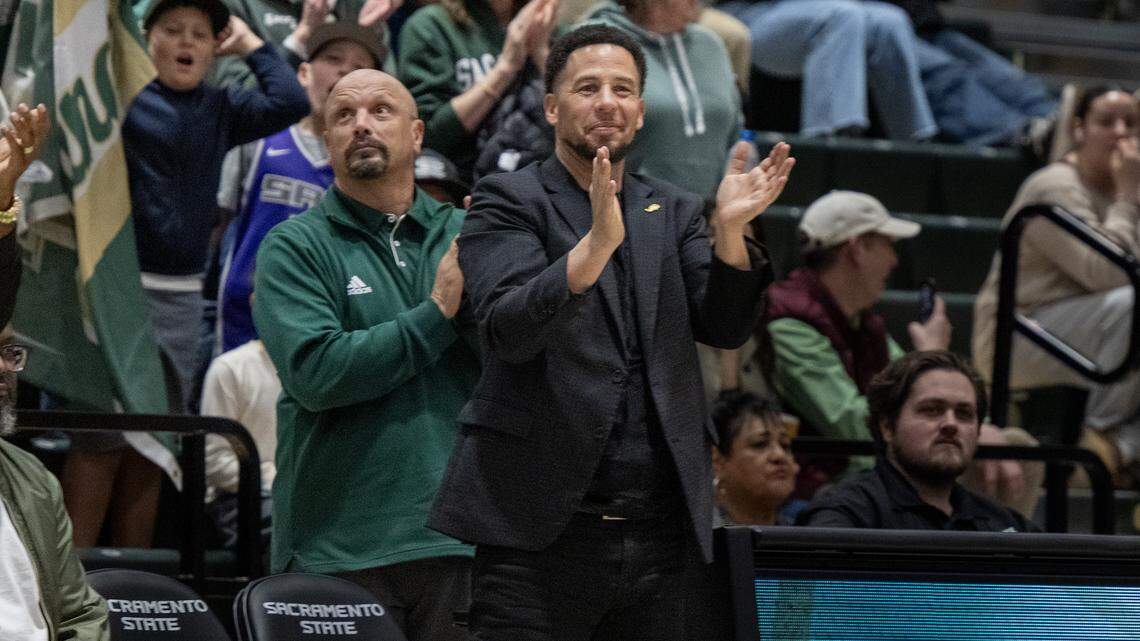
Sacramento State President Luke Wood celebrates the victory over the Northern Arizona Lumberjacks on Thursday, Jan. 15, 2026, in Sacramento. The university’s yet-to-be-disclosed deal to join the Mid-American Conference for football raises numerous questions.
JOSÉ LUIS VILLEGAS
jvillegas@sacbee.com
Sacramento State has finally made it to college football’s elite level, the Football Bowl Subdivision, but only after reportedly agreeing to pay a huge price: $23 million.
So many questions linger about the deal the university made with the Mid-American Conference. That is because the university has chosen to remain silent about many of the details. Simply put, there are many more questions than answers about what university President Luke Wood and Sac State just did.
Here are five reasons why the public should be skeptical:
Sac State is slow to provide the details
Wood’s agreement with the MAC is a public document for this public university, a formal agreement between this institution and another.
Yet, to our knowledge, nobody has been allowed to see it yet.
The university’s news release mentions an external economic analysis of this pact, which estimates tens of millions of dollars in benefits to the university, including increased exposure and game day revenue. But for now, the analysis remains top secret.
Separately, Wood on social media has said that various analyses are complete on how to convert the horse track and grandstand at Cal Expo into the Hornets’ new stadium. Again, no release of new and important information.
The university delays the inevitable by funneling requests for the documents under the California Public Records Act through a portal process that can take weeks and even months.
How can the institution get a historic deal done, one that changes the trajectory of the university, and not have public information at the ready?
$23 million in fees, and $11 million due soon?
North Dakota State, previously a second-tier team like Sacramento State in the Football Championship Subdivision, recently worked out a similar deal as Sac State to climb into the FBS. The Bison reportedly agreed to pay $12 million to join an FBS conference, the Mountain West.
The MAC apparently is requiring an all-too-willing Sacramento State to pay 50% more, $18 million. If you factor in the $5 million fee levied by the National Collegiate Athletic Association, the total tab hits $23 million.
Of the $18 million due to the MAC, $6 million is due this year. So is the $5 million due to the NCAA.
That’s $11 million in new university costs for this year. Where is this money going to come from?
In interviews with select media outlets since the MAC announcement, Wood predicts no red ink for the football program and goes a big step further about profits from the entire athletics department. “We’ll be one of the few … athletic departments in the country that actually generates revenue rather than bleeds revenue,” he told Front Office Sports News last week.
Again, we’d like to see the documents that back this up.
Surrendering away-game payments
For lesser FBS teams like Sacramento State, a tried-and-true way to make some money is to play a superior team from another conference on the road. In exchange for the likely victory, the home team pays a so-called “guarantee” to the visiting team, often an amount exceeding $1 million.
Normally, this is an important revenue source for a college football team to offset expenses. Not for Sacramento State, however.
The Hornets have agreed to pay off the $12 million balance of that $18 million entrance fee to the MAC with these guarantees. This appears to be a first in college football history: a team volunteering to give up this key revenue source. It only adds to the mystery of how the university can afford what it’s doing.
Paying MAC teams to travel to Sacramento
On top of all these millions in new entrance payments, there is another new cost.
As yet another price of admission into the MAC, Sac State is apparently on the hook to pay the full travel costs of visiting teams, unfamiliar names in these parts like the Akron Zips, Central Michigan Chippewas and Kent State Golden Flashes.
These costs for a single game routinely run into the hundreds of thousands of dollars.
Where is the campus support?
In all the testimonials gathered by the university to support the Feb. 16 announcement, there was an abundance of elected officials, alumni and business leaders.
Conspicuously missing were any current student leaders or faculty members.
The last time Wood tried to raise a campus fee last year, students rejected it. This is not the most activist student body in the history of higher education, but that vote was a pretty public rejection of the president’s plan.
Student fees and state education funds are the financial backstops for this university. The silence by campus leadership upon this announcement was deafening.
Wood wants us to believe there are only upsides to spending all this money and giving up all this football revenue. If he’s right, he needs to heed the advice offered in the famed football movie “Jerry Maguire.” Show the public the money … and release all the documents with the fine print.
Until then, it’s hard to get excited about weeknight gridiron matchup pitting Sac State against the Toledo Rockets.
Related Stories from Sacramento Bee

Tom Philp is a Pulitzer Prize-winning editorial writer and columnist who returned to The Sacramento Bee in 2023 after working in government for 16 years. Philp had previously written for The Bee from 1991 to 2007. He is a native Californian and a graduate of the Medill School of Journalism at Northwestern University.
LeBron Hill is an opinion writer for The Sacramento Bee and a member of its Editorial Board. He is a native of Tennessee, with stops at The Tennessean in Nashville and the Chattanooga Times Free Press. LeBron enjoys writing about politics, culture and education, among other topics.