
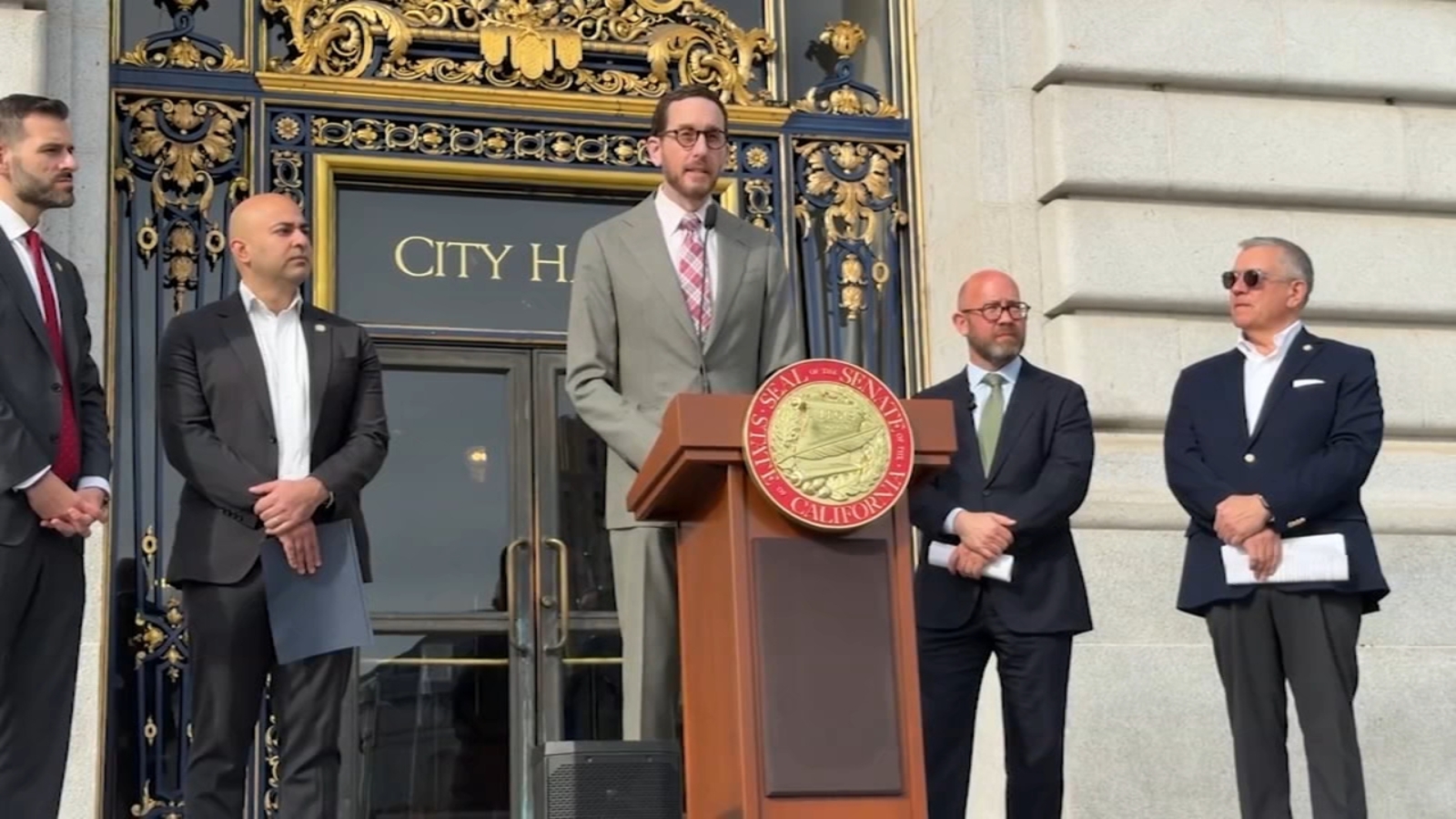
SAN FRANCISCO (KGO) — California Senator Scott Wiener says his latest bill would help cities sever ties with PG&E.
Sen. Wiener is calling it the “Breakup Bill,” which would ease the burden of proof required for San Francisco to justify its switch from a private to publicly owned utility.
“We are done, and it is time for San Francisco to break up with PG&E,” Wiener said Monday.
Wiener took to the steps of San Francisco City Hall to introduce SB 875.
MORE: SF supervisors grill PG&E officials about mass outage last December, demanding accountability
“It is time for California to get serious about giving San Francisco and other cities the ability to make that breakup a reality, to actually be able to make that decision, and that is what this legislation will do,” he said.
At his Monday press briefing, Wiener said this comes after the series of blackouts starting in December. He also criticized PG&E’s maintenance and customer rates.
Conversations around public power have gone back decades; in recent years, the San Francisco Public Utilities Commission made offers to PG&E that were refused in 2019.
Another proposal was made by the city in 2020, and that was also declined.
Wiener said his legislation would allow cities to use eminent domain, an option he says is virtually impossible right now.
MORE: SF nearly had its own power grid 100 years ago until PG&E came along. Here’s what happened
Imagine San Francisco owning its power system. It almost happened 100 years ago. Now there is a push to finish what the city started and save customers money by purchasing PG&E’s grid.
“Normally, government can exercise eminent domain under long established standards that have been around for the history of California,” he said. “The utilities have put poison pills in to say, in addition to all that, you have to do a bunch of other things that make it unbelievably hard and allow the utilities to just drag out the process and make it overly complicated and at times, potentially impossible to actually be able to do the eminent domain, whether through the CPUC or in court,” he said.
PG&E released a statement that said:
PG&E has had the privilege of serving the residents of Northern and Central California for more than 100 years, and we remain committed to serving them for many years to come. Government takeovers of parts of our grid would not make customer energy bills less expensive.
San Francisco has dramatically underpriced the value of PG&E’s electric system, suggesting that the assets in San Francisco are worth only about $2-$3 billion. Not only is that a lowball amount, but the California Public Utilities Commission (CPUC) has been clear that the City and County of San Francisco (CCSF) would have to pay far more than the value of the assets, which means a takeover will drive customers’ rates up, not lower them.
Specifically, the CPUC determined that over and above the fair market value of any PG&E assets that it wants to take, San Francisco would also have to pay PG&E to rebuild its system after the separation and make all customers whole. This means that:
San Francisco will have to pay not only the fair market value for any PG&E assets it wants to acquire, but also cover two major additional costs. First, San Francisco would be responsible for all expenses to separate its system from PG&E’s, including building new substations and lines to ensure PG&E can continue serving its remaining customers. For example, if San Francisco takes over PG&E’s Martin substation, it would have to pay for PG&E to construct completely new infrastructure to maintain reliable service in San Francisco and San Mateo Counties.
San Francisco would also owe PG&E business severance damages-these are critical state policy charges that cover costs such as wildfire mitigation and support low-income customers. Current PG&E customers pay these charges, and CCSF would be responsible for them to make sure that these costs are not unfairly shifted onto those customers who continue to receive electric service from PG&E. If these costs are ignored, PG&E’s remaining customers are left paying more.
At PG&E, we’re focused on real solutions for driving down costs. In January 2026, PG&E dropped prices for the fourth time in two years. Residential electric prices are now 11% lower than they were in January 2024, for customers who get both energy supply and delivery from PG&E. An average customer using 500 kWh of usage per month is paying about $20 less for their monthly bill. By working smarter and modernizing our processes, we’ve also reduced costs for customers by $3.5 billion over four years, enabling us to do more work for customers and use the savings to help offset the costs of some of that work.
Wiener said he’s calling for the process to determine the value to be completed, but he said PG&E has, for years drawn out the CPUC process to find out the value.
Now that the bill introduced, it will be referred to committees.
Wiener said the first hearing of the bill could happen sometime in the Spring. If it moves through, it will have to be sent to the governor by the end of August.

Copyright © 2026 KGO-TV. All Rights Reserved.