
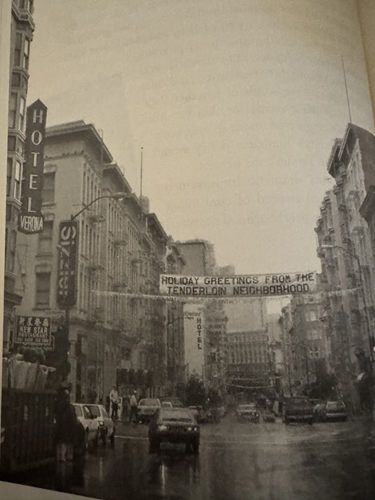
The Tenderloin Circa 1990
Has Anything Changed?
“I think since 1985, when I chaired this big crime march, that the Planning Coalition should be more involved in this issue. Because my experience is that people of every economic level in this neighborhood, that’s their big concern.” Randy Shaw, interviewed by Morry Hermon, November 8, 1990.
Going through boxes I recently found a 17-page interview I did with Hermon, who was getting a masters in planning and spent a year in the Tenderloin. I found remarkable similarities between the Tenderloin of 35 years ago and today.
While the Tenderloin has more housing, new parks, and a different blend of retail since 1990, the neighborhood’s top priorities are unchanged: public safety and economic development.
Unlike the Mission, SOMA, Potrero Hill and arguably every San Francisco neighborhood other than Chinatown, the Tenderloin never gentrified. It remains San Francisco’s densest neighborhood for families with children. It’s mix of immigrant families now includes vastly more Latinos and Arab-Americans and fewer Southeast Asians. But it remains a neighborhood of immigrant families, low-income and working people, and those on disability or public assistance.
Economic Challenges
In 1990 I felt the Tenderloin needed a combination of neighborhood serving businesses and those that served tourists and outsiders. I told Hermon that “We certainly can’t have businesses which can survive in an area where people have no money.”
I entered the Tenderloin in 1980. We were soon fighting three luxury tourist hotels and the potential touristification of the neighborhood. We didn’t want the Tenderloin’s fate to follow that of Powell Street, where tourists came to outnumber residents. But the Tenderloin desperately needs tourist revenue. I’m glad that I recognized that by 1990.
It took roughly 25 more years for the Tenderloin to achieve this balance between resident and outsider support for businesses. By 2015 we finally had enough popular evening venues to attract outsiders. Why did this finally happen? Mayor Ed Lee (2011-17) loved the Tenderloin and went all in on helping it.
I told Hermon 35 years ago, “The most important thing is that the mayor must do something for this neighborhood. If the mayor of San Francisco wants this to happen, they can do it. We need the mayor’s office to give us economic development assistance and to help improve the business environment. The Tenderloin hasn’t gotten a dime in economic assistance from the city in ten years. We desperately need help. We need the mayor’s office to take an incredibly active role.”
Ed Lee became the mayor that took that incredibly active role. The Tenderloin prospered.
Many forget the Tenderloin was making steady progress until it was erased by COVID. And then set back by Mayor Breed’s responding to the pandemic by turning the Tenderloin into a drug containment zone.
The 1990 Tenderloin also faced City Hall retrenchment. I told Hermon, “The problem is that people thought the Tenderloin was turning around. The government practiced benign neglect saying all these Asian immigrants were starting businesses and turning things around. And obviously things didn’t work.”
The Sizzler under the Cadillac Hotel, opened to great fanfare in 1986 but closed a few years after my interview. As I describe in my updated book on the Tenderloin’s history, the Sizzler’s closure reflected City Hall’s larger betrayal of the neighborhood.
A Lot More Housing
“We will see a number of new housing projects in the Tenderloin for the simple reason that every other neighborhood in the city fights it. Non-profits can’t even build housing in Bernal Heights anymore without a fuss. We’re the only neighborhood who says ‘build all you like, we like it.’”
The Tenderloin’s high percentage of non-profit housing units helps explain how it escaped gentrification. My interview reminded me that those of us seeking longterm affordability for the Tenderloin benefited from the city’s prevailing NIMBYism. Nonprofits often built in the Tenderloin because they faced neighborhood opposition almost everywhere else. It’s why the city now needs to spend its affordable housing money in the many parts of the city that lack it.
A Tight-Knit Community
Despite its problems, the Tenderloin has remained an unusually tight-knit community. I often hear from people who once worked in the neighborhood who positively look back on their time. It’s not every neighborhood where you run into someone you know whenever you go out. This community cohesion has kept people going through difficult times.
Cadillac Hotel owner Kathy Looper reminds me that holiday decorations used to go up and down Eddy street. The banner shown in the photo would have become an annual installation but insurance companies demanded a huge fee to display it.
I’ve described 2026 as a make or break year for the Tenderloin (See “A Tenderloin Tipping Point in 2026?“). Residents and businesses are working hard to get the Tenderloin back on track.
But as I argued in 1990, the ball is ultimately in City Hall’s court.
Read about the Tenderloin’s rich history through the present in Randy Shaw’s updated new book, The Tenderloin: Sex, Crime and Resistance in the Heart of San Francisco.

Randy Shaw is the Editor of Beyond Chron and the Director of San Francisco’s Tenderloin Housing Clinic, which publishes Beyond Chron. Shaw’s new book is the revised and updated, The Tenderloin: Sex, Crime and Resistance in the Heart of San Francisco. His prior books include Generation Priced Out: Who Gets to Live in the New Urban America. The Activist’s Handbook: Winning Social Change in the 21st Century, and Beyond the Fields: Cesar Chavez, the UFW and the Struggle for Justice in the 21st Century.