
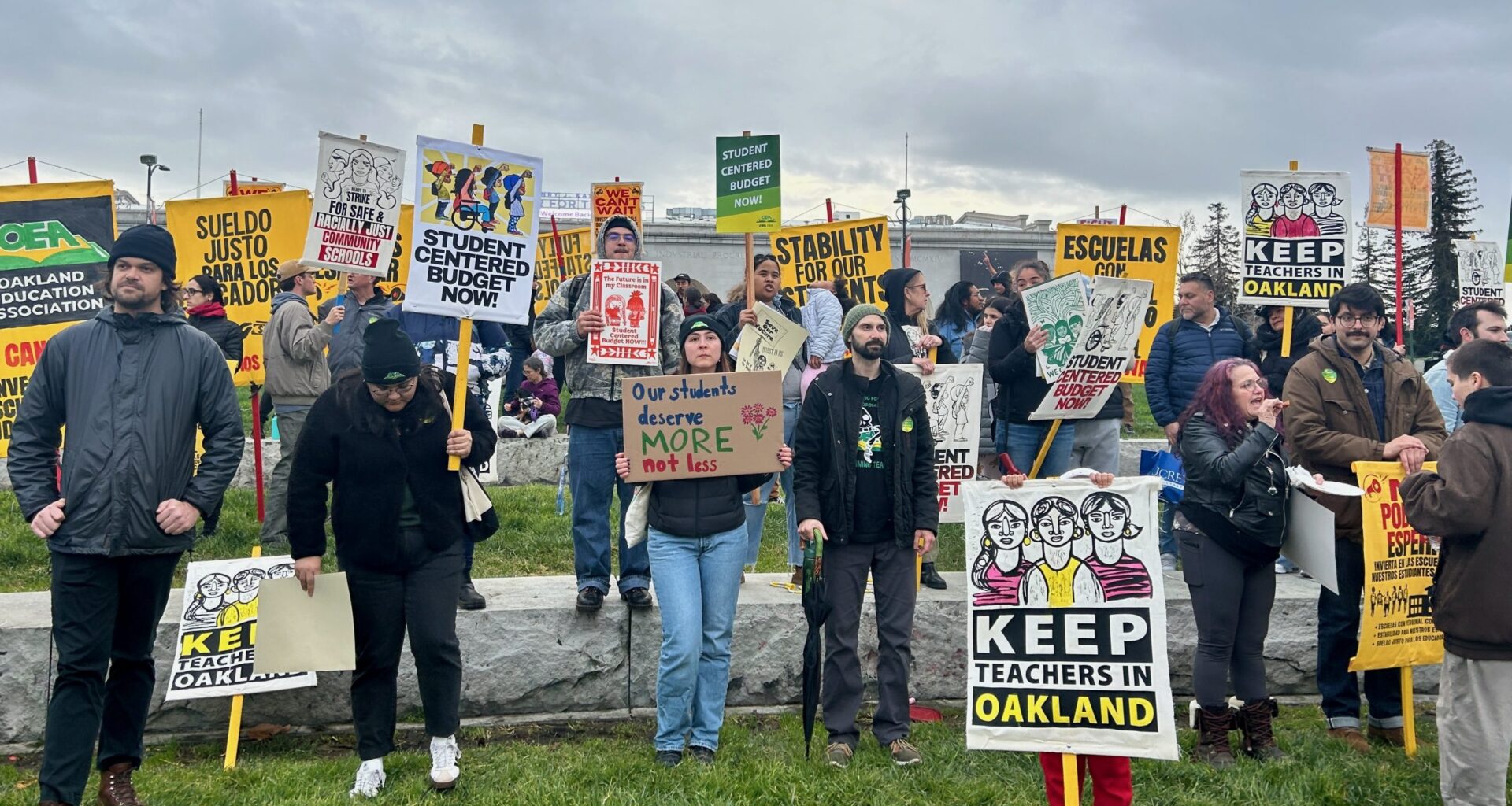
The Oakland teachers union could walk off the job as soon as this week after members voted to authorize a strike on Friday following nearly a year of contract negotiations with the Oakland Unified School District.
Tuesday would be the earliest day that the teachers union, the Oakland Education Association, could call a strike, or two days after the close of the strike authorization voting period. The union would have to give 48 hours notice of a walkout.
The strike vote was a blowout. Out of about 2,600 members, 2,328 cast a vote and 91% voted yes.
If teachers walk out, it would be the third open-ended strike since 2019. The union also held a one-day strike over school closures in 2022. Last year, OEA planned a one-day strike for May 1 but called it off the day before.
Negotiations with OUSD have been stalled since November, when the district and the union reached an impasse. After a mediation stage did not yield a deal, negotiations moved to a fact-finding phase by a panel including an impartial chairperson plus one representative from each side. The report, written by the neutral, state-appointed fact-finder, Cheryl Stevens of the Oakland-based Stevens Arbitration, analyzed disputes around pay, class size, and the district’s reliance on contractors.
The report recommended that the district offer a 9 to 10% raise over two years, with an additional 2% for special education teachers, and cap class sizes at 22 children for kindergarten and first grade. The district estimates that each 1% in raises costs the district $5 million, so the compensation package alone would cost around $50 million.
The district released a statement on Friday saying OUSD is still working to come to an agreement with OEA. John Sasaki, the district spokesperson, pointed to the Friday statement when asked for comment.
“The district has been trying to come to terms that honor OUSD educators for the work they do every day in service of our students, while at the same time staying within our means because of the very real financial challenges with which the district is currently contending,” the district’s statement said.
A $102 million deficit, with a recommendation for raises
The OEA and OUSD began contract negotiations in March of last year, ahead of the previous contract expiring in July 2025. The union asked for a 14% raise over two years that would be frontloaded for the most senior educators. OEA also proposed smaller class sizes in the earliest grades, which leaders said was crucial to improving students’ academic outcomes.
Prior to fact-finding, OUSD had offered a 0% increase to teachers, claiming that in order to maintain fiscal solvency, it could not afford any raises.
Denise Saddler, the interim superintendent, has said the district needs to cut $102 million in expenses out of next year’s budget. Over the last two months, the district’s fiscal advisors have identified around $50 million of reductions toward that goal — primarily relying on $32 million in cuts to the central office staff — and have to identify further cuts, which will likely go deep into school site budgets, to close the remaining $50 million gap.
That first round of cuts are a step in the right direction, said Kampala Taiz-Rancifer, the OEA’s president.
“In the first three weeks, they found $50 million,” she told The Oaklandside. “Great, there’s more there. We want them to go back and continue with their analysis.”
During the fact-finding stage, OUSD raised its raise offer from zero to 6.5% to 8% over two years (with the 8% raise reserved for the most senior teachers), plus a 2% one-time bonus totaling about $5 million.
Stevens, the fact finder, found that the district could not afford OEA’s full wage demands and still retain its required minimum of 3% in reserves. But she found that the district’s offer “will not improve OUSD’s standing when compared to…neighboring districts” and won’t allow teachers to keep up with rising costs of living in the Bay Area.
The fact-finding report noted that due to declining enrollment, the district’s revenues have decreased from year to year. During the 2024-2025 school year, OUSD received $9 million less in state funding than it did the previous school year. Spending exceeded revenues by more than $61 million that school year, causing the district to deplete more than half of its reserves. The report clarifies that OUSD cannot use its reserves to pay for raises.
The report acknowledged the district’s financial stabilization plan, which has so far identified around $50 million in cuts for next year. The report found that the district could budget for a 10% raise over two years by decreasing spending on consultant contracts.
The lowest pay in Alameda County
First-year teachers in OUSD currently start out at $62,695; mid-career teachers earn $82,716; and the most senior teachers, after 24 years, can earn as much as $109,878. In the 2024-2025 school year, the most recent school year for which state data is available, the average OUSD teacher earned $84,127, the lowest average wage of all Alameda County districts. OUSD’s top earners rank second from the bottom in pay in Alameda County.
OUSD does pay the full health insurance costs for staff and dependents, which has been a flashpoint in other Bay Area union and district negotiations.
Union leaders say their proposals are crucial to retaining teachers. OUSD’s teacher retention rate is around 83%, meaning 17% of teachers leave their roles each year. Between the 2024-2025 and 2025-2026 school years, more than 400 teachers out of about 2,400 left their jobs. The cost of replacing that many teachers is around $7.5 million, according to the Learning Policy Institute.
“That kind of instability impacts our ability to provide instruction,” Taiz-Rancifer told The Oaklandside. “We have low wages that make people leave to other districts that actually are able to provide better wages.”
Turnover among teachers early in their careers is especially pronounced, she said. Nearly one in three educators who were in their first or second year of teaching last year did not return to teach in OUSD this year, according to district data.
To avert a strike, OEA leaders said OUSD would need to invest in increasing wages, reducing class sizes, and allocating more prep time for teachers.
“These are structural issues,” Taiz-Rancifer said. “There is structural dysfunction in the way OUSD budgets and that has to get fixed. If we really want to improve outcomes for kids, they have to take that on.”
“*” indicates required fields