

If the near-constant warnings about a doom loop of BART station closures and deep cuts to Muni service have you on edge (opens in new tab), well, that’s part of the plan.
A life preserver for the two agencies —as well as 10 other Bay Area public transit operators — is in the hands of the public. In November, voters will decide on a regional sales tax measure that would raise funds to close severe transit budget shortfalls due to a lagging post-pandemic recovery.
The masterminds of the campaign, known as Connect Bay Area, have centered on a clear strategy to encourage taxpayers to pull the lever: scare the crap out of them. It’s intense but effective. Political experts say campaigns that lean hard on the worst-case scenario can be extremely persuasive if the stakes are high enough. Here, the threat is stark: Without new revenue, transit agencies face deep cuts — or even complete closure.
Similarly, last year’s Proposition 50 campaign leaned on grave warnings (opens in new tab) that congressional district lines must be redrawn to prevent them from further entrenching right-wing power and hamstringing Democrats in upcoming elections.
BART is particularly screwed. The agency faces a roughly $350 million budget deficit in the next fiscal year and has warned that if it doesn’t get a windfall of cash, it will likely have to close 10 stations by January and five more by July 2027. While it has secured a $590 million loan (opens in new tab) from the state, it can spend the money only if the tax measure passes, since the revenue will be used to pay back the loan.
If it can’t safely run a scaled-back train system with 15 closed stations, the agency warns, BART service could cease altogether within two years (opens in new tab).
“That isn’t political messaging; it’s budget balancing facts,” BART spokesperson Alicia Trost said.
While it is legal for BART to endorse ballot measures, the SFMTA cannot under city policy, according to the City Attorney’s office. However, both can share information about dire financial realities. BART has raised public awareness about what could happen if the measure fails through social media posts, public hearings, and news coverage.
During a public meeting, BART staff described to the board of directors what would be needed to balance the shrunken budget: massive service cuts — including eliminating the Blue line — and station closures.
BART directors reacted with alarm.
“The way I see this entire scenario is kind of putting BART on life support,” Barnali Ghosh said.
“It’s been, to put it bluntly, a bummer to contemplate such draconian measures,” said Robert Raburn.
The SFMTA has stopped short of endorsing any ballot measure to fund itself — neither the regional sales tax nor a local parcel tax that is slated to go before San Francisco voters at the same time — but has announced (opens in new tab) the severe consequences of a failure to secure more money. Among the predictions: halving service to some Muni routes while eliminating others, no free Muni for youth, and the elimination of cable cars. “The future of Muni is at stake,” an SFMTA blog post (opens in new tab) reads.
But the fear of doubled commute times, killed lines, and traffic chaos is the point. Think of it as a carrot-and-stick strategy that’s pretty much all stick.
“People react to threats more than rewards,” said political consultant Jim Ross. “Negative messaging is always more powerful than positive messaging.”
Muni has a similar deficit — $307 million — and has taken a similar fire-and-brimstone (opens in new tab) tack, predicting that it will run up to half as many buses or trains on some lines, shut down lines that have low ridership, end cable car service, and operate dirty trains. “Devastating” and “terrifying (opens in new tab)” are among the most popular descriptors of the potential cuts.
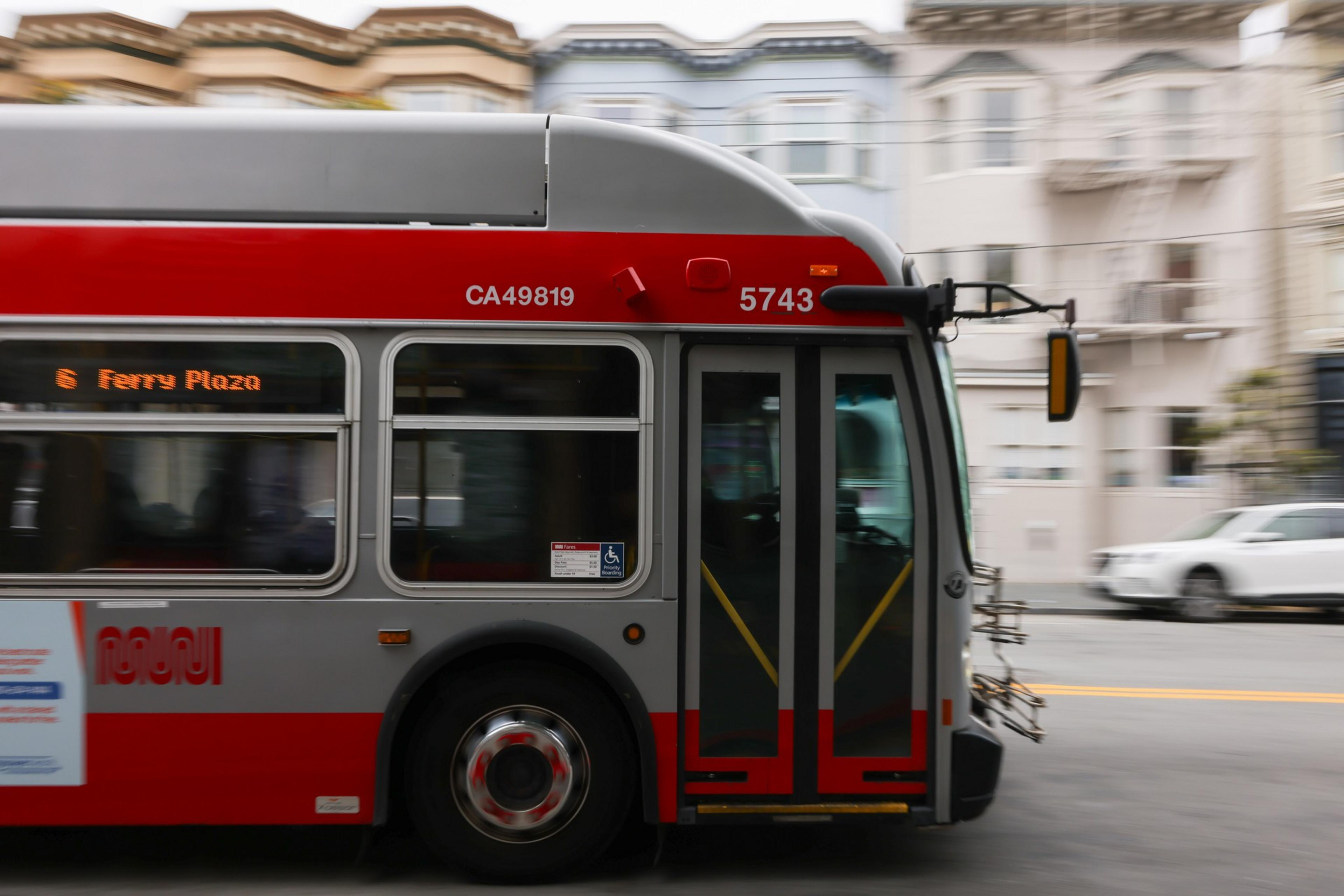 The SFMTA has publicly shared its budget deficit and the need for service cuts to address it. | Source: Jeremy Chen/The Standard
“We have a responsibility to be transparent with our customers and constituents about financial information, impacts, and outcomes as they relate to our budget planning process,” said an SFMTA spokesperson.
Via public meetings and reports, transit agencies can tacitly make the case for why voters should support the ballot measures, without running afoul of laws that prohibit them from campaigning.
“They can lay down the situation to make it easy for the campaign to connect voters to the answer,” said John Whitehurst, a partner at BMWL Public Affairs.
The website of the Connect Bay Area (opens in new tab) campaign, which is in favor of the new sales tax, has banners warning of BART slashing trains from 4,200 a week to 500, 50% Muni service cuts, and Caltrain eliminating weekend trains.
Stoking fears of a BART shutdown is especially effective while recent transit meltdowns are fresh in voters’ minds, Ross said.
Reminding voters what they stand to lose can broaden the message beyond core transit riders to suburban motorists who fear increased congestion.
“They may want to go to a Giants game and not pay $100 for parking,” Ross said.
 BART has warned in public meetings that service cuts, which would be made if a regional tax measure isn’t approved in November, could lead to more congestion. | Source: Paul Kuroda for The Standard
The tax measure’s campaign calls public transportation “the heartbeat of the Bay Area.”
“It’s about the Bay Area, and this is what you’ll lose if it doesn’t pass,” said SF State political scientist Jason McDaniel. “They’re trying to appeal to a broader identity.”
A November poll (opens in new tab) on the regional tax measure from the Metropolitan Transportation Commission found that 58% of respondents agreed with the idea that public transit is important to the Bay Area, versus 47% two years prior. The survey also found that 56% of voters said they’d support the regional measure — more than the simple majority needed for passage.
Political campaign expert Jason Overman said Bay Area voters are generally fatigued by tax measures. But messaging that can break through functions to convince the electorate that the stakes are really that high.
“The campaign’s job is to communicate with voters that this is not a drill,” he said. “Then voters can ask themselves, is this a doomsday situation or not, and do I want to find out?”
Correction: This article has been updated to amend an earlier statement that BART cannot endorse ballot measures.