
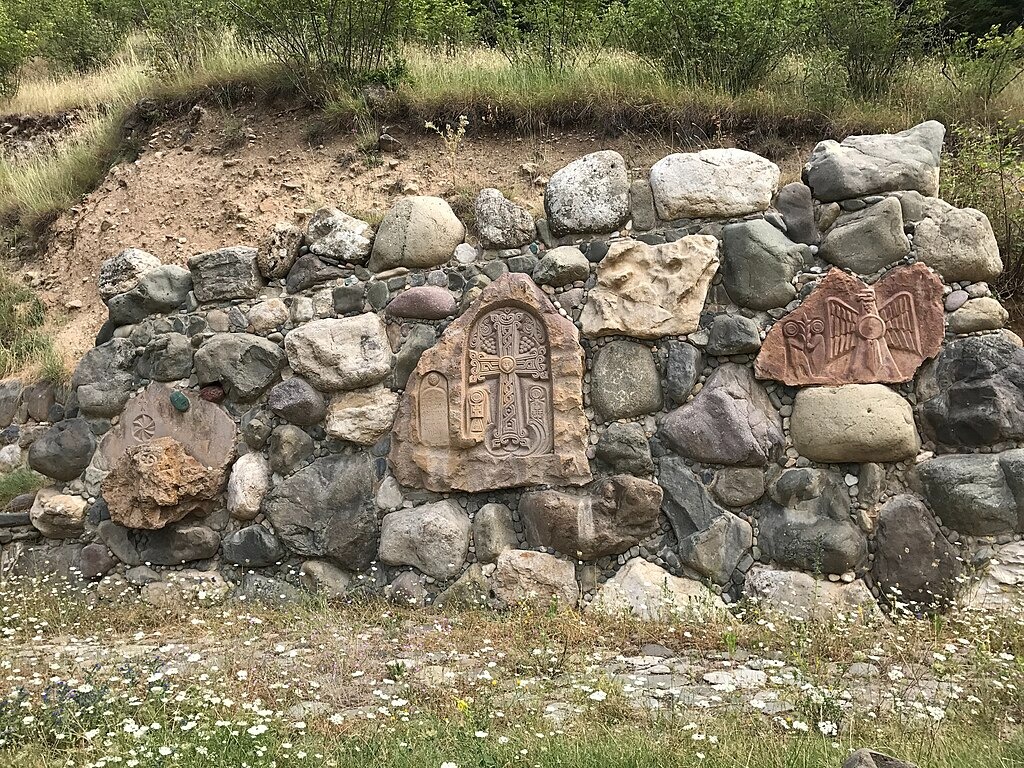
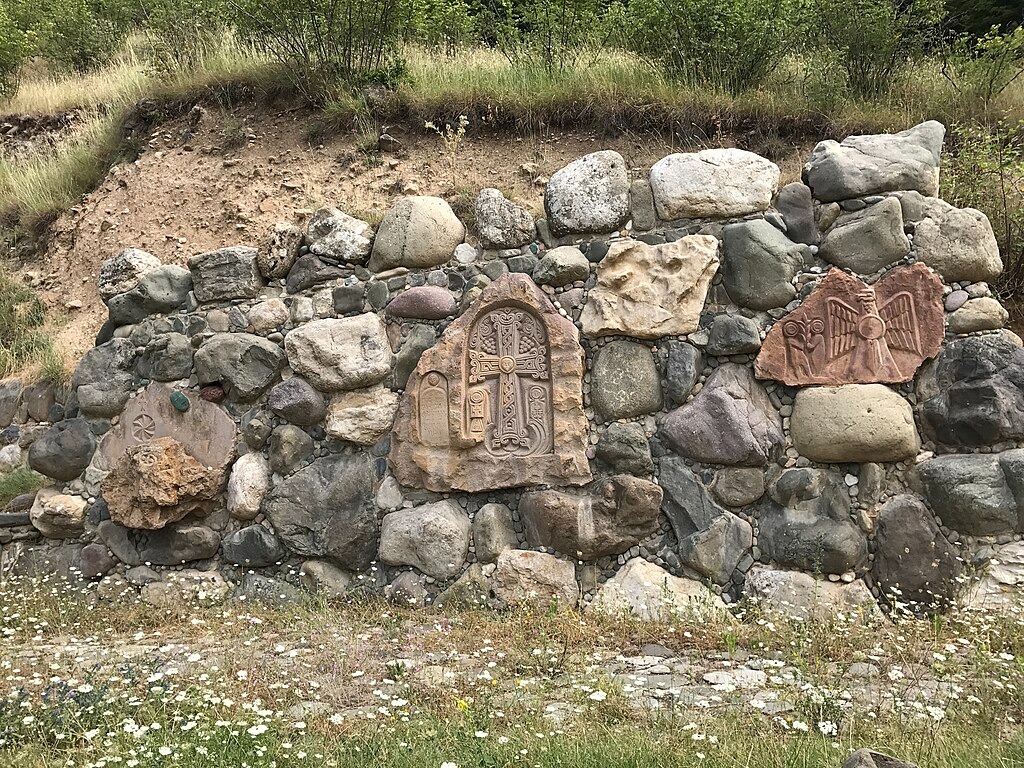
 Khachkars on the edge of North-South Highway in Artsakh. (Photo: WikiCommons)
Los Angeles is home to one of the largest Armenian diasporas in the world, with over 200,000 Armenian residents. Since September 2023, many Armenians in the diaspora have been deeply affected by the recent theft and ethnic cleansing of their homeland.
Azerbaijan’s 2023 ethnic cleansing and invasion of Artsakh, a disputed territory located in the South Caucasus, led to the exodus of an entire population from a land that has been inhabited by Armenians for centuries. Disruption and horror unfolded as hundreds of Armenian families fled their homes, only carrying what they could hold.
On September 19, 2023, Azerbaijan, backed by Turkey, launched a major full-scale attack on Artsakh in order to ethnically cleanse the land of its Armenian population and establish full control. Azerbaijan utilized heavy weaponry, including ballistic missiles, aerial systems, and drone attacks, slaughtering at least 223 Armenians, including 5 children. Following the attack, on September 25, an explosion occurred at a fuel depot near Artsakh’s capital, Stepanakert, as Armenians were refueling their vehicles to flee their homes. This explosion resulted in the killing of another 220 Armenians, 70 of whom were killed while fleeing their homes. Azerbaijan’s onslaught forced hundreds of thousands of ethnic Armenians to flee their homes in fear of death and living under oppressive Azerbaijani rule.
Prior to the attack, Azerbaijan had imposed a blockade on Artsakh for 9 months, enforcing a starvation campaign on the entire population. There were food shortages, electricity was cut off, and no entry was allowed for humanitarian aid to the Armenians of Artsakh, who were experiencing a brutal winter. This was a genocidal tactic intended to drive them out.
In just the span of a week, over 120,000 Armenians were displaced. Tens of thousands of refugees were provided with accommodations in Armenia, but many are still in need of roofs over their heads. Many organizations and scholars regard the events that took place as genocide, including the International Association of Genocide Scholars.
Once Azerbaijan’s attack on Artsakh unfolded, the reaction from the international community was underwhelming. There continues to be little regard for the suffering of Armenians, who till today are dealing with generational trauma of the 1915–1917 genocide committed by Ottoman Turkey, and the most recent offensives from Azerbaijan.
Instead of putting a full stop to this unbearable exodus, President Biden provided $11.5 million in aid in 2023. A United Nations mission also arrived to assist humanitarian needs after the fact, which many Armenians expressed was far too late. According to ABC News, Richard Giragosian, director of the Regional Studies Center stated, “They (The United Nations) didn’t reach Nagorno-Karabakh until well after 99% of the Armenians were driven and forced to flee.”
Coverage of the ethnic cleansing and its aftermath have rarely been discussed, but its lasting physical and psychological effects have devastated the lives of many Armenians, including families of those in the Los Angeles community.
Shant Jaltorossian, an Armenian-American and member of the Armenian Assembly of America’s Los Angeles regional committee, says that the loss of Artsakh deeply affected Armenians everywhere. “The loss of Artsakh psychologically devastated Armenians both here and worldwide, but we remain committed to continuing our cause. We have struggled to make sense of the tragedy, but we are rebuilding to the best of our ability.”
Chloe Mirijanian, an Armenian-American law student at Loyola Marymount University, stated, “I feel like our family has, in many ways, become accustomed to loss — a kind of persistent, generational loss that feels almost normal to us. It’s exhausting, more than anything. And I notice that sadness and fatigue deeply, especially among the older Armenians in our community here in Los Angeles.”
“I worked very closely with three men from Artsakh for two years, starting just after the fall of Artsakh,” said Karena Avedissian, an Iranian-Armenian-American writer who previously lived in Los Angeles. “All three of them lost their homes, friends, and family members, they’re dealing with a whole other level of trauma, and it’s one that’s not even public, even in Armenia. We’ve had conversations about how everyone they know from Artsakh is dealing with insomnia, depression, eating disorders — which we said could be from the 9 month blockade that Azerbaijan imposed, or maybe just another one of these trauma outcomes.”
Avedissian continued, “The pain is always there. If you scratch at it just a little bit, it’s just underneath the surface and it comes out all at once, we are living with this loss constantly. It just becomes such a part of everyday life, it’s like the water fish swim in, you don’t notice it anymore, it’s not healthy. I do worry about what’s happening to us collectively. How does this impact our relationships, our families, what are the long-term cultural effects?”
Before Azerbaijan’s 2023 attack, the most recent large-scale war between the two countries happened on September 27, 2020, where ongoing tensions and fighting on both sides quickly erupted. Things took a sharp turn when Azerbaijan committed a full-scale offensive against Artsakh, which turned into a 44-day war — the longest between the two countries since the 90s.
The capital of Artsakh, Stepanakert, was heavily targeted and bombarded. Azerbaijan advanced, occupying Armenian territory and territory surrounding the Artsakh enclave. Azerbaijan, with unequivocal backing from Turkey, bombed civilian areas in Artsakh, and many reports indicate that the death toll of Armenians rose to over 2700. After over a month of war, Azerbaijan — armed with Israeli weaponry — weakened Armenia. Armenia then surrendered, signing a ceasefire on November 9, 2020. In response, Azerbaijan declared victory.
“I know people who have been killed in the 2020 Artsakh war, and their families displaced,” said Avedissian. “The particular village I had lived in after the Azerbaijani takeover was completely razed to the ground, destroyed by bulldozers — it doesn’t exist anymore.”
Natalie Kamajian, an Armenian-American PhD student at UCLA and the founder and co-director of an Armenian dance and music ensemble collective, expressed how much things have changed since the theft of Artsakh. “I have so many stories of us dropping everything and going to Armenia to help bring supplies from the US because Armenia is landlocked and it’s just so difficult to get things into Armenia,” she said. “We were in this very grassroots volunteer network of people — buying our tickets to upgrade us so we can fit the seven suitcases of stuff to fit with us. All of that was so beautiful and amazing. I said to myself, ‘wow!’”
She continued, “I felt so proud to be Armenian — that everyone was coming together in such a strong and powerful way, to do the little bit that they could. And then Artsakh fell. After that it was total loss, total helplessness, and hopelessness.”
According to Armenian national assembly member Tadevos Avetisyan, the aftermath of the ethnic cleansing resulted in over $50 billion in damages and economic loss. This loss is reflected in the destruction of productive agricultural lands, the closure or destruction of businesses and factories, and the loss of natural resources and utilities. Under Azerbaijan’s blockade, Artsakh suffered economic losses of about $1.9 million per day.
Not long after Azerbaijan’s ethnic cleansing campaign, a whirlwind of violence erupted within the region. Jaltorossian reflected on the solidarity that expanded outside the Armenian community, stating, “Shortly after the expulsion of Armenians from Artsakh, Israel’s assault on Gaza formed a stronger bond between Armenians and Palestinians — this linking of struggles has been empowering to previously isolated communities.”
“It’s been beautiful to see Palestinians show up for us as well, sharing information, calling representatives, and protesting in solidarity,” said Mirijanian. “I’ve heard stories about Palestinian families who took in Armenian orphans after the 1915 genocide. To see that same solidarity returned over a hundred years later, even amid their own struggle, speaks to a shared resilience and understanding between our peoples.”
I asked whether the ethnic cleansing of Artsakh has united or divided Armenians. “I think it’s done both,” said Kamajian. “I think because Armenians are extremely divided right now, when it comes to the Pashinyan regime, and how Armenians are now in a post-ethnic-cleansing state … there [are] a lot of people who are very pro-Pashinyan until the day they die, and there are a lot of people who were always very skeptical and considered him to be a CIA agent, and then there are some people who recently kind of realized that this has to be like a planned capitulation or else it doesn’t make sense.”
Kamajian continues, “On one hand there is the total division of Armenians about this issue, which leads to a lot of paralysis on how to move forward because we can’t even trust our own government. But then on a positive note, I think it has actually made a lot of Armenians see things from a larger global geopolitical standpoint and see how it’s all interconnected to Israel’s role in the region [and] the suffering of Palestinians. I think that has united Armenians together around that notion, but also other groups.”
Mirijanian reflected on the growing solidarity she’s witnessed after September 19, saying, “The solidarity I’ve seen has been especially powerful from Armenians who might not fit older generations’ standards of being ‘Armenian enough.’ Despite sometimes facing criticism, they [younger Armenian generations] continued to show up with compassion, commitment, and love. They organized drives, donated, and traveled to help on the ground, often doing more than anyone else.”
As many activist spaces continue to hold space to discuss and educate individuals about the many atrocities happening around the world, many Armenians feel that Artsakh is almost always forgotten. Kamajian said, “I feel no one really talks about Artsakh anymore. We have so many political prisoners still held illegally by Azerbaijan. I don’t want to undermine the important work people are doing, but it’s just not the same.”
The preservation of Artsakh has become increasingly urgent, as Azerbaijan continues to steal, destroy, and claim Armenian culture and heritage. Education and resources on Artsakh and its ancient history are very limited, much of it mostly being written in Russian or an Artsakh dialect of Armenian. Kamajian explained, “There is a lot of scholarly appropriation, very pro-Azerbaijani writing, that has skewed a lot of research — there is an absence of Artsakh, I cannot really speak to an exact reason, I think because Artsakh has always been this de facto region that you can only reach by going through Armenia.”
She added, “You can’t be a non-Armenian speaker and research Armenian culture — it’s really hard, it has remained as a really tight-knit and strong oral-history and transmission-based culture.”
When asked how the Armenian diaspora in LA and allies can continue the fight for the liberation of Artsakh, Jaltorossian said, “The Armenians of Los Angeles and its allies should press their government officials to demand a more forceful foreign police in support of Artsakh’s Armenians. There should be an open dialogue among local Armenian and allied groups about changing conditions and needs.”
Kamajian gave examples of ways to increase awareness of Artsakh’s current and past history, including, “inviting Armenian speakers at cross solidarity vigils, bringing in the Artsakh issue as we’re talking about the genocide in Palestine, Sudan, and Congo, and bringing in actual Armenian voices to organizing spaces.”
Mirijanian said that, to help Artsakh Armenians today, allies should, “Learn about the history of Armenia and Artsakh. Don’t rely on stereotypes. Form your own understanding through real relationships with Armenians in your community. And if you’re able, support organizations like Children of Armenia Fund, AGBU initiatives such as Artsakh Relief or Camp Nairi, the Artsakh Relief Fund from the Society for Orphaned Armenian Relief, Artsakh Support Funds, and All for Armenia. Many Artsakh Armenians are now refugees and homeless in Armenia. They need support.”
After the ethnic cleansing of Artsakh, a very small minority of Armenians stayed behind: about 14–20 ethnic Armenians, a majority of them being sick and disabled and unwilling or unable to abandon their homes after the Azerbaijani invasion. As of January 2026, 11 remaining Armenians have been transferred from occupied Artsakh to Armenia; Azerbaijani officials claim it was upon their “written requests.”
It has now been over 2 years since the ethnic cleansing of Artsakh, however it has not erased the fight for liberation and the eternal hope for return. Artsakh remains an obligation amongst Armenians worldwide. As the Armenians of Los Angeles continue to mourn the loss of their homeland, the fight for the return of Artsakh remains unwavering.
Related