
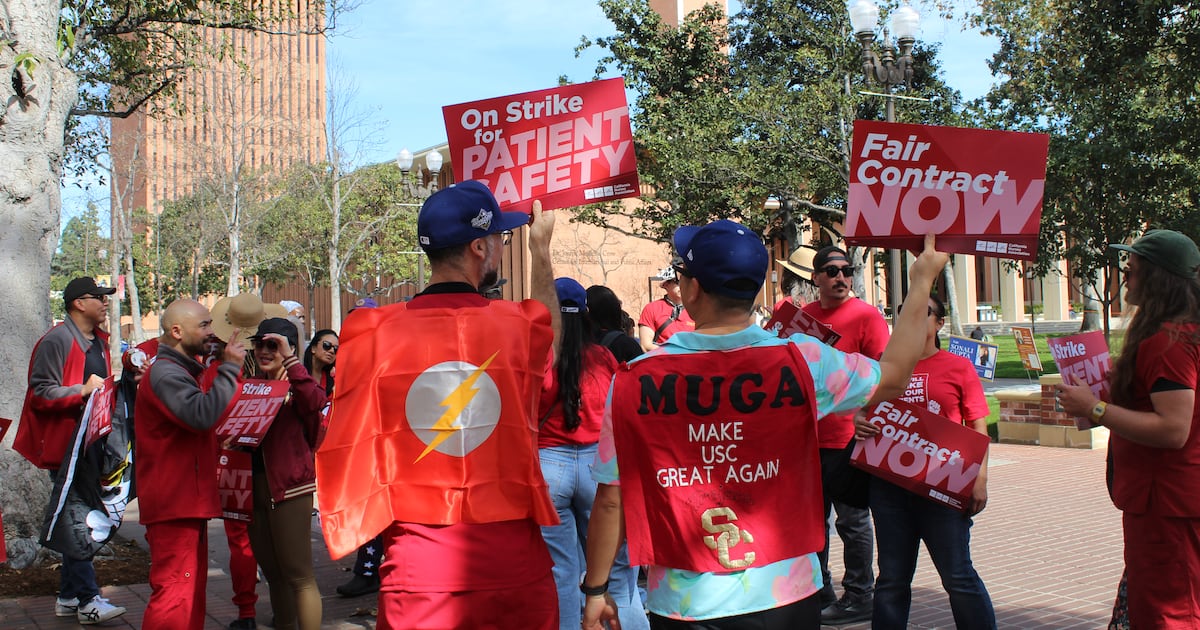
After months of contract negotiations and amid silence from the university, dozens of unionized Keck Hospital and Norris Cancer Center nurses gathered outside the Tommy Trojan statue on Monday afternoon, demanding that President Beong-Soo Kim and other USC administrators address their concerns about changes to their health care plans.
“We are the nurses, the mighty, mighty nurses, fighting for our health care,” demonstrators chanted in unison.
More than 2,000 nurses took to the picket line on Feb. 19, beginning a seven-day strike over USC’s proposal to “restructure employee health care plans,” which will push nurses towards USC providers, according to a press release by the California Nurses Association. Nurses are set to remain on strike until 6:59 a.m. on Thursday, Feb. 26.
“[Registered Nurses] warn the introduction of hundreds of RNs and their families to USC facilities will overload an already strained network, leading to longer wait times and delayed care for both employees and existing patients,” the press release said.
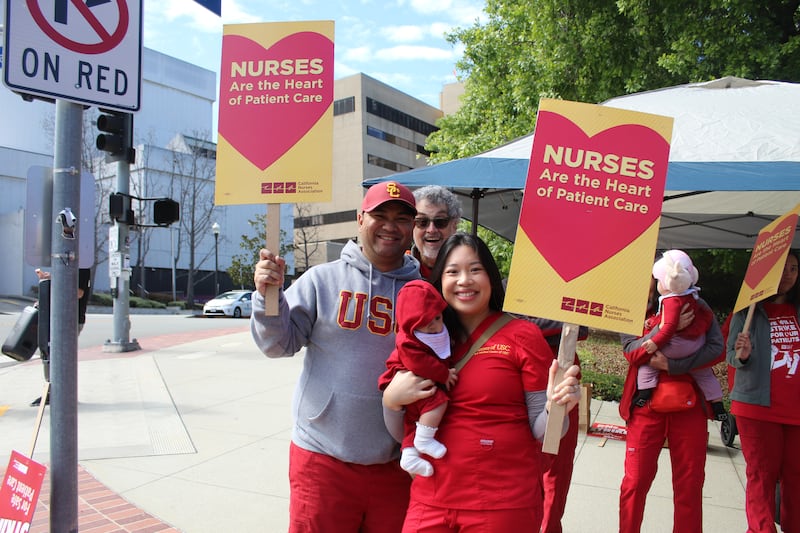 Nurses taking to the picket line on Feb. 19, 2026 (Photo by Senna Ihab Omar)
Negotiated by nurses during the 2021 collective bargaining agreement, the EPO Select was a free, premium insurance plan available to the Keck Hospital National Union of Healthcare Workers.
This year, the HMO has been completely restructured.
“A new EPO Select plan, a no-premium plan, is available to some union-represented employees of the health system as part of their ratified contracts,” Keck Medicine said in a statement to Annenberg Media.
Kerri Dodgens, an ICU nurse and the union’s chief nurse representative, said that in the past, nurses were offered a free premium HMO plan through Anthem Blue Cross, which provided comprehensive care to nurses and their families across health care departments.
This year, nurses were not offered the Anthem HMO plan and instead will have access to benefits similar to those of the USC EPO. Tier 1 care is limited to Keck Medicine of USC providers, and Tier 2 includes additional providers from the Anthem network. Now that network excludes major, top-tier hospitals in the area where many USC employees and their families previously received care. Those exclusions include USC Keck competitors such as: UCLA, UC Irvine, City of Hope, Cedars-Sinai Medical Center, Cedars-affiliated Huntington Hospital and Torrance Memorial Hospital.
“If people choose a Tier 1 provider, they do have a lower out-of-pocket cost,” said USC Chief Campus Health Officer Dr. Sarah Van Orman. However, most nurses who previously used the Anthem HMO network have been cut off from their healthcare providers.
“It’s concerning because I personally have had a very bad experience trying to navigate our primary care,” Dodgens said. “Our system already is broken, and we already have patients leaving our system because wait times to be seen by a doctor are so long. It’s impossible to make an appointment, and it is just a very time-consuming process.”
After gathering outside Bovard Auditorium and attempting to speak with Kim, nurses were told by DPS officers outside that the university president was not available. In response, they chanted, “We’ll be back, we’ll be back,” before returning to Keck Hospital, the original strike location.
Since negotiations for the new collective bargaining agreement began in September, union representatives allege the university has been “bargaining in bad faith,” said Chief Nurse Representative Rudy Cuellar, a cardiothoracic ICU nurse who has been at Keck for almost 30 years. Unionized Keck Medicine nurses previously went on a 24-hour strike in October, demanding safer staffing levels and better working conditions amid contract negotiations.
“They are using the non-premium healthcare as leverage against their own nurses, which is unfortunate,” Cuellar said.
In response to the strike, Keck Medicine said in a statement, “While we respect the union’s right to strike, we are disappointed by their decision.”
The university alleges that in November 2025, the two sides reached a “tentative agreement” that included wage increases, the availability of a no-premium health plan, and an increase in the number of resource nurses.
“Unfortunately, the tentative agreement was not ratified,” the statement said.
Cuellar explained that for the roughly 700 to 800 nurses enrolled in the free HMO plan, losing that option forces many into an impossible choice.
“For my family and me, we’ll have to pay over $14,000 a year just to be able to cover our care through PPO to have access to the physicians that I need,” he said.
Valerie Hernandez, a telemetry nurse who has worked at Keck for nearly nine years, said she no longer has access to any of her longtime physicians.
“A lot of [nurses] are very upset, including myself, because we’re losing access to our providers and our pediatricians for our kids that we’ve had for 10 plus years,” she said. “Now the nurses are having to be forced to choose between paying a lower premium for this EPO select and having these restrictions, or paying the very expensive PPO to gain back our access to the providers we currently have.”
Nurses said the shift would be concerning under any circumstances, but what alarms them most, they added, is that the Keck system they are being pushed into is already strained.
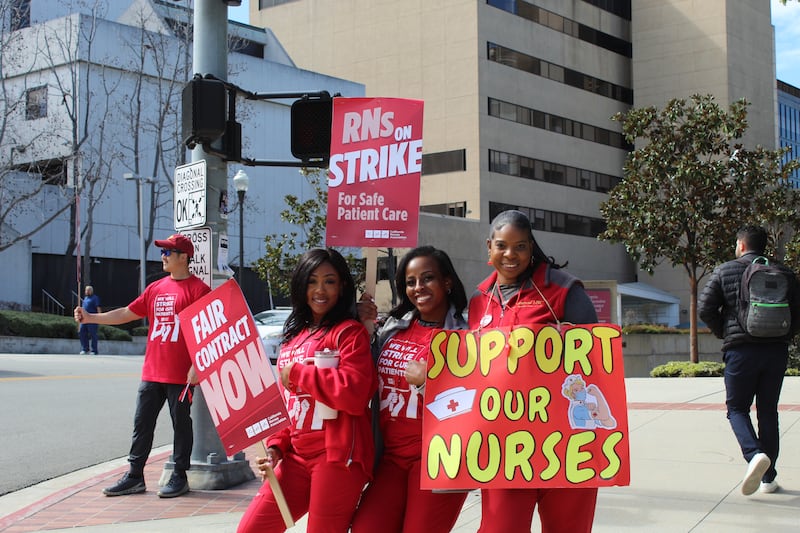 Nurses taking to the picket line on Feb. 19, 2026 (Photo by Senna Ihab Omar)
Dodgens said she has seen firsthand how difficult it can be for patients to access Keck providers.
“There have been times I’ve been on hold for 45 minutes just trying to confirm if a patient has an appointment before discharging them,” she said. “We have this strange system where you can’t just call your doctor and make an appointment. You have to go through centralized scheduling and speak to an operator … It’s very frustrating.”
She added that Keck women’s health care and pediatric facilities are not staffed to handle the influx of new patients entering the system.
“The fact that there are two gynecologists for the entire USC community does not make sense,” Dodgens said. “It just proves the complete lack of interest on the part of USC to invest in women’s healthcare.”
Eugena Vergara, a nurse and single mother of three, said many colleagues on the Trojan EPO plan have had similar experiences.
“It takes them so long to get appointments for their primary care, and by the time they come around to getting to that appointment, that physician has left or has canceled, and they have to start from square one,” Vergara said. “We don’t feel that the hospital is ready to take on all of these patients.”
Vergara said she once took her father, who has hypertension and diabetes, to Keck for care after he ran out of insulin.
“They’re told me, ‘Oh, our soonest appointment is four months from now,” she said. “So am I supposed to have my diabetic father just wait four months? This is why our patients end up in the emergency room.”
When she first joined the staff at USC, Vergara felt the university “really cared” about their employees’ health care.
“Now to get treated this way is … so disheartening,” she said. “I expected better, especially from USC.”
For Keck operating room nurse Gabriela Morales Ortega, the stakes are painfully personal.
“I honestly don’t care about myself. I care about my kids,” she said. “Their pediatric care is through Huntington, and I love their doctors. My kids have to see a specialist, and trying to start over is very frustrating. Where PPO is not even an option in my paycheck, which is not an option for a lot of nurses.”
When she searched for Tier 1 pediatric providers in the Pasadena area using USC’s tool, what she saw made her uneasy.
“It’s like the rated one-star and two-stars,” she said. “I know what world-class looks like, and you’re kind of forcing me to go into these two-star clinics. It’s not good enough.”
Other nurses described similar financial and emotional pressure.
Vergara, a single mother of three, said she cannot afford to switch to PPO without jeopardizing her ability to pay rent.
“You feel very helpless,” she said. “We put everything aside to care for these patients, and then at the end of the day, the facility that you work for, that you pour your heart into, just kind of slaps you in the face.”