

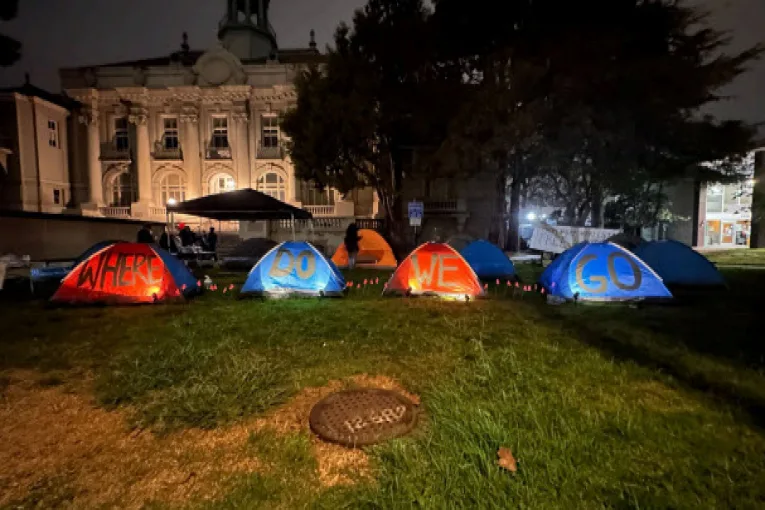
Tents in Berkeley – courtesy photo
BERKELEY, Calif. — The City of Berkeley is set to begin evicting individuals from the Harrison Corridor encampment, even as a federal lawsuit alleging violations of the Americans with Disabilities Act remains pending before the court.
A hearing is scheduled for March 20, 2026, in a lawsuit filed by the Berkeley Homeless Union, which alleges violations of the ADA and asserts that residents were not provided an adequate opportunity to request disability accommodations. According to a case status update from the Berkeley Homeless Union, the case is currently pending before U.S. District Judge Edward M. Chen.
The City of Berkeley had planned to proceed with a formal eviction notice Feb. 26, 2026, to disabled residents and advocates, according to the Berkeley Homeless Union. Berkeley City Hall hosted a press conference Monday, Feb. 23, 2026, to address additional information about the case.
The Americans with Disabilities Act is a law that protects the rights of people with disabilities and requires reasonable accommodations. According to Congress.gov, the act mandates “changes to policies and the removal of barriers that prevent people with disabilities from enjoying equal opportunity.” Therefore, discussions of the City of Berkeley’s alleged violations cite the law.
On Jan. 13, 2026, Judge Chen issued an order directing both parties in the lawsuit to file cross-motions proposing summary judgment. The order requires the city to explain its reasoning for the eviction, including accommodating disabled residents, the availability of moving assistance, identification of alternative relocation options, and the origin of the reported leptospirosis outbreak and measures taken to mitigate its impact on residents.
A report referenced by the Berkeley Homeless Union on Jan. 29, 2026, states that the city did not address the court’s required questions and instead filed a motion arguing that the Berkeley Homeless Union lacks standing, that individual defendants are entitled to immunity, and that the court had no authority to order the briefing in the first place.
Anthony Prince, legal counsel for the Berkeley Homeless Union, stated that although the court had ordered the city to answer specific questions regarding its accommodations for disabled residents, the city has not provided a response. He explained, “The city now plans to sweep the encampment before the court can rule on the issue of the ADA, which impacts the majority of our members in that camp. That is bad faith, plain and simple. We are asking the court to intervene before people are irreparably harmed.”
The Berkeley Homeless Union further explained that a hearing on summary judgment motions is scheduled for March 20, 2026, before Judge Chen, where the court will determine whether the city violated the ADA and whether additional intervention is necessary.
The Berkeley Homeless Union’s report states that eight of its members are covered by the preliminary injunction, despite over 80% of the city’s residents having disabilities.
On Feb. 17, 2026, the city posted notices requiring residents of the Harrison Corridor encampment to vacate by Feb. 24, 2026. According to the Berkeley Homeless Union, the notice allowed one week to leave, did not specify relocation sites or storage for belongings, and omitted the ADA accommodation advisory.
The city confirmed Monday, Feb. 23, 2026, that it will not conduct a sweep this week but still intends to clear the Harrison Corridor. The city said it will post new notices soon.
The Berkeley Homeless Union stated it continues to demand that the new notices, unlike those posted Feb. 17, contain language informing residents of their right to seek accommodations under the ADA; that at least three safe, legally permissible relocation sites be designated by the city prior to the sweep date; and that the city assist those relocating in maintaining access to basic survival gear, including tents and vehicles, sanitation services, and continued medical support through the Lifelong Medical Street Team.
Yesica Prado, president of the Berkeley Homeless Union, stated after reviewing the case file, “The city claims people’s belongings are too dangerous to handle, yet they expect everyone to carry them out in the rain. This is not a public health response. It is a targeted eviction of disabled people.”
The Berkeley Homeless Union cites public health efforts addressing the rodent issue, including weekly rat testing by Alameda County Vector Control and dog vaccinations by Berkeley Pawfund before the city’s alert.
At the Feb. 23, 2026, press conference, the Berkeley Homeless Union called to halt any sweep by the city until residents can request disability accommodations, provide relocation options, restore sanitation services, enforce rodent abatement on nearby private properties, and engage in a good-faith interactive process under the ADA.
Follow the Vanguard on Social Media – X, Instagram and Facebook. Subscribe the Vanguard News letters. To make a tax-deductible donation, please visit davisvanguard.org/donate or give directly through ActBlue. Your support will ensure that the vital work of the Vanguard continues.
Categories: Breaking News Homeless State of California Tags: Americans with Disabilities Act berkeley Disability Rights Eviction Federal Court Homelessness