

 A police car arrives at the scene of a car crash in San Bernardino in 2021. Photo via iStock Photo
A multimillion-dollar battle is playing out between Uber and an opposition coalition over a November ballot initiative that could affect every driver on California roads, writes Levi Sumagaysay.
Since last fall, the ride-hailing service has poured $32.5 million into a proposed ballot measure that would cap personal injury lawyers’ contingency fees to 25%. The measure would also limit medical damages for all car crashes in the state — even those not involving Uber. The company says that by allowing car crash victims to keep 75% of the settlements they receive, less payout money would go to lawyers, who on average receive about 33% of settlements.
Nathan Click, a spokesperson for Uber’s campaign, in a statement: “Californians deserve a system that prioritizes victims over ambulance lawyers, and that’s exactly what this measure does.”
Critics say that capping fees is a form of price control, and attorney groups, doctors and other medical providers have raised about $55 million so far to fight the proposal. If lawyers do not have enough incentive to take on a case, they could be discouraged from helping crash survivors secure compensation — which is Uber’s ultimate goal, the opposition argues.
Doug Saeltzer, president of the Consumer Attorneys of California: “Uber wrote it to be expansive, to keep victims from finding attorneys.”
In response to Uber’s efforts, attorney groups have proposed retaliatory ballot initiatives that would make the company more liable for passenger injuries and for sexual misconduct against riders or drivers. Another proposal would ban new state laws that restrict people from hiring the lawyers they want.
At a recent earnings call, Uber executives told investors that they expect the company’s lower insurance costs to boost revenue growth. Last year the company made $14 billion. By early February, Uber had gathered at least 25% of the more than 874,000 signatures it needs to collect by June 8 to qualify for the ballot.
What’s next for criminal justice in California? Join us in Los Angeles or virtually on Wednesday for a conversation with L.A. County District Attorney Nathan Hochman, former CDCR Director Dave Lewis and Heidi Rummel of the Post-Conviction Justice Project. They’ll talk with Joe Garcia, a formerly incarcerated CalMatters journalist who is the author of The New Yorker story ‘Listening to Taylor Swift in prison.’ Register here.
Other Stories You Should Know
What’s holding back the heat pump?
 Photo via iStock
As part of California’s goal to lower greenhouse gas emissions, the state aims to install 6 million heat pumps in homes by 2030. These electric, energy-efficient alternatives to gas-burning furnaces can heat up homes in the winter, but also work as air conditioning units in the summer.
But there’s a major hurdle stopping heat pumps from wider adoption: Our sky-high electricity prices.
As CalMatters’ Ben Christopher and Alejandro Lazo explain, Californians pay some of the highest residential electricity bills in the country. Though a recent study from Harvard University found that heat pumps would likely lower utility bills for households across the American South and the Pacific Northwest, the same can’t be said for all of California.
Rather, data shows that high residential electricity prices in California can make switching from a gas furnace to a heat pump a potentially expensive endeavor — especially for counties where homes are larger, winters are colder or electricity is more expensive.
Tensions rise in Mexico
 A charred vehicle sits outside a damaged supermarket in Guadalajara, Jalisco, Mexico, on Feb. 22, 2026. Photo by Alejandra Leyva, AP Photo
Let’s dive into some immigration news:
Conflict in Mexico: Violence broke out Sunday in at least a dozen Mexican states after Mexican security forces killed a top cartel leader known as “El Mencho.” As cars and businesses were set ablaze, the U.S. embassy in Mexico told American citizens in nine Mexican states to shelter in place. Some experts say the heightened violence could lead to northbound migration. But a spokesperson from the U.S. Customs and Border Protection said the agency does not expect any impact on migration. Read more from CalMatters’ Wendy Fry.
Legal defense funds: A number of California cities and local governments are setting aside public money to help provide immigrants with legal aid as President Donald Trump’s mass deportation campaign continues. Deportation proceedings take place in civil court, and unlike criminal cases, defendants do not have a right to a free, court-appointed lawyer. Alameda and Santa Clara counties, as well as San Francisco, Richmond and Los Angeles, have either allocated additional funds for immigrants or established immigration defense funds. Read more from Renée Bartlett-Webber for CalMatters.
And lastly: Housing for CA college students
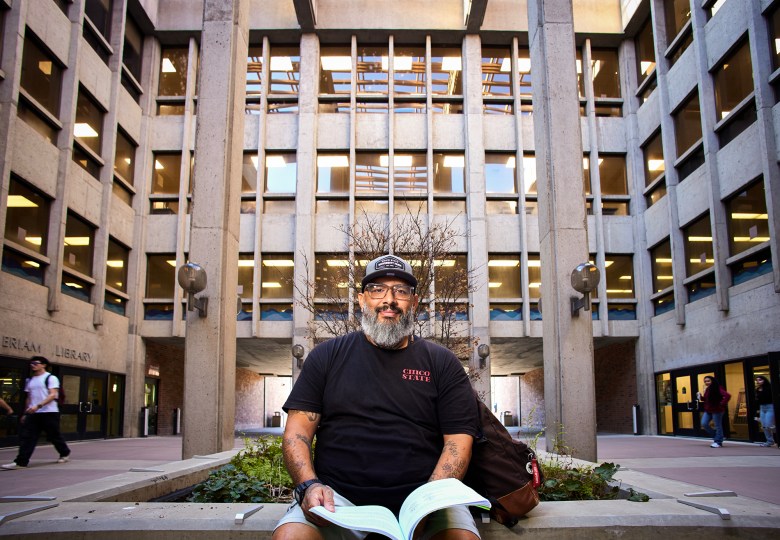 Oscar Deleon Jr., a student and Rapid Rehousing beneficiary, sits outside Meriam Library at Chico State in Chico on Feb. 5, 2026. Photo by Salvador Ochoa for CalMatters
With one in 12 Californians facing homelessness, the state’s Rapid Rehousing program has helped more than 9,000 college students on the brink of homelessness find housing since its launch in 2020. Students in the rehousing program also report higher grades and improved mental health. Read more from Khadeejah Khan of CalMatters’ College Journalism Network.
California Voices
CalMatters columnist Dan Walters: A Sacramento-based nonprofit has developed a guide to explain the State Board of Education’s bewildering school dashboard, giving us a better understanding of the shortcomings plaguing California’s public schools.
Uber’s ballot proposal would protect negligent drivers and make it nearly impossible for crash victims to find doctors to provide treatment on a lien, write Jamie Court, president of Consumer Watchdog, and Nick Rowley, a trial lawyer and author.
Other things worth your time:
US Sen. Padilla will give Spanish-language rebuttal to Trump // The New York Times
Republicans want to use the farm bill to kill a CA law they hate // San Francisco Chronicle
State Sen. Wiener unveils PG&E breakup bill // The San Francisco Standard
Widespread Kaiser strike to end after 4 weeks with no deal yet // KQED
How a $44K bill shows the dysfunction in CA’s home-insurance market // The Wall Street Journal
How many CA schools are in the 3,200-foot buffer zone where the state bans new drilling? // EdSource
Trans athletes face intense efforts to sideline them. These CA teens are resisting // Los Angeles Times
Letters reveal what life is like inside Adelanto ICE detention center // The Orange County Register
Supreme Court will not review ruling that Huntington Beach has to comply with state housing law // LAist
.wp-block-group__inner-container > :not(h2){margin: 16px 40px !important;}.cm-cta.long-ask .wp-block-group .wp-block-group__inner-container{display: flex;gap: 12px;align-items: center;}.cm-cta.long-ask figure{max-width: 40px;flex-shrink: 0;}.cm-cta.long-ask .wp-block-group p{font-size: 18px;font-weight: 700;line-height: 120%;letter-spacing: -0.36px;width: 100%;}.cm-cta.long-ask .wp-block-group .wp-block-buttons{flex-shrink: 0;}.cm-cta.long-ask .wp-block-button__link{padding-left: 40px;padding-right: 40px;}@container long-ask (min-width: 601px){.cm-cta.long-ask *{font-size: 16px;}}@container long-ask (max-width: 600px){.cm-cta.long-ask h2,.cm-cta.long-ask .wp-block-group p{text-align: center;}.cm-cta.long-ask h2{background: linear-gradient(90deg,#FFE094 0%,#FFB500 100%);padding: 12px 20px;font-size: 20px;letter-spacing: -0.4px;}.cm-cta.long-ask .wp-block-group .wp-block-group__inner-container{flex-direction: column;}.cm-cta.long-ask > .wp-block-group__inner-container > :not(h2){margin: 16px 20px !important;}}]]>
Nonpartisan, independent California news for all
We’re CalMatters, your nonprofit and nonpartisan news guide.
Our journalists are here to empower you and our mission continues to be essential.
We are independent and nonpartisan. Our trustworthy journalism is free from partisan politics, free from corporate influence and actually free for all Californians.
We are focused on California issues. From the environment to homelessness, economy and more, we publish the unfettered truth to keep you informed.
We hold people in power accountable. We probe and reveal the actions and inactions of powerful people and institutions, and the consequences that follow.
But we can’t keep doing this without support from readers like you.

Please give what you can today. Every gift helps.

Lynn La is the newsletter writer for CalMatters, focusing on California’s top political, policy and Capitol stories every weekday. She produces and curates WhatMatters, CalMatters’ flagship daily newsletter…
More by Lynn La