
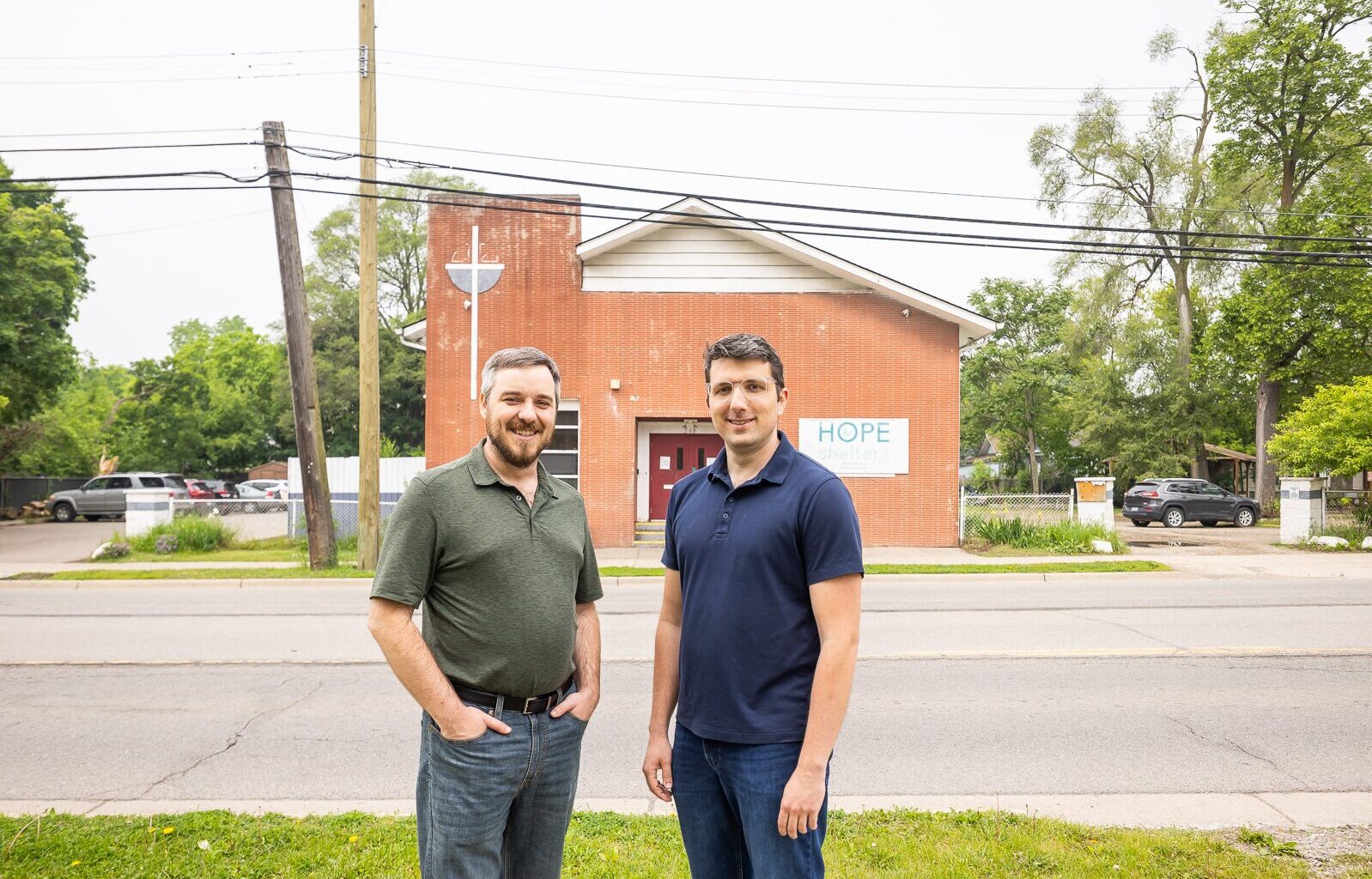
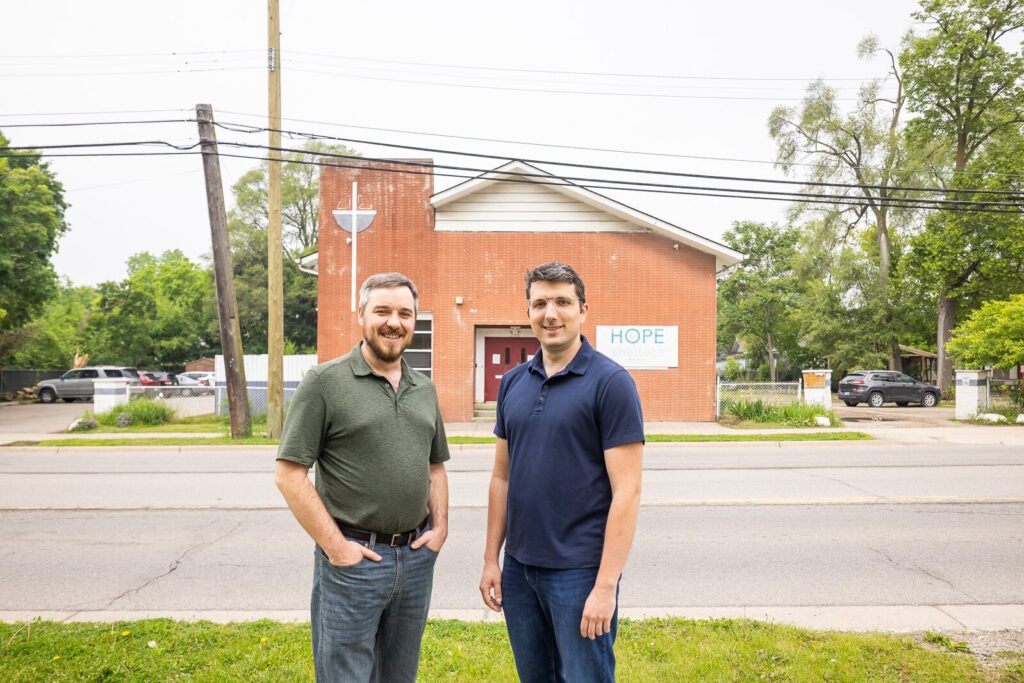
 Cam Underdown and Chris Powers are the co-founders of ReciproCity, which developed a new housing resources website called Shelter Oakland. David Lewinski
This story is part of a series that highlights the challenges and solutions around housing in Southeast Michigan and is made possible through underwriting support from the Oakland County (Region L) Regional Housing Partnership.
While in the checkout line one night at Meijer, Cam Underdown struck up a conversation with the man next to him and learned that the man had nowhere to sleep that night. Fortunately, as a co-founder of the Pontiac-based software development and consulting collective ReciproCity, Underdown was able to help the man immediately using a tool ReciproCity had developed: the website Shelter Oakland. Underdown describes Shelter Oakland as being “like a hotel management system” for four Oakland County homeless shelters, offering real-time shelter bed availability and allowing users to apply for a bed.
“On his own phone, he signed up, put in all his information, and made a little note about what he was looking for in his situation,” Underdown says. “And I found out the next day that he had made it in.”
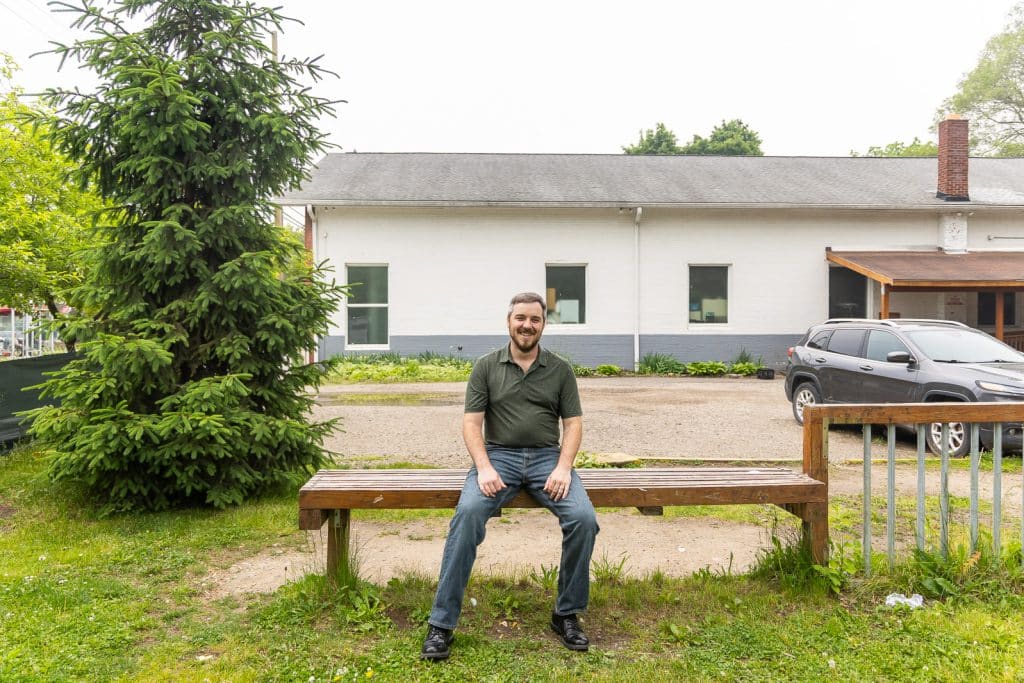 Cam Underdown. David Lewinski
Shelter Oakland launched this summer thanks to a partnership between the Pontiac-based nonprofit Alliance for Housing and ReciproCity. In 2023 the Alliance for Housing began contracting with ReciproCity, whose mission is “to build public goods with technology,” to develop technological solutions to housing- and homelessness-related problems in Oakland County. Their partnership has been funded by the United Way, the McGregor Fund, the Community Foundation of Southeast Michigan, and Oakland County. Shelter Oakland is the first major outcome of their work.
ReciproCity co-founder Chris Powers says Shelter Oakland “became sort of critical infrastructure quicker than we thought.” It’s already fielded 3,000 inquiries for shelter from 700 households, and added two shelters (Welcome Inn and Safe Tonight Shelter) to the two available on the site at launch (HOPE Shelters and Lighthouse Family Shelter). Powers, Underdown, and Alliance for Housing Executive Director Leah McCall all say the system has been highly successful in removing burdens for both shelter seekers and shelter staff.
“The response that we’ve gotten from the shelter providers as we’ve gotten people trained and up and running has been great,” McCall says. “We need Shelter Oakland to see who’s in the beds and what we have available and what’s coming up. So I think it’s definitely doing what we hoped it would do for individuals looking for shelter and for community partners to really help organize in a coordinated way.”
“This just makes them more heroic”: Fine-tuning Shelter Oakland
Shelter providers say Underdown and Powers’ responsiveness to their feedback has been key to making Shelter Oakland a valuable tool. In addition to quickly adding new shelters to the system, ReciproCity has already made some key changes to the service to make it work better for shelter providers and seekers. Steve Norris, administrator of the Safe Tonight Shelter Fund, says he appreciates that Underdown has had “boots on the ground” to understand how Safe Tonight Shelter works and walk shelter staff through how to use Shelter Oakland.
“He’s been really great about that and accessible through those processes,” Norris says. “And there’s already been multiple revisions. … Being as small as [ReciproCity is], they have the capability to pivot and maneuver quickly and make those changes that I think larger organizations don’t have.”
Underdown and Powers sought feedback from both shelter providers and shelter seekers to strengthen the system. Underdown says one “watershed moment” involved addressing intersecting frustrations among shelter seekers and shelter providers. Shelter seekers were frustrated about the challenges of navigating shelters’ varying rules for applying for shelter and reaching overwhelmed shelter staff. At the same time, shelter providers were frustrated about following up with shelter applicants via phone and not hearing back. An easy solution was to set Shelter Oakland to send a daily automated update to shelter seekers about the status of their requests.
Underdown says that change makes shelter seekers’ lives easier and “takes some of the pressure off of each provider to be everything to everybody,” allowing them to “focus more on doing what they do best, which is getting people housed.”
“Lots of times these people were just missing each other,” Underdown says. “… Being able to bring them onto a platform where the operational rules are defined has limited … some of that stress, some of that dissonance.”
In another change, shelter seekers now submit a single Shelter Oakland application that is then routed to the most appropriate of the four shelters, rather than applying to shelters individually. Although the latter approach was used at launch, when there was just one adult shelter and one family shelter on the platform, the growing number and types of shelters on Shelter Oakland necessitated a more streamlined approach. It also lightened the load for community health workers and nurses working Oakland County’s recently rebranded Oakland Connects hotline, who sometimes need to apply for shelter on shelter seekers’ behalf.
“It really made it just easier overall,” McCall says. “You didn’t have to look at which shelter you were applying at or who had beds. You just apply and then you’re filtered to the correct location based on your family structure and makeup.”
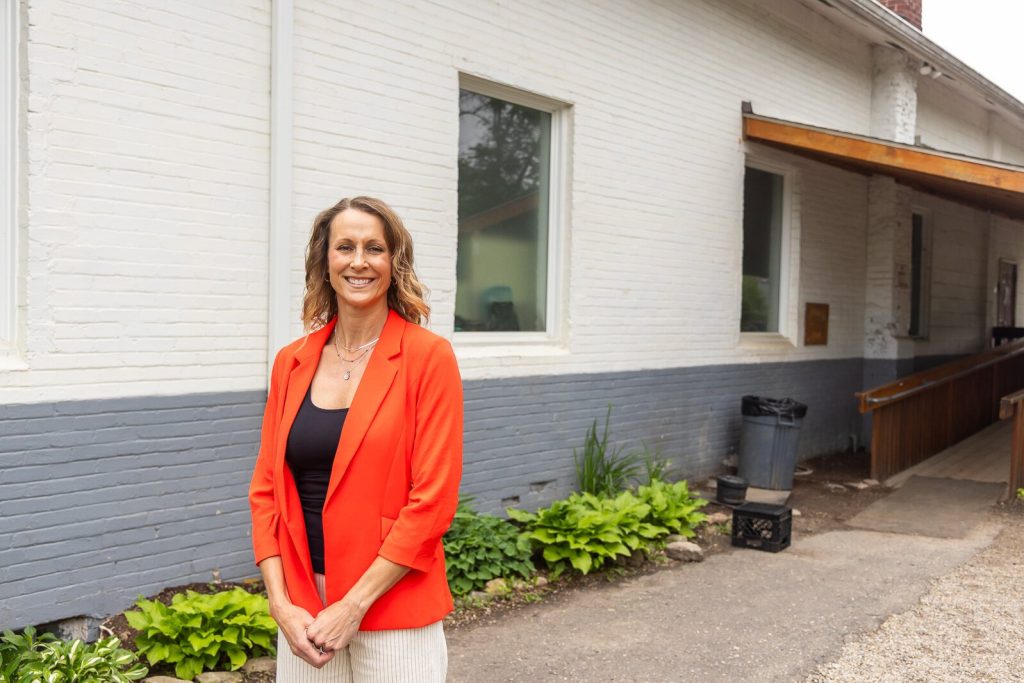 Leah McCall. David Lewinski
Underdown lavishes praise on Oakland County shelter providers for their willingness to adopt and fine-tune the new system, especially during a punishing winter that has prompted especially high need for their services.
“They are heroes in my eyes already,” he says. “And this just makes them more heroic because now they’re investing in how to make this better. … So they’re doing double duty during this season of learning and iteration, and I just could not be more grateful for them.”
Next steps: Increasing shelter capacity, replicating the model
Shelter providers say Shelter Oakland is also helping bring light to other housing challenges in the county. Norris says that, while it’s now much easier to seek shelter in Oakland County, there still simply aren’t enough shelter beds to fill demand. But he says Shelter Oakland is helping to illustrate that problem, quantifying the number of shelter seekers whose needs are going unfulfilled.
“There was no system before,” he says. “So … [Shelter Oakland] was a huge improvement to where we can at least get a snapshot of what the need was.”
Norris says that has already prompted “tons” of conversation in the county about how to increase shelter bed capacity to meet demand. He credits those discussions in part for the establishment of the Safe Tonight Shelter at Pontiac’s New Birth International Church this winter, and hopes to see further expansion of shelter capacity as a result.
McCall, Powers, and Underdown all emphasize that Shelter Oakland is just the first big piece of a larger puzzle, which will eventually look like a one-stop shop for housing availability, housing assistance funds, and other resources like eviction support services in Oakland County. Their work is already attracting attention elsewhere. Powers and Underdown say they’ve received inquiries about Shelter Oakland from across the country, and McCall says she hopes the system will be replicated in other communities.
“If it’s already there, and it’s a resource, and it’s a technology-based solution to some of the work that we do, I would love to share that,” she says.
Underdown says he’s excited for the way his technology will cause people to “suddenly feel empowered” to help each other, as he did with the man in the checkout line.
“Sometimes you drive by someone that’s struggling or you walk by them,” he says. “I want to help. I just don’t know what I can do. And this is a really concrete, tangible, excellent first step to just go over to that person and be like, ‘Do you know about Shelter Oakland?’”