
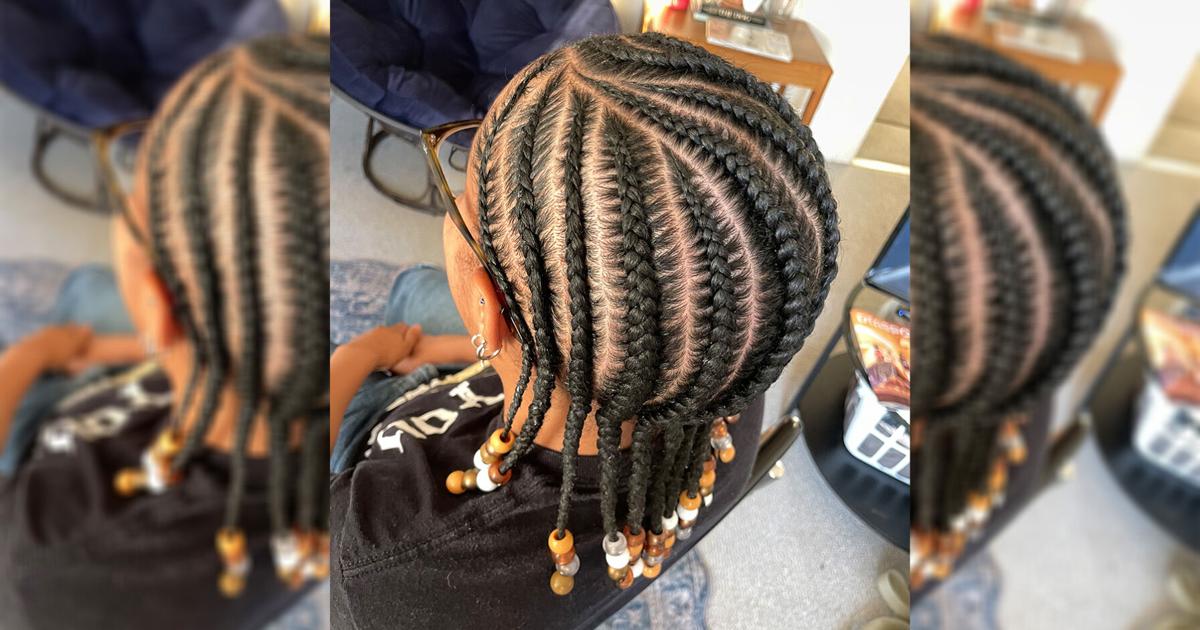
Neat parts and beautiful braids are the precision that Mira McDavitt and Sylvia Akanno aim for. Both self taught, they provide braiding services for UC Berkeley students and the local community.
McDavitt and Akanno first practiced braiding on themselves in middle school and continued into high school before launching their businesses in their freshman year in the dorms while in the African American Theme Program, or Afro Floor.
“Around three months in, everybody’s braids were looking old, and would say, ‘Oh my gosh, I need my hair done,’” Akanno said. “They couldn’t find anybody, so they started asking me, ‘Who did your hair? Who did your hair?’ I did it myself.”
The first time Akanno braided someone else’s hair, it took 24 hours and she only charged $60, but her skills began to grow after more clients and practice. Now, she has gained more than 700 followers, along with a loyal clientele.
The difficulty her peers faced trying to find braiders in the area is what drove Akanno to start her business.
“A lot of people in the Bay charge up to $1,000, which I think is absolutely crazy,” Akanno said. “And then they’re far out in the Bay in Hayward or Pittsburgh … these are college students. They don’t have a car at this time. They can’t really make that commute.”
Akanno added that she typically spends six to eight hours braiding a client’s hair and described the end result as a “beautiful masterpiece.” She loves taking her time to ensure her work is “perfection,” and she said she takes extra time to ensure her parting is crisp with no flyaways.
Aside from braiding as a business, McDavitt defines it as an art and outlet that has translated to her pursuit of a career in psychology. Currently, she’s working with a campus research lab that combines her passion for psychology with braiding.
Focusing on externalizing and addiction mechanisms in the Black community, McDavitt said her lab has developed a braiding protocol for coarse and curly hair that has enabled more Black participants to be included in electroencephalogram studies. These studies test the electrical activity in people’s brains by attaching metal electrodes to the scalp.
McDavitt recalled a fond memory of when she was braiding her housemate’s hair that bonded them closer together. The braiding session took almost 30 hours and required a trip to the beauty supply store halfway through.
“It’s a personal, personal experience,” McDavitt said. “The braiders have the opportunity to open up and be your most vulnerable self because your hair is so intimate.”
McDavitt added that she loves to paint and draw, but it gets to be “very messy” as a full-time student with extracurriculars. However, she finds braiding a more accessible and rewarding art form.
Braiding has taught Akanno to not underestimate herself. While her braiding business was difficult to manage at first, she continued on. Akanno added that braiding allowed her to imagine more for herself, being able to better envision her goal of being a dermatologist researcher.
McDavitt said braiding has made her feel more connected to her ancestry and her Blackness, particularly being from Humboldt County, California, a rural area where she didn’t engage with the Black community on a daily basis.
“It’s so important to emphasize that braiding is an art for sure,” McDavitt said. “It’s such a foundational way that Black women are able to express their creative self in both wearing the style or doing it. … It’s an art medium that should be normalized.”