
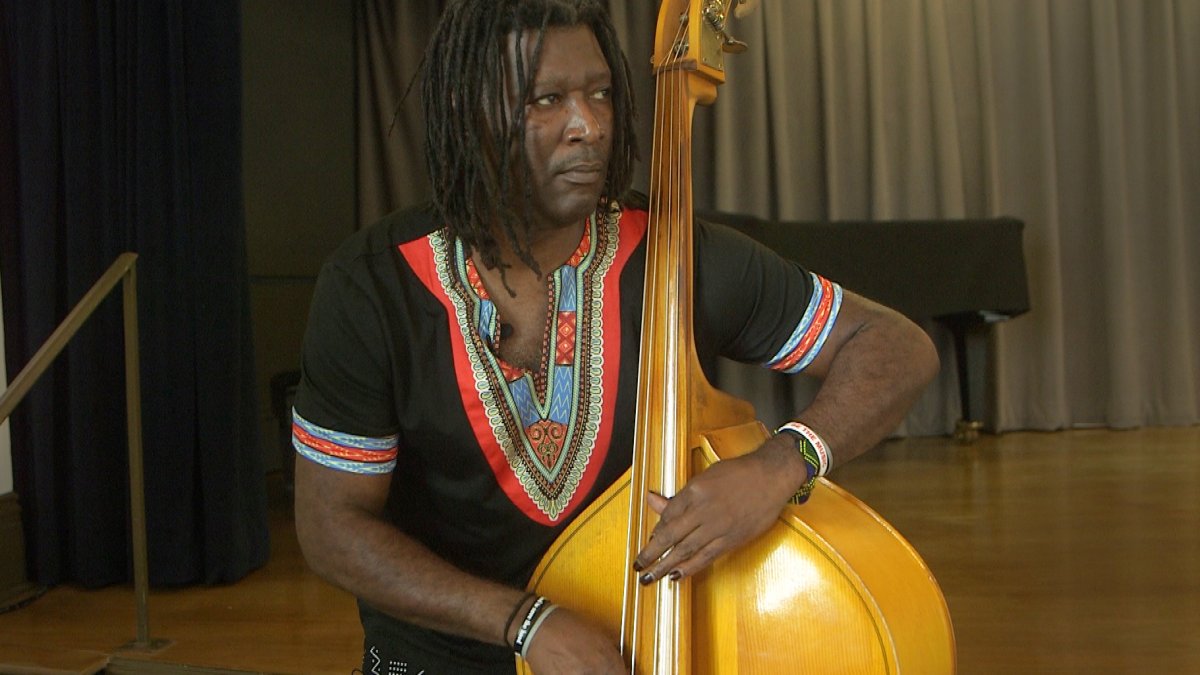
Inside the auditorium of a San Francisco Victorian home-turned music school, Marcus Shelby plucked an upright bass, its thunderous staccato tones skipping off the wood floors along with flickers of daylight. Every tone, every phrase from the instrument seemed to share a story — channeling jazz, folklore and chapters of Black History.
“I can understand certain things about a person’s character, or about time and place and energy,” Shelby said, gazing out the auditorium windows. “All that can be described by music.”
In the vein of other noted jazz bass players like Charles Mingus, Charlie Haden and Avishai Cohen, Shelby has pushed well beyond the four string instrument and etched his name as a composer. His music — much of it instrumental — dives deep into chapters of the Black American experience, amply tackling subjects like Harriet Tubman, MLK, and the Negro Baseball Leagues.
“There’s so much music in blues and swing, the type of music I’m attracted to,” Shelby said, “that can tell these kind of stories of time and place and character and mood.”
It’s a good thing for the music world Shelby didn’t follow his initial career impulse; electrical engineering, which landed him a job at the Jet Propulsion Laboratory in Los Angeles that only lasted a couple weeks.
The job was a success in that it got him to Los Angeles where he attended the California Institute of the Arts and fell-in with a musical community that included trumpeter Gilbert Castellanos, drummer Willie Jones III and drummer Billy Higgins who co-founded The World Stage, a Los Angeles cultural center where Shelby sharpened his passion for jazz. With Castellanos and Jones III he went on to form the influential jazz group Black Note which toured for six years and recorded four albums. When the group disbanded in the mid-nineties, Shelby made his way to San Francisco.
“I was looking for a scene where I could learn and develop individually as a composer,” Shelby said, leaning back in a folding chair in San Francisco’s Community Music Center. “And it just seemed there were spaces here to do that.”
One of Shelby’s first compositions was a tribute to the 1944 Port Chicago incident — an explosion at a Navy munitions loading dock in Contra Costa County that killed 320 people, and led to the court martial of 50 Black sailors who refused to continue working in unsafe conditions. The incident led to the desegregation of the military. Shelby’s suite of blues and swing-infused music set-out to capture the era and the moment.
“I did some research on it,” Shelby said, “we met the author of the book and that inspired music.”
NBC Bay AreaNBC Bay Area
Bass player and composer Marcus Shelby plays an upright bass in the auditorium of San Francisco’s Community Music Center.
The project revealed Shelby’s willingness to go deep in the pocket to paint his subjects. His next project was based on the life of abolitionist Harriet Tubman. Shelby spent six months at Stanford University in a residency where he and a group of students researched the Civil War and the Women’s Suffrage Movement. For the first time, he also wrote lyrics for the music.
“The music was able to capture her energy,” Shelby said. “There were a lot of spirituals that she sang I rearranged.”
Shelby’s unlikely path was born in an unusual place. H was born in Japan, the son of a Navy man. The family moved often before landing in Sacramento where young Shelby pursued a career as a basketball player. At the the time he didn’t want to be the next Mingus, he wanted to be the next Michael Jordan. In band class he chose the upright bass, not because of any internal calling but because a friend chose the bass and Shelby wanted to be next to him in class. It was only later the seeds of the low end of music began to find purchase.
“I didn’t really fall in love with the instrument until later when I learned more about it,” Shelby explained, “and learned more about the history of the instrument and the pioneers of the instrument.”
He went on to study electrical engineering at Cal Poly San Luis Obispo but around then he also had a brush with a musical legend would short circuit his plans. He saw trumpeter-composer Wynton Marsalis play and it re-wired the circuits of his aspirations.
“In music I saw what I could do, even if it wasn’t going to happen right away,” he said. “And I saw it all through this one individual, Wynton Marsalis who was doing exactly that.”
Shelby’s bass playing draws from the musical ancestors; Mingus, Paul Chambers and his Cal Arts teacher Charlie Haden are all there in his playing. On stage with his big bands, his presence is like the hub of a wheel — the flurry of musicians, notes and arrangements all circling the fulcrum of his bass.
Rather than a flick of the wrist of a conductor, it’s the pluck of his fingers across the bass strings that drives and guides his bands. His bands serve as the muse for his compositions that have addressed subjects like the prison industrial complex, the pandemic and his homage to the Negro Baseball Leagues called Black Ball. For his big band’s Black Ball concert at SF Jazz, the entire group dressed in baseball uniforms.
“Music can tell the story of baseball like no other, particularly blues and swing,” Shelby laughed. “I mean it has the word swing in it.”
Among his compositions, Shelby set out to write a piece about Dr. Martin Luther King Jr. which took him down a rabbit hole of Black History and civil rights. He visited the Deep South: Alabama, Mississippi, Arkansas. He traced the path of the freedom marchers, visited King’s home base, Ebenezer Baptist Church in Atlanta, Georgia — and turned the experience into a composition called South of the Movement – Meditations on Dr. Martin Luther King Jr. It told the story of the bus boycotts, Emmett Till, and the Freedom Riders.
“So it was really about all these different stories that made up the Civil Rights movement that really resonated with me,” Shelby said.
Shelby has also delved into other mediums as a storyteller; he’s sat on San Francisco’s Art Commission for more than a decade, and is Artistic Director of the Healdsburg Jazz Festival.
And in a nod to his own path through music, he teaches the teen big band at San Francisco’s Community Music Center, the Mission District grassroots music school that operates out of a pair of Victorian homes.
He sees that last role as perhaps his most significant. Because he hopes he’ll spark a love of music in young people, the same way Wynton Marsalis inspired him.
“I just want to give the way it was given to me,” Shelby said. “It’s really that simple.”