
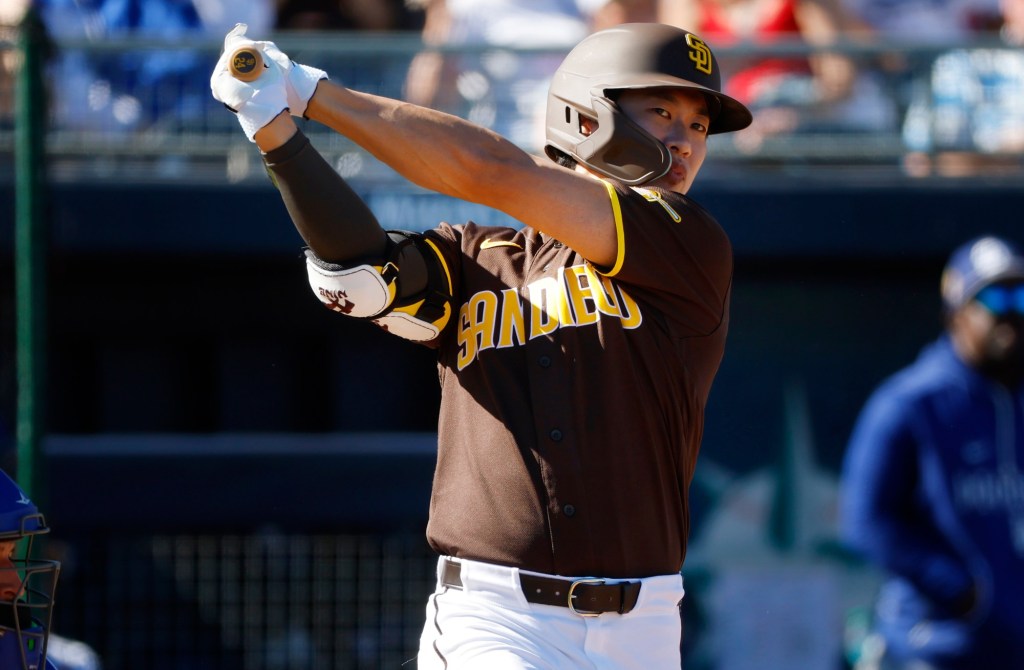
PEORIA, Ariz. — Now that the Padres are confident Sung-Mun Song’s oblique issue is fully behind him, he has begun in earnest his quest to catch up to the speed of the game and the speed of the pitches in the major leagues.
It was just a couple days ago that Song started swinging in the batting cage against high-velocity pitches from a machine. Before that, he spent several days standing in the batter’s box “tracking” pitches that whizzed past him at 100 mph or so.
In his two Cactus League games, thorough five plate appearances, Song has yet to swing at any of the three pitches he has seen in the strike zone at 97 mph or faster.
Song has already impressed the Padres with his strength, his glove in the infield and the way he runs. This spring will largely be about him getting used to seeing plenty of fastballs the likes of which he did not see all that often in the Korean Baseball Organization. It is a progression that will continue into the season and beyond.
“In the big leagues, everybody is sitting like at least 95, 96,” Song said through interpreter Sam Jeong on Tuesday after going 0-for-2 with a walk against the Cubs. “So it’s a big difference between KBO and MLB.”
He is 0-for-4 in all, striking out on a 94 mph fastball from Cubs left-hander Shota Imanaga and lining out softly to shortstop on a 94 mph sinker against Dodgers minor-league lefty Christian Suarez. Against three right-handers, which the left-handed hitter will likely almost exclusively face in the regular season, he has walked, rolled over to first base on a 96.1 sinker and watched a 98 mph fastball for a called third strike.
The average fastball Song saw in Korea, where he played for nine seasons before signing a four-year, $15 million contract with the Padres, ran about 91 or 92 mph.
“He’s figuring it out still,” manager Craig Stammen said. “… He’s gonna get comfortable at the plate the more at-bats he gets. … We’re gonna get him as many at-bats as he can.”
The KBO is likened by scouts to Double-A, but with only a handful of pitchers who throw hard. It takes even the best Korean hitters time to adjust.
The process for Song will involve starting his pre-swing movement earlier. Hitting faster pitches is not a matter of swinging harder. It is about a hitter retraining himself to time the pitcher differently and be ready quicker. That takes time to turn into a habit, which is what it must become to survive in the major leagues.
“I think definitely seeing (velocity) as much as possible, ” hitting coach Steven Souza Jr. said. “What we’re trying to do is just take his velo program and move it up faster, see it as much as he can, so he can start to slow it down and self organize.”
The Padres witnessed Ha-Seong Kim improve a little each year against hard throwers over his four seasons with the club.
“That’s what is helpful for us,” Stammen said. “We’ve had a player from Korea we think is really good come over here and try to get adjusted to the United States and Major League Baseball. We just feel like the more at-bats that we can give him, the better chance he has of catching up to the speed of the game, seeing a little bit more velocity and then just seeing pitchers that he’s probably going to face during the regular season.”
Impending decisions
The Padres are getting calls on their relievers.
While mulling the danger of potentially weakening the club’s greatest strength, they could make a move by the end of spring, dealing from their abundance of bullpen arms.
The Padres have six relievers virtually assured of big-league jobs to start the season. Those are closer Mason Miller, Jeremiah Estrada, David Morgan, Bryan Hoeing and left-handers Adrian Morejón and Wandy Peralta.
Two more – Jason Adam and lefty Yuki Matsui — will be in the bullpen if they are healthy at the start.
All but Hoeing, who battled a shoulder issue early in the season, contributed significantly to what was by many measures MLB’s best bullpen in 2025.
If the Padres go with eight relievers at the start of the season, as they figure to do, that means there are no jobs available. (It is also possible that they use a sixth starter for a stretch of games in April, which would leave just seven relievers were on the roster for a time because it will be likely that no starters have options remaining.)
The enviable problem in constructing their roster is that the Padres have multiple other viable candidates to log relief innings. Chief among those are Ty Adcock, Alek Jacob, Ron Marinaccio, Bradgley Rodriguez and left-hander Kyle Hart.
Some can be tucked away in Triple-A, at the ready to be called up due to inevitable injury or ineffectiveness.
Marinaccio, however, is out of options and can’t be sent to the minors unless he clears waivers.
And with the hard-throwing Rodriguez seemingly ready for a full-time big-league gig after coming up late last season and allowing one run and striking out nine in 7⅓ innings, Estrada or Morgan could be expendable for the right price.
Wanting time to assess their needs elsewhere on the roster and cognizant of the often capricious nature of bullpens and the possibility of injury, the Padres will almost certainly not make a move until shortly before the season. That is, if they make one at all.
A-list
The Padres on Monday and Tuesday ran out what would be considered B squads for games against the Brewers and Cubs.
The next few afternoons, more stars will be visible.
Another interesting one.
via @Padres pic.twitter.com/WmRgkrq0yZ
— Kevin Acee (@sdutKevinAcee) February 25, 2026
Xander Bogaerts, Manny Machado and Fernando Tatis Jr. were in the starting lineup Wednesday and will likely start at least once more over the next two days before they depart to prepare for the World Baseball Classic.