
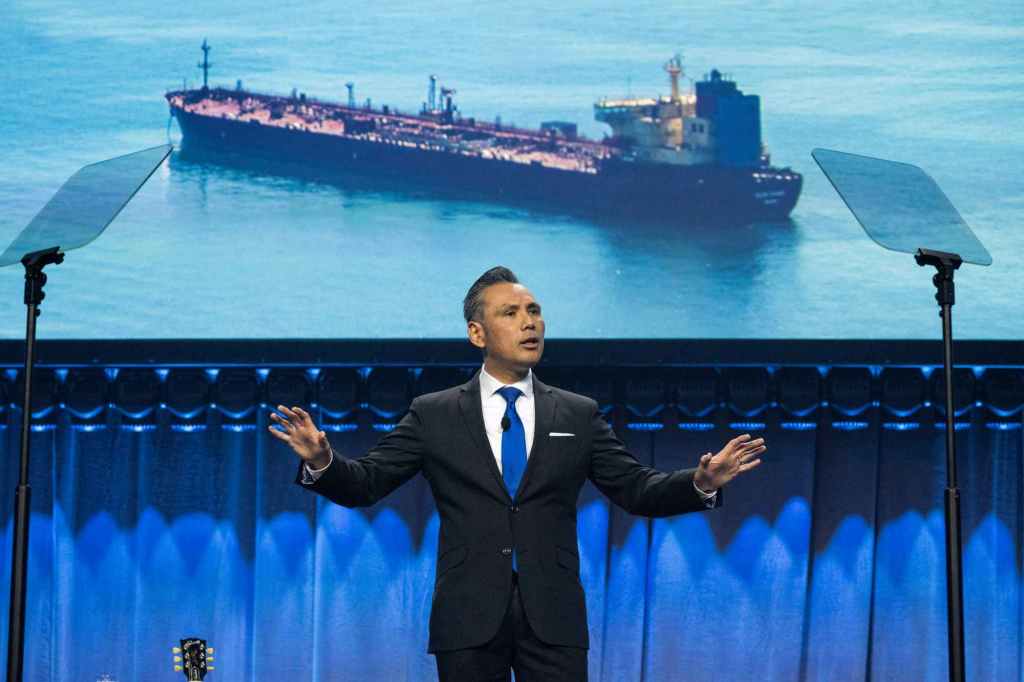
Amid ongoing uncertainty over tariffs, the Port of Long Beach surged through January, topping cargo numbers reported earlier by the Port of Los Angeles to claim status as “the busiest port in the nation,” POLB CEO Noel Hacegaba said on Wednesday, Feb. 25.
Total containers moved in January at Long Beach were 847,765. It marked the port’s second-busiest January on record.
The Port of L.A. previously announced January container numbers there at 812,000.
Both ports, however, also saw year-over-year drops in January — a 12% dip from January 2025 in L.A. and an 11% drop in Long Beach — as the unpredictability of tariffs continues to roil the industry waters.
Cargo volume in the Port of L.A. topped 10.2 million container units in 2025, making it the third busiest year in the port’s 118-year history.
In the Port of Long Beach, the overall 2025 number broke that port’s record by handling 9.9 million twenty, or TEUs. And Long Beach also set a record for container volumes in 2025, becoming the “busiest port in the nation” in the first four months of that year, Hacegaba previously said.
Hacegaba reported Long Beach’s numbers for last month in a virtual news briefing on Wednesday, boasting that POLB started 2026 “leading the nation as the busiest port in the United States.”
“We led the nation and moved 51% of cargo processed at the San Pedro Bay complex last month,” he said.
In January, Port of Long Beach dockworkers and terminal operators moved 847,765 twenty-foot equivalent units of cargo containers, down 11% from the same month in 2025, which remains the port’s best January and second-busiest month overall in its 115-year history. Imports were down 13.1% to 409,818 TEUs, and exports rose 0.8% to 99,478 TEUs. Empty containers moving through the port declined 11.5% to 338,470 TEUs.
But a slowdown could be looming.
Port of L.A. Executive Director Gene Seroka said recently that a cargo flattening is anticipated for the first six months of 2026, citing tariffs and other economic uncertainties. Earlier this month, the National Retail Federation and Hackett Associates also projected that import volume at the nation’s major container ports was expected to see “a significant year-over-year decline during the first half of 2026,” citing the impact of tariffs.
“We are leading the nation in trade, and providing a safe harbor in the sea of tariff and trade uncertainty for our customers and the goods movement industry,” Hacegaba said Wednesday during the first of his monthly Supply Chain Insight virtual media briefings. “No matter what happens with cargo volume, the Port of Long Beach has the capacity, infrastructure and workforce to move goods quickly, efficiently and reliably.”
Hacegaba’s stress on Long Beach’s push under the moniker as the “Port of Choice,” meanwhile, also appears to be signaling a resurgence of what has long been a competitive stance with its larger neighboring port, even as the two continue to join forces on efforts to cut pollution.
“As we navigate all of these changes,” Hacegaba said, the port “will continue to be a safe harbor” for its shipping industry customers.
While Hacegaba said he’s upbeat about the future — and has a positive outlook for the year ahead — there are challenges.
The future of tariffs, he said, remains unpredictable. Despite the Supreme Court’s ruling striking down the emergency-power tariffs last week, President Trump has vowed to pursue other tariffs up to 10% or 15% on all nations.
“The only certainty is uncertainty,” Hacegaba said.
The shipping community is worried, he said.
“The feedback I’m getting is, overwhelmingly, a continued concern,” Hacegaba said. “There was some thought that the Supreme Court ruling (on tariffs) would bring an end to the uncertainty. But in reality, it’s created more questions.
“While this decision ruled on the legality of the IEEPA tariffs, it did little to remove the uncertainty we’ve seen – and continue to see – across the global supply chain,” Hacegaba added. “Our customers are seeking clarity on whether tariffs already paid will be refunded, and consumers are seeking relief from higher prices.”
The Port of Long Beach, meanwhile, is also zeroing in on 2050 as the year when it expects its own cargo numbers to double from what it is now, the CEO said.
In his Jan. 15 State of the Port address, the newly appointed port leader said POLB needs to prepare for an aim of doubling its cargo flow by 2050.
“According to our latest cargo forecast, 2050 is the year our container volumes will reach 20 million TEUs,” Hacegaba said during that event. “We have 24 years to prepare to double our container throughput and figure out how we’re going to handle all that cargo quickly, safely, efficiently, and sustainably.”
Along with its continued “Green Port” focus, Hacegaba said, the port is pursuing a range of ambitious projects — chief among them the Pier B Rail development.
The planned Pier B On-Dock Rail Support Facility is the centerpiece of the Port of Long Beach’s rail capital improvement program and a key part of its Green Port vision. It will shift more cargo to on-dock rail, where containers are taken to and from marine terminals by trains. Moving cargo by on-dock rail is faster, cleaner and more efficient, as it reduces truck traffic. No cargo trucks would visit the facility.
The facility will be built in phases and as each is completed, capacity and operations will increase. Construction began in 2024 and the entire project is expected to be complete in 2032. An update meeting is planned for March 4.
Asked about the year ahead, Hacegaba said he was “still bullish about 2026. I think it will be a strong, robust year.”
He added, though, that it will depend on how the Trump administration proceeds following the Supreme Court decision — and how shippers and consumers, in turn, also respond.
“Let’s not forget that tariffs are taxes,” Hacegaba said.
And while costs are primarily born first by shippers, he said, they hit consumers as well.