
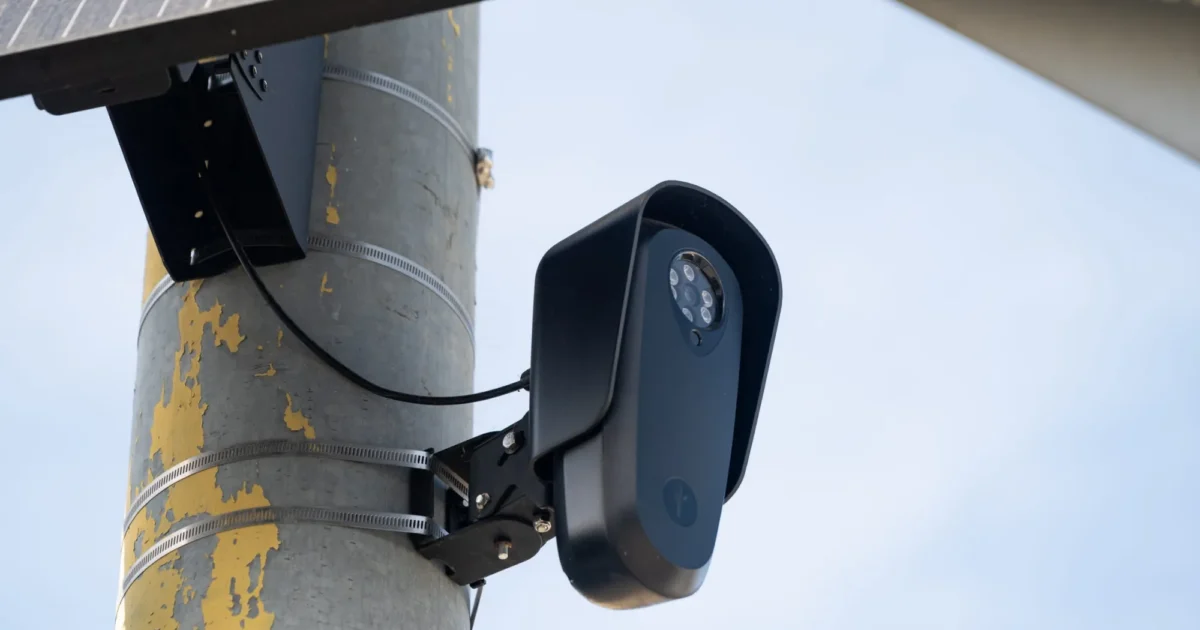
The Mountain View City Council unanimously voted on Tuesday to terminate its license plate camera contract with Flock Safety, heeding the calls of dozens of impassioned residents who spoke at the meeting urging the city to cut ties with the surveillance technology company.
Police Chief Mike Canfield disclosed last month that unauthorized law enforcement agencies had searched the city’s license plate data for more than a year. With Tuesday’s vote, Mountain View joins a handful of other cities nationwide that also have recently cut ties with the company citing privacy and data security concerns, including Santa Cruz and Los Altos Hills.
“History reminds us what can happen when civil liberties are overridden and when safeguards fail,” Councilmember Ellen Kamei said at the meeting. “It’s incumbent on all of us city councilmembers to be vigilant in protecting both our public safety but also our civil rights.”
The city’s decision to terminate its contract with Flock Safety follows a Mountain View Voice investigation which revealed that data from the city’s automatic license plate readers (ALPRs) was searchable by agencies across California. This was in violation of a city policy requiring the police to approve departments individually. The Voice found more than 250 unapproved agencies had conducted roughly 600,000 searches of the city’s records from December 2024 through December 2025. That access was only turned off after it was discovered last month.
There also was a three-month period in late 2024 during which out-of-state agencies could tap into the city’s ALPR data. At the time, only one camera had been installed in Mountain View. Canfield acknowledged in a report to the council that this was in violation of city policy and state law, which prohibits the sharing of ALPR data with out-of-state agencies, including for immigration enforcement purposes.
“To be very clear, we did not know this was going on,” Canfield told the council on Tuesday. “We had not set it up, and we were surprised to learn of it.”
Amid intense public scrutiny, the police department announced Feb. 2 that it would disable all Flock Safety cameras until further direction was provided by the council at its Tuesday meeting.
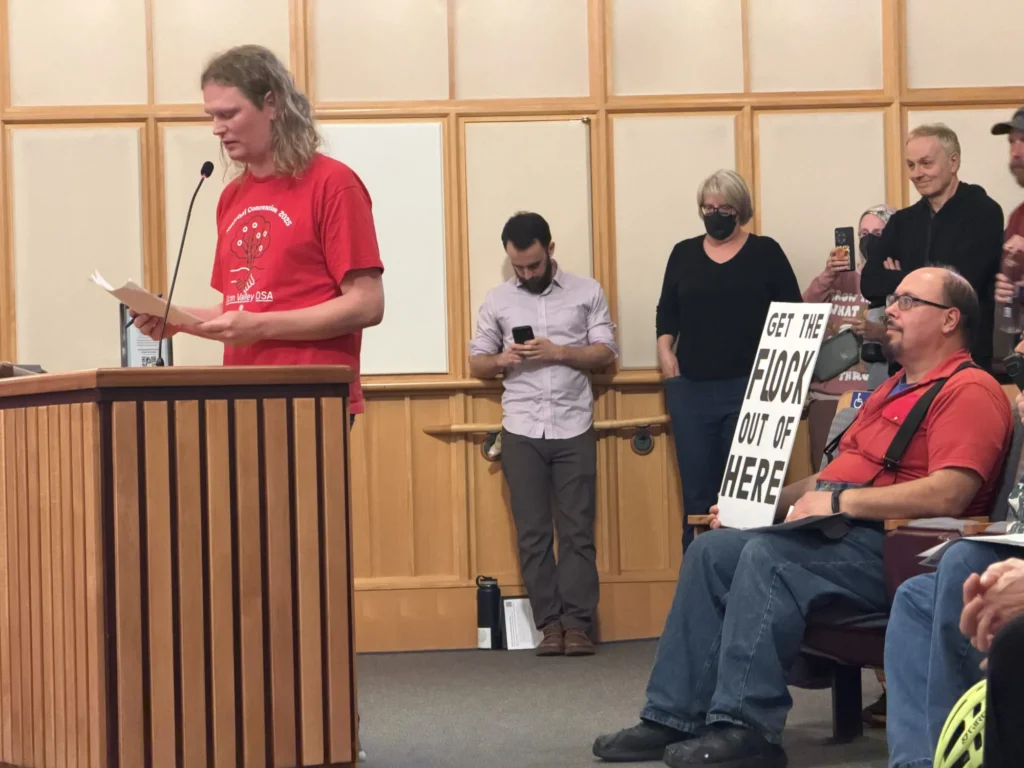 Mountain View resident Tim MacKenzie urges the City Council to cut ties with Flock Safety at a meeting on Feb. 24, 2026. Photo by Emma Montalbano.
Councilmembers weigh in
On Tuesday, councilmembers supported a formal recommendation from Canfield to terminate the city’s contract with Flock Safety. They urged the police department to take down the cameras as quickly as possible, with a few councilmembers also clarifying they did not have any interest in pursuing other iterations of an ALPR program.
“It is suffocating, how terrifying it is for our community now,” Mayor Emily Ann Ramos said, referring to heightened fears of federal immigration enforcement under President Donald Trump’s administration. “I hope we can find a way to get those cameras out.”
The council approved the implementation of an ALPR pilot program two years ago, selecting Flock Safety as the vendor. The first camera was put up in August 2024, and the final one was installed last month, bringing the total number up to 30. The cameras capture license plate numbers and other identifying information from the back of passing vehicles. The data is then cross-checked with a “hot list” of vehicles potentially associated with crimes, providing real time alerts to law enforcement agencies.
According to Capt. Evan Crowl, the Flock cameras provided Mountain View police with “actionable leads,” including in investigations of commercial burglaries, home and vehicle break-ins, a mail theft ring, missing persons and kidnapping.
Residents speak against Flock
Public speakers, however, lined up in droves to denounce Flock Safety and its data sharing breaches. They also objected to the idea that ALPR technology is a beneficial public safety tool.
“Mass surveillance does not keep our public safe,” resident Tim MacKenzie said. “No guardrails can prohibit any ALPR vendor from violating our fundamental constitutional rights to privacy.”
Resident George Duque also stressed the importance of the city terminating its contract with Flock Safety. He said he fled Colombia to the U.S. with his mom and sister 35 years ago. Since then, he has built a life in Mountain View.
“I can’t imagine how I would have felt knowing that I was being watched, knowing that ICE was coming after people like my family,” Duque said, with his two kids in the audience.
Several commentators questioned whether all of the Flock cameras have been deactivated, stressing it could be difficult to physically remove them since the cameras are not owned by the city, but rather leased from Flock.
Seeking to reassure residents, Crowl noted the police department had reached out to Flock Safety to ensure the cameras were turned off and not collecting data.
“We were assured that there’s no data being captured,” he said.
Canfield added the city was exploring the possibility of taking down the cameras itself to expedite the removal process, or using an outside vendor to do it.
On the whole, councilmembers strongly supported the staff recommendation to end the city’s contract with Flock Safety and get rid of the ALPR cameras. However, there was some discussion about potentially allowing the police department to “query” Flock’s database to assist with investigations, without having cameras in Mountain View that would contribute data to the system.
Councilmember Chris Clark broached the topic, which was shut down by colleagues who expressed discomfort with the idea of severing a contract with Flock while simultaneously maintaining a relationship with the company.
Councilmember Alison Hicks also noted it could complicate the city’s efforts to seek reimbursement from Flock Safety, which the city has paid $154,650 thus far, according to the staff report.
Looking to cut ties with Flock Safety completely, Councilmember Pat Showalter said the cost of the program was not just about money.
“We don’t want to spend $100,000 on something that we shouldn’t spend it on,” she said. “But what’s the real cost? (It’s) the cost to our civil liberties.”
This story originally appeared in the Mountain View Voice. Emily Margaretten joined the Mountain View Voice in 2023 as a reporter covering City Hall.