
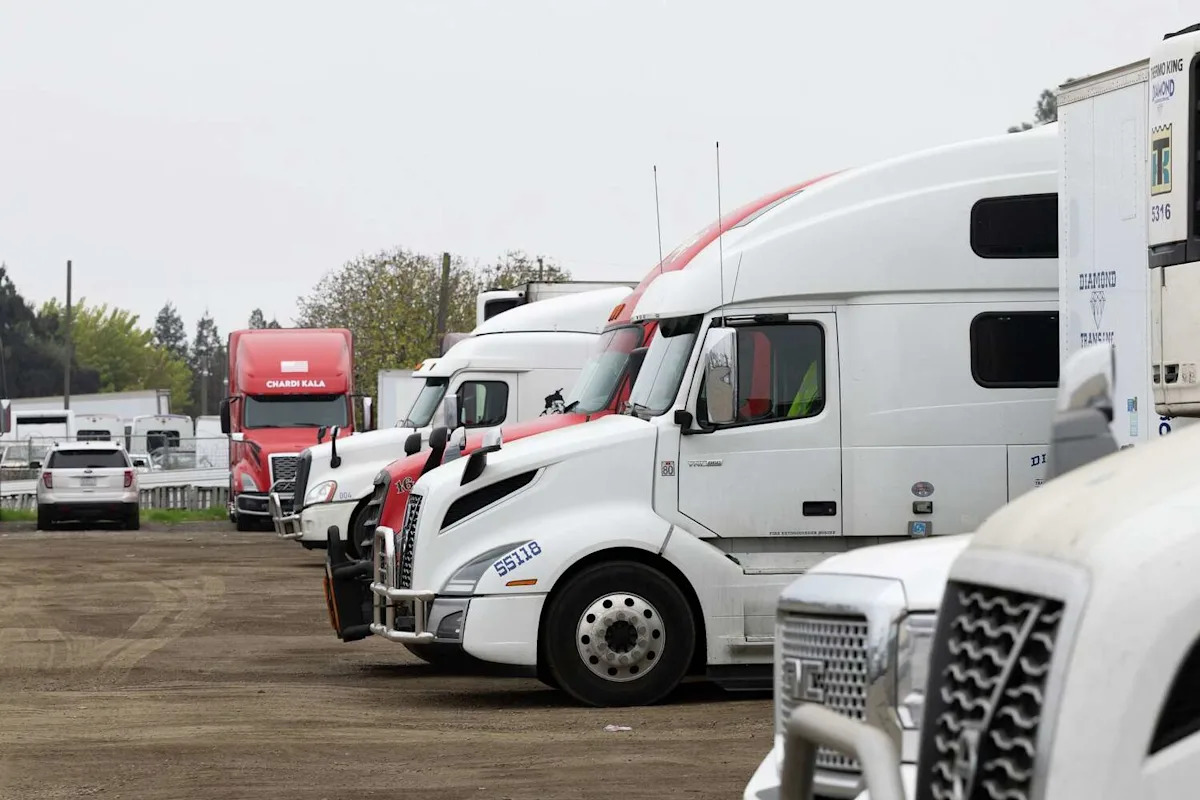
California says the Trump administration is intentionally stalling efforts to re-issue immigrant truck drivers’ licenses in order to keep them from ever driving professionally again.
Time is running out to issue new licenses to roughly 20,000 immigrant truckers in California whose licenses are set for cancellation on March 6 through no fault of their own. The DMV notified the drivers that their licenses would be revoked as a result of a clerical error on the agency’s part.
The mess stems from an ongoing dispute between the Trump administration, which has decried “dangerous foreign drivers” and accused California of flawed licensing practices, and the state, which said it identified a legitimate error in how it issued licenses – but that the error violated state rules, not federal ones, and does not justify the ensuing federal crackdown.
New rules imposed by the administration that would ban virtually all non-citizens from the trucking industry are set to kick in on March 16. That means the state has less than three weeks to help immigrants whose licenses were wrongly canceled – or the new rules will prevent them from obtaining one. The federal government regulates states’ commercial driving programs and could rescind California’s certification if it finds it’s out of compliance.
The state now says federal regulators “never intended” to allow the California Department of Motor Vehicles to “reissue licenses to eligible drivers at all,” according to an emergency motion filed last week asking a federal judge in Washington D.C. to intervene. The state accused federal regulators of “moving the goal posts” as a delay tactic.
Starting in November, California notified thousands of truck drivers that their licenses would be canceled because of a DMV system error in which they were issued with an expiration date that extended past when some immigrants’ work permits expired.
In most cases, those drivers’ work authorizations had been extended and updated, negating any conflict. But the DMV did not have those records on file and drivers were never told to present them. Now, drivers have no way to present proof they are still eligible because of the federal government’s pause.
The state has argued it’s been ready since December to resume processing commercial licenses for immigrant drivers, with fixes in place to ensure the dates align. But state officials say instead of accepting the fixes and allowing California to re-issue licenses, federal regulators continue to create new benchmarks.
“Its actions make sense only as a manifestation of hostility to immigrant drivers and a desire to force them from the commercial market,” said the state’s motion, which was submitted by Attorney General Rob Bonta.
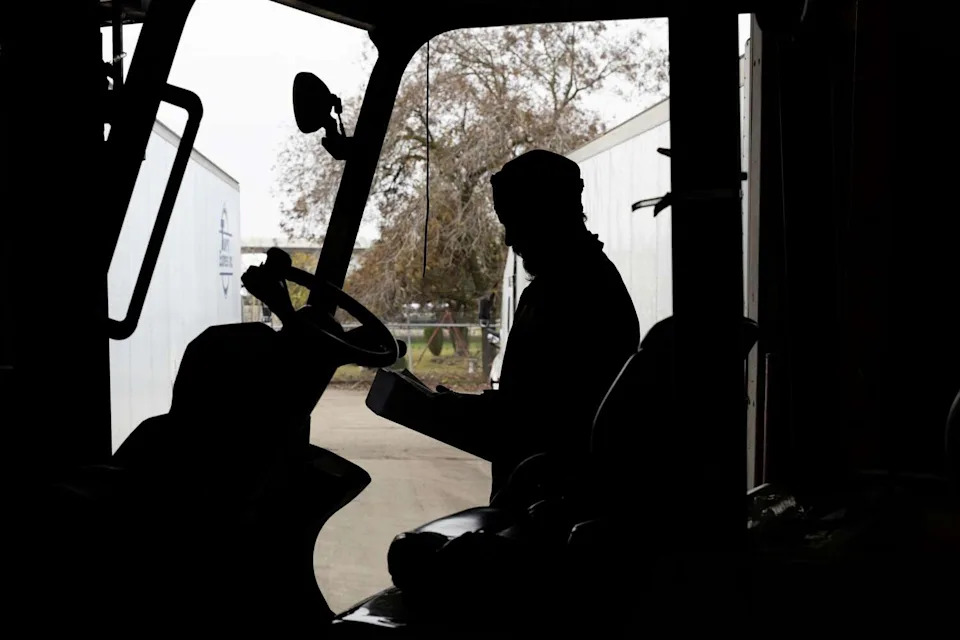
A driver with Diamond Transportation Logistics Inc. in Stockton approaches a truck on Dec. 15, 2025. (Benjamin Fanjoy/For the S.F. Chronicle)
California has about 65,000 so-called “non-domicile” drivers, a high concentration of which are Punjabi immigrants with ongoing asylum cases. Non-domicile drivers can also be refugees or DACA recipients.
President Donald Trump has repeatedly targeted immigrant drivers, and has used tragic accidents on the roads involving Punjabi drivers – some of which he has mischaracterized or described with falsehoods – as justification for new rules that lock most non-citizens out of the trucking industry altogether.
“Many, if not most, illegal aliens do not speak English and cannot read even the most basic road signs to direction, speed, danger or location,” Trump said during his State of the Union speech Tuesday.
Trump urged Congress to pass legislation named after a victim of one crash that would bar “any state from granting commercial driver’s licenses to illegal aliens.”
Advocates with the Sikh Coalition and other groups representing Punjabi drivers said they support increased safety standards and testing to ensure safety on the roads. They say punishing all non-citizen drivers for the mistakes of others is unfair and won’t make roads safer.
The pause has also impacted eligible drivers whose licenses weren’t canceled, because they cannot renew licenses with upcoming expiration dates.
That’s true of one driver suing the DMV in Alameda Superior Court over the cancellations.
One of the plaintiffs, identified as John Doe 4, got a cancellation notice the state now admits he should have never received. His license expires on Feb. 27 – and there’s currently no way for the state to renew it. He and others drivers argue the state is required to provide an opportunity to reapply and provide proof of work permits. A judge agreed during a hearing in Oakland on Wednesday.
The plaintiff is a school bus driver for disabled children in Southern California. He has a newborn son who was recently in the intensive care unit, according to court filings He will lose his job without a valid commercial license – and that means losing his family’s health insurance, court records say.
“I had nights where I could not sleep,” he said in a court filing. “I would constantly think about what would happen if my license were cancelled … and when I could fall asleep, I would dream about being at the DMV, waiting for my number to be called but being repeatedly told that I was not able to keep my (license) .”
Jane Doe, another plaintiff, is a school bus driver whose income will be cut in half if her license is cancelled March 6 because the DMV did not put the right expiration date on her license. The school district she works for can only offer her a lesser-paying job. The other drivers in the lawsuit include a mix of other bus drivers, long-hauler truckers and a tow truck company owner. Most have ongoing asylum cases. All have valid federal work permits, according to court records.
“There’s a potentially very limited window for DMV to fix this problem and to actually reissue licenses before that final rule is scheduled to take effect and to ensure that people are not deprived of livelihoods,” said Josh Rosenthal, an attorney with the Asian Law Caucus representing the drivers.
The state said in its filing last week in D.C. circuit court that federal regulators have put California in an “impossible situation.” Regulators will likely decertify the state’s commercial driving licensing program if it begins issuing licenses without federal permission, an outcome that could upend the industry.
“DMV has attempted to navigate this dilemma to avoid either outcome,” the state wrote in a Feb. 18 court filing. “Unfortunatley, (regulators) have refused to engage with DMV in good faith.”
Last month, the federal government rescinded $160 million in transportation funds, citing the dispute over the licenses. In court records, the state says federal regulators have threatened to withhold another $300 million.
Emails between the state and federal regulators show a professional but at times tense back-and-forth. At one point, regulators said they couldn’t accept any of the DMV’s system updates until it came to do an in-person “simulation” of how it would process commercial licenses for the immigrant drivers.
A tentative visit was scheduled for Feb. 24 to Feb. 26, emails show, but the DMV did not respond to a request for comment confirming the meeting would or had taken place. Emails show California had pushed for an earlier visit.
Federal regulators said in court filings they would not accept the state’s system fixes until it cancelled the roughly 20,000 licenses with date issues. Department of Justice Attorney Brett A. Shumate wrote in a response filed Feb. 16 that the state’s decision to delay canceling those licenses – which were originally slated to expire in January – showed the state had not “completed the corrective actions it was required to undertake.”
That creates a chicken-and-egg problem: The state can’t help immigrants whose licenses are set for cancellation until the federal government allows it to resume operations. The federal government won’t allow it to resume operations until the state cancels the licenses.
Shumate said in court records that regulators delayed an in-person review because they wanted to have all the documentation of the DMV’s new processes to ensure they were prepared for a productive visit.
Once the new federal rules begin March 16, the only new non-citizens able to drive commercially will be those in the country on temporary work visas tied to their employers: H2-A, H2-B, and E-2. If the judge grants California’s motion, it would be able to process licenses before the new rules take hold.
Transportation Secretary Sean Duffy said in a statement celebrating the new rules that they close a “safety loophole” and add additional vetting. Meanwhile, those new rules are facing legal challenges in another D.C-based case.
“Moving forward, unqualified foreign drivers will be unable to get a license to operate an 80,000-pound big rig,” Duffy said. “Under President Trump’s leadership, we are putting the safety of the driving public first.”
The press release points to 17 crashes and 30 deaths by non-domicile drivers in 2025. That accounts for less than .5% of the total fatal bus and truck crashes in the United States, according to the latest full-year data available on the Federal Motor Carrier Safety Administration’s website.
On Wednesday, members of the Sihk community packed an Oakland courtroom to support the drivers at risk of losing their licenses. Among them was Gunveer Singh, 33, of Hayward.
He’s a former truck driver who helps run a brokerage to assign drivers hauling produce to Texas grocery stores. He can’t find enough drivers to handle the deliveries. If 20,000 licences get canceled in March, the problem will only get worse, he said.
“And then your prices will go up at the grocery store,” he said. “It’s simple supply and demand.”
This article originally published at California pulled immigrants’ trucking licenses. Now it can’t give them back.