
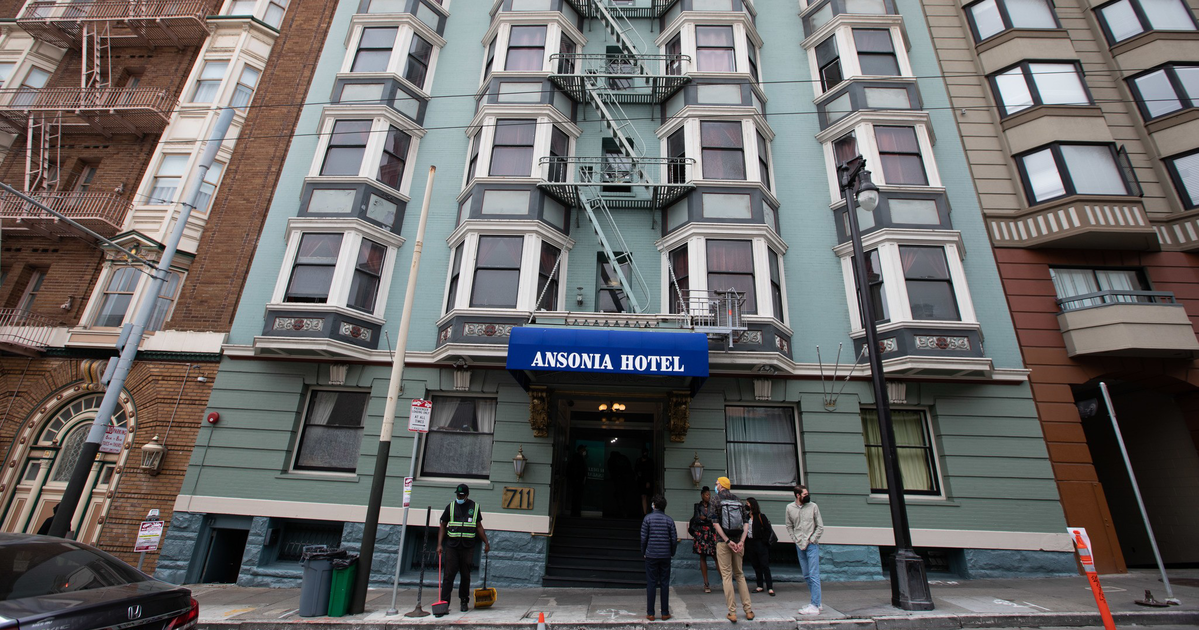
After years of seeing homeless shelters open around her since the pandemic, Lower Nob Hill resident Barbara Swan says the neighborhood has reached its limit.
Swan, who leads the Lower Nob Hill Neighborhood Alliance, is petitioning the city to close a 280-bed shelter operated by homeless services nonprofit Urban Alchemy at 711 Post St., arguing that it has worsened drug use and violent crime in the area and harmed businesses.
Opened in 2022, the shelter — one of the city’s largest, catering to severely mentally ill and addicted clients — is part of a heavy concentration of services for vulnerable people in the neighborhood, which borders the Tenderloin and Nob Hill. There are three shelters within 28 blocks, plus seven other facilities serving current and formerly homeless people, including a behavioral health center and permanent supportive housing sites.
“We’re not against the homeless — we have to do our part,” Swan said. “But we have done way more than other neighborhoods.”
Her petition (opens in new tab) has gathered about 170 signatures, mostly from residents of Post Street. But the city has made no indication that it will close the shelter — even as the district’s supervisor, Danny Sauter, has called for doing so.
“No residential neighborhood can survive this level of concentration, and Lower Nob Hill is now in crisis,” the petition says.
 Jones Street between Geary and Post streets was devoid of drug use or dealing during a visit late Tuesday. | Source: Garrett Leahy/The Standard
During a Monday afternoon tour with Swan, the area around 711 Post appeared fairly calm. Within five blocks of the five-story building that houses the shelter, formerly the Ansonia hotel, The Standard saw only three people who appeared to be homeless. Several needles were discarded on the sidewalk about a block from the shelter, but there was none of the brazen drug use and crowded sidewalks commonly spotted in trouble zones in the Tenderloin and SoMa.
Swan insisted that five people idling on Jones Street near Geary were drug users.
“It’s clean now,” she said. “It’s better during the day, but it gets worse at night.”
During a follow-up visit late Tuesday, Lower Nob Hill’s rain-soaked streets were mostly quiet. Between 10:30 p.m. and 12:30 a.m., The Standard met three people holding pipes or foil used to smoke drugs. One said they were staying at the 711 Post shelter. Most activity was on Geary Street, with small clusters of people and a few sleeping on a sidewalk or in a doorway.
The areas Swan said transformed into drug markets at night, including Jones between Geary and Post, Shannon Street, Derby and Taylor streets, and Cosmo Place, were all empty around 11 p.m.
 Shannon Street, another area Swan says is a den of drug use, was also empty. | Source: Garrett Leahy/The Standard
Swan cited a video (opens in new tab) posted by a controversial street videographer who goes by the moniker JJ Smith taken roughly four hours later, showing small groups gathered and sleeping on Pine and Sutter streets, north of Post.
“They keep moving around,” she said.
Police data paints a mixed picture: Drug offenses in Lower Nob Hill have nearly doubled since 2019, while weapons offenses rose 47.4%. There were two homicides in 2019 and five in 2025. However, over that time period, assaults and robberies declined sharply, and total crime fell about 20%, compared with a 50% drop citywide.
Meanwhile, non-emergency calls to the city’s 311 service related to Lower Nob Hill have roughly doubled since 2019, to 29,000 last year. Street-cleaning requests jumped 170% over that period, and noise complaints rose by a similar margin, but reports of encampments fell by about 33%.
Most neighbors who talked to The Standard said they haven’t noticed an uptick in drug use or violent crime nearby, as Swan’s petition alleges. Only one person interviewed said they felt unsafe in the area.
Some residents noted that drug use creeps into the neighborhood at night but disputed that there’s been an increase.
“I don’t have a problem here,” said Rodger Claxton, who has lived on the same block as the shelter for three years. “I’ve never been hassled.”
Jairen Sylvester, who has lived in Lower Nob Hill for 10 years and has been unhoused and sleeping on the streets for the last three, said drug use hasn’t increased since the pandemic-era hotel shelters opened in 2021.
“And it’s not that bad up here because of Urban Alchemy,” Sylvester said.
 Jairen Sylvester says drug use in Lower Nob Hill hasn’t increased. | Source: Garrett Leahy/The Standard
Others said drug use has gotten worse overall, not just near the shelter.
“It’s not because of one hotel,” said Tracy Stephens, who lives nearby. “It’s worse in general everywhere.”
Business owners along Post Street largely echoed that sentiment, describing occasional petty theft or loitering but no major disruptions directly tied to the shelter.
“We don’t have problems here from the guys in there,” said Raul Licea, co-owner of Chuy’s Fiestas Taqueria II. “All the time when I come out, it’s clean.”
Urban Alchemy spokesperson Jess Montejano said the nonprofit chose not to renew its contract to operate the shelter because of tensions between neighborhood residents and staff. In September, an Urban Alchemy worker was fatally shot (opens in new tab) in nearby Civic Center after telling a person not to use drugs in public.
“We’re super proud of what we accomplished, helping to place hundreds of guests into permanent housing,” Montejano said.
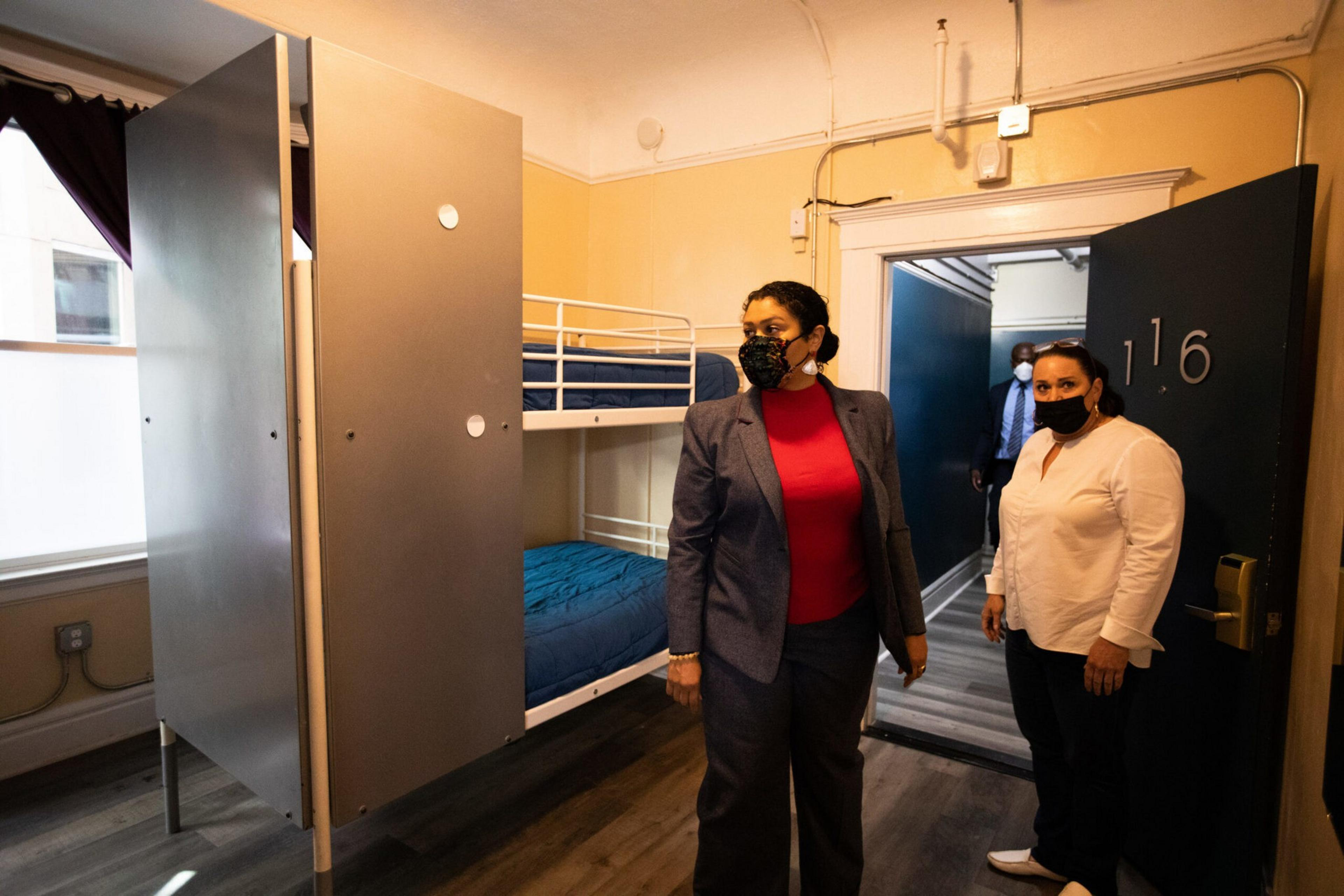 Former Mayor London Breed tours a bedroom at the shelter at 711 Post St. in 2022. | Source: Benjamin Fanjoy
The Department of Homelessness and Supportive Housing declined to comment on contract negotiations with a new shelter operator, but Five Keys Schools and Programs CEO Steve Good said his nonprofit has been selected to take over operations April 1. The nonprofit is negotiating with the city to operate the shelter through the rest of 2026 with a possible two-year extension, though a contract has not been finalized, he said.
Staffing and services will remain largely the same, Good said, including street patrols to discourage loitering and public drug use.
“We plan to offer the same services Urban Alchemy has,” he said.
Dispersing facilities for homeless people around the city, rather than concentrating them in particular areas, is now official policy. Last year, supervisors passed a law (opens in new tab) barring new shelters in neighborhoods already saturated with them.
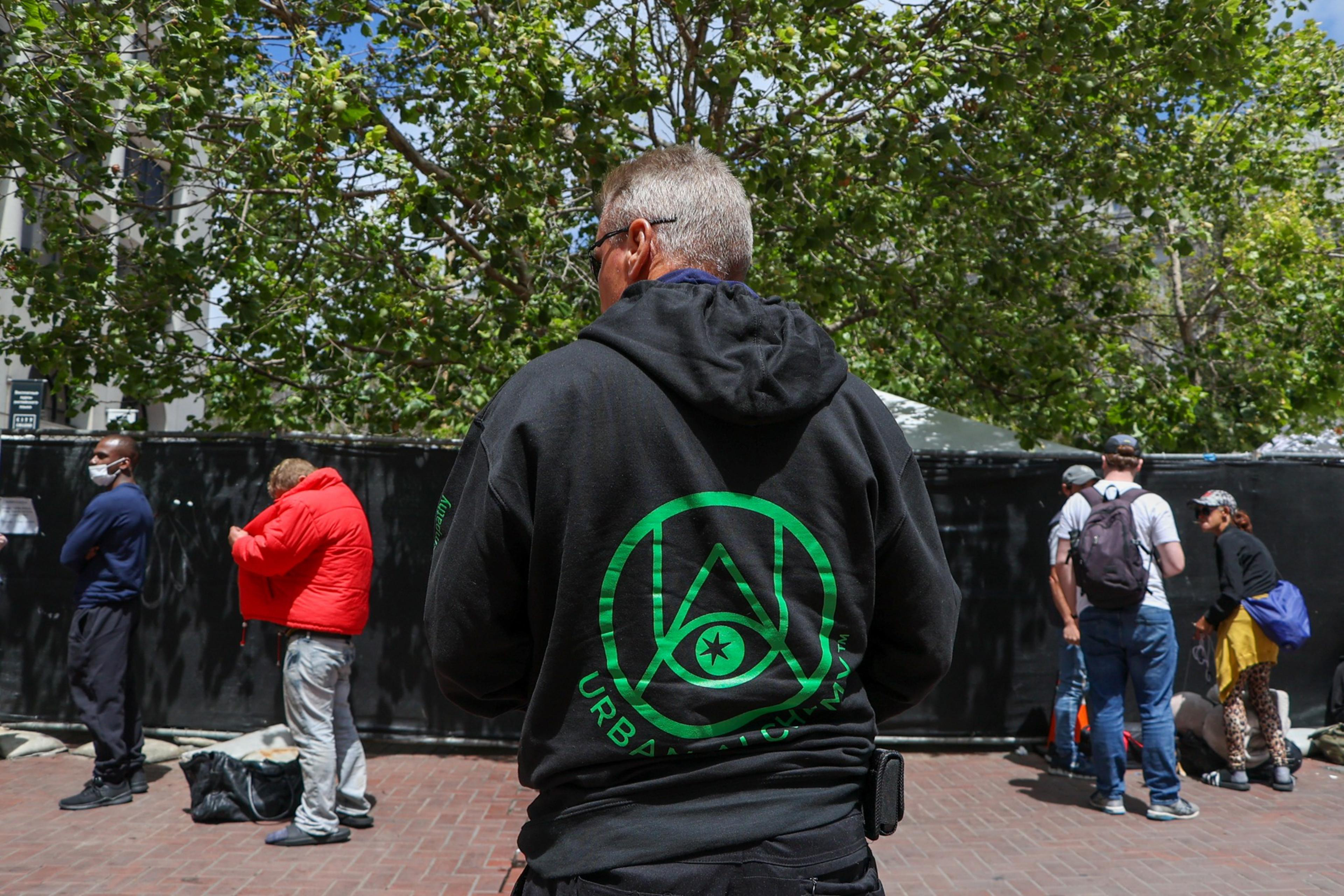 Urban Alchemy will cease to operate the shelter on March 31. | Camille Cohen/The Standard
The extent of the homelessness crisis in the city is in flux. Results of the 2026 homelessness count, which was conducted Jan. 29, are not complete. The most recent point-in-time count (opens in new tab) with available data, from 2024, found a 7% increase in the total number of homeless people from two years before. Temporary shelter and crisis intervention programs were at or above 90% capacity (opens in new tab) between July 2023 and July 2025.
Sauter supports converting 711 Post to a youth hostel but has not outlined a plan for doing so. The supervisor’s office has received complaints about weapons and drug use at the site.
Shelter residents, such as Jonathan Bankes, strongly oppose closing it.
Bankes acknowledged that there is drug use but questioned whether shelter residents are responsible for broader neighborhood issues, saying drug users are likely to stay close to where they live. “If you go somewhere else, it’s from another shelter,” he said.
Another resident, Sierra Heredia, said closing the shelter would push hundreds of people back onto the street. Getting a bed at 711 Post “changed everything for me,” she said.