
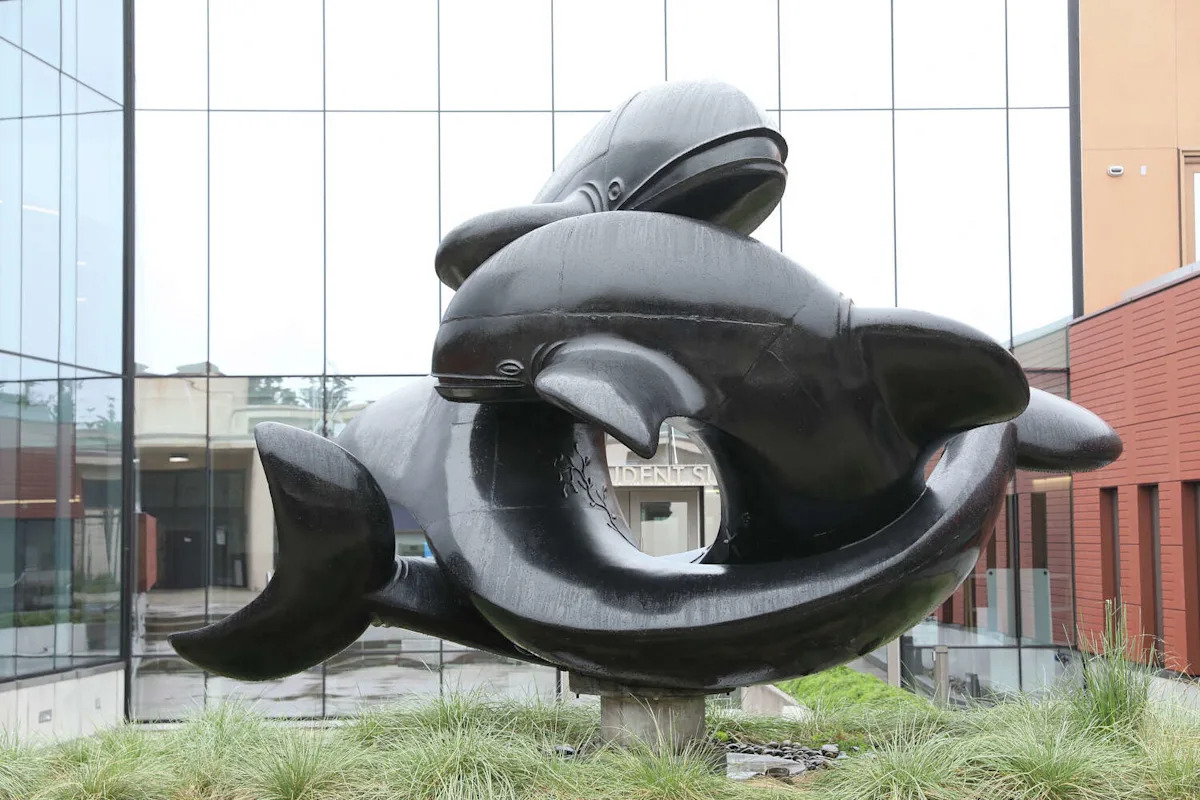
My appreciation for art started with a mediocre bologna and American cheese sandwich at the foot of an epic San Francisco sculpture.
For nearly a half-century, Robert B. Howard’s “Whales” in the courtyard outside Steinhart Aquarium was the ideal meeting spot for classroom visits to California Academy of Sciences. We’d eat our sad school lunches on the concrete rim that served as a bench around the two playful intertwined cetaceans, then run circles around the sculpture’s fountain until it was time to reenter the museum and visit the epic fish roundabout again.
That was the 1980s, and the Cal Academy was the second stop for Howard’s sculpture, which made its debut in 1939 at the Golden Gate International Exposition on Treasure Island. It moved outside the aquarium in the mid-1950s, serving as a favorite landmark until the old Cal Academy was demolished in 2005.
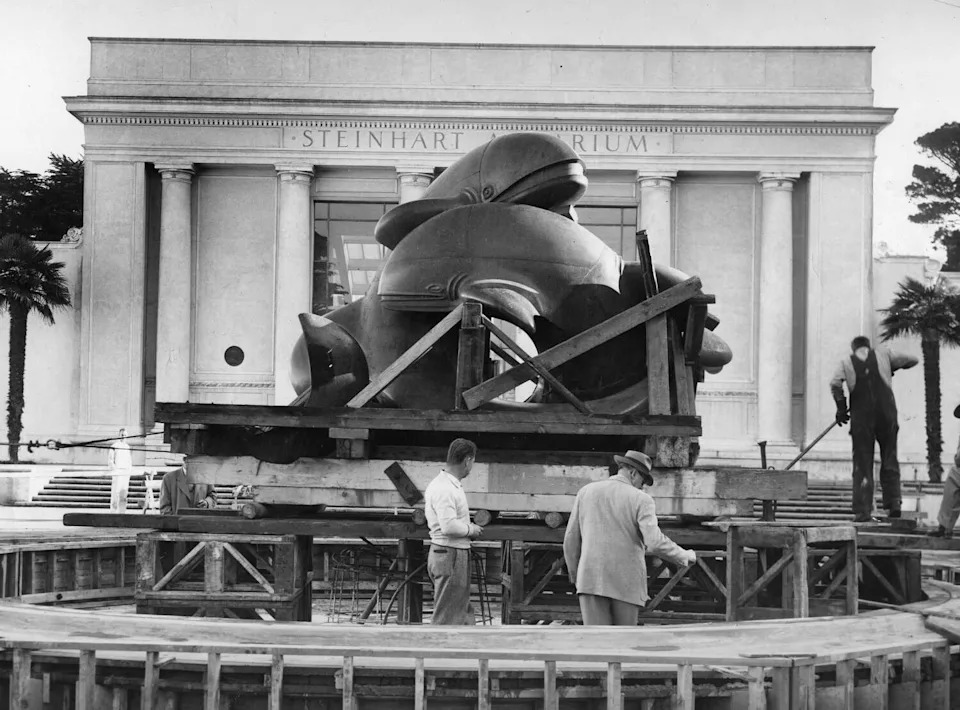
1956: Workers install Robert Howard’s “Whales” sculpture outside Steinhart Aquarium at the California Academy of Sciences building in Golden Gate Park. (Bob Campbell/S.F. Chronicle)
After two decades in storage it resurfaced last year in the southwest corner of the City College of San Francisco.
Its third home may be the best yet. The community college in Balboa Park has become an island of misfit public art toys, with an iconic Benny Bufano sculpture at the entrance and Diego Rivera’s “Pan American Unity” mural returning to public display soon. But even a completely random walk around the campus is filled with eclectic sculptures, murals and immersive art projects. It’s like the city’s secret art museum, open air with stellar views and completely free to visit.
And “Whales” is the rug that ties the room together.
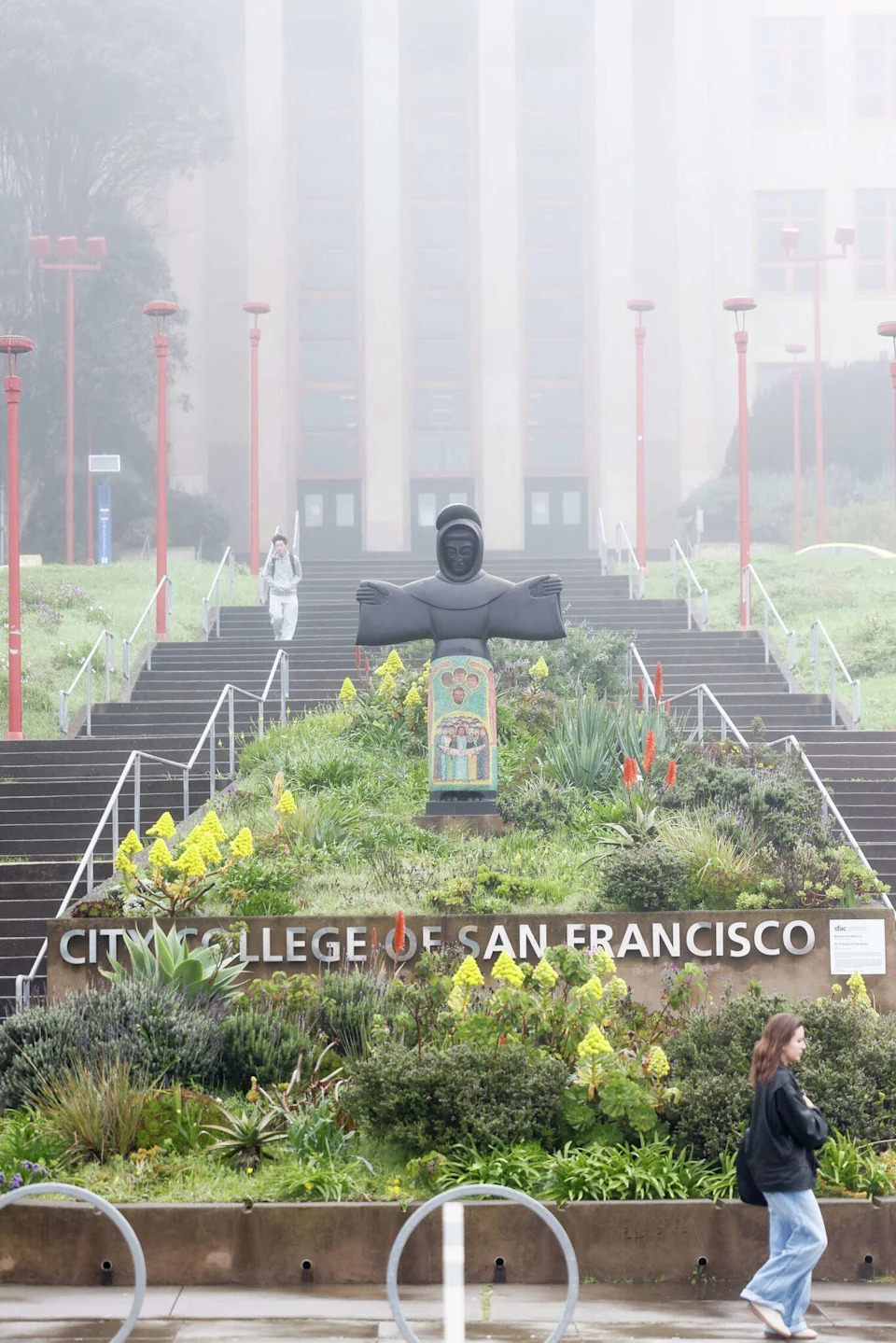
“St. Francis of the Guns” by Benny Bufano is seen in front of the Science Building at City College of San Francisco. (Lea Suzuki/S.F. Chronicle)
“They’re just fun and kind of fantastic,” said Allison Cummings, civic art collection registrar for the San Francisco Arts Commission, which owns the aquatic artwork. “It really does feel like it’s moving. That’s a testament to the sculptor’s ability to understand movement and space.”
“Whales” was an immediate hit when it debuted at the exposition in 1939. Howard was a well-known local artist, arguably eclipsed in fame by his architect father John Galen Howard, who designed the Campanile at U.C. Berkeley and the San Francisco Civic Auditorium.
Not long after Chronicle art critic Alfred Frankenstein saw the piece, he began fretting what would happen to it once the world’s fair ended, making a “strenuous call” for its preservation.
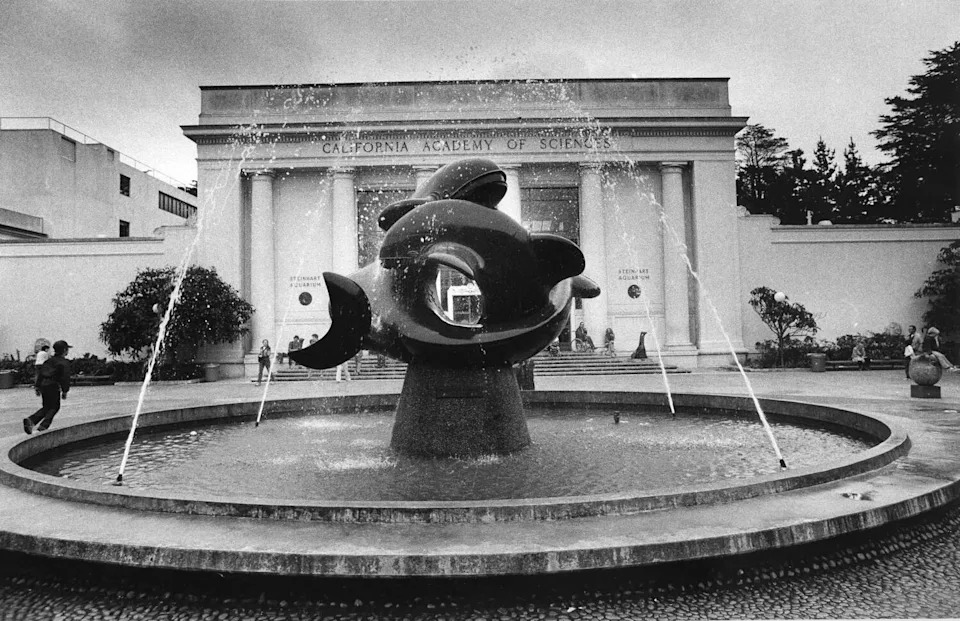
Feb. 27, 1983: Robert Howard’s “Whales” sculpture at the California Academy of Sciences. It was originally part of the Golden Gate International Exposition on Treasure Island. (Frederic Larson/S.F. Chronicle)
The sculpture went into storage, and over the next decade Chronicle readers continued to demand its return in letters to the editor. Critics lauded a populist charm that turned even easily distracted children into art enthusiasts.
What “Whales” fans didn’t realize is that the 11-ton piece had been lost. It was discovered in 1950 during a routine facilities inventory, stashed in a stable where peacocks roamed on the west end of Golden Gate Park. The sculpture reappeared at Cal Academy in 1956, replacing a seal pool with two black granite cetaceans that seemed as alive as anything inside the aquarium.
“Whales” went back into storage at CCSF after the Cal Academy rebuild left no place for it, but Cummings said new generations had already fallen in love. (“Almost annually there was some kind of inquiry,” she said.) The sculpture finally emerged last fall, set in an alcove on the west end of CCSF’s new student center.
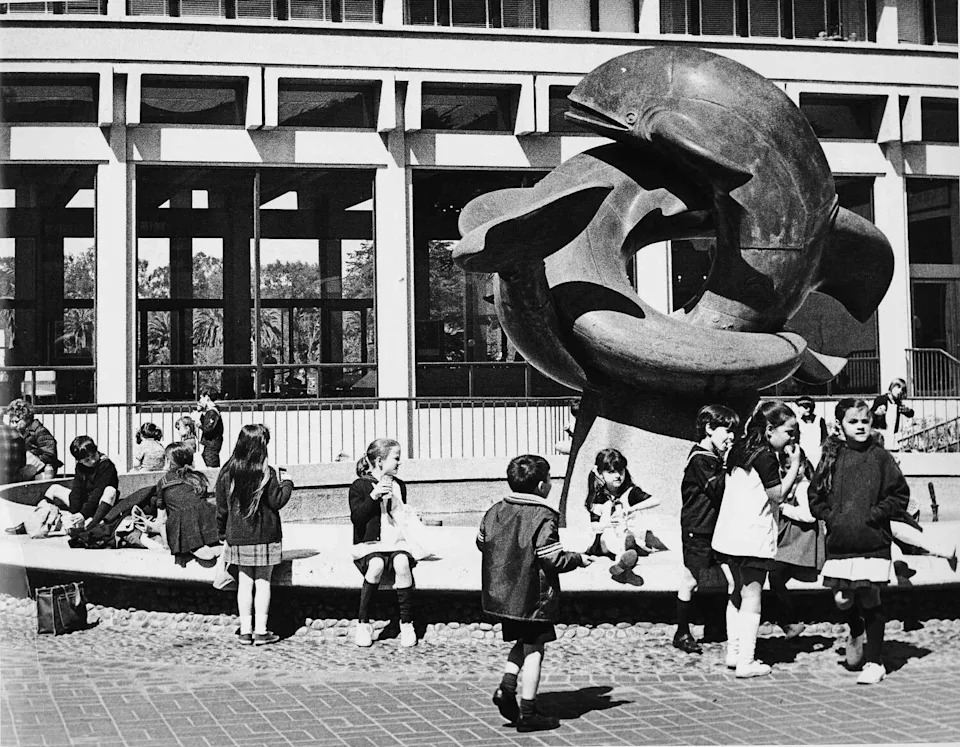
Children gather around sculptor Robert Howard’s “Whales” in the old courtyard of the California Academy of Sciences. (California Academy of Sciences/courtesy Cal Acad. Sciences)
Mapping out my visit to the sculpture, I’m shocked how close the campus is to downtown, just a 15-minute BART ride to the Balboa Station plus a five minute walk. (Bonus: Beep’s Burgers is another two blocks away.) The sculpture is tucked behind the building, but that’s a plus; it’s bordered on three sides by mirrored windows, making me feel surrounded by a pod of whales.
There’s no wide fountain here, but that means the shiny stone is almost close enough to touch. I see shells, crabs and seaweed stamps on the whales I never noticed before, lending credence to my theory that Howard wanted us to see them through our child’s heart.
I let the nostalgia linger – first time I’ve craved a bologna sandwich … ever? – then hop on my bike to tour the school’s nearly three dozen installations. (Most are on this map.)
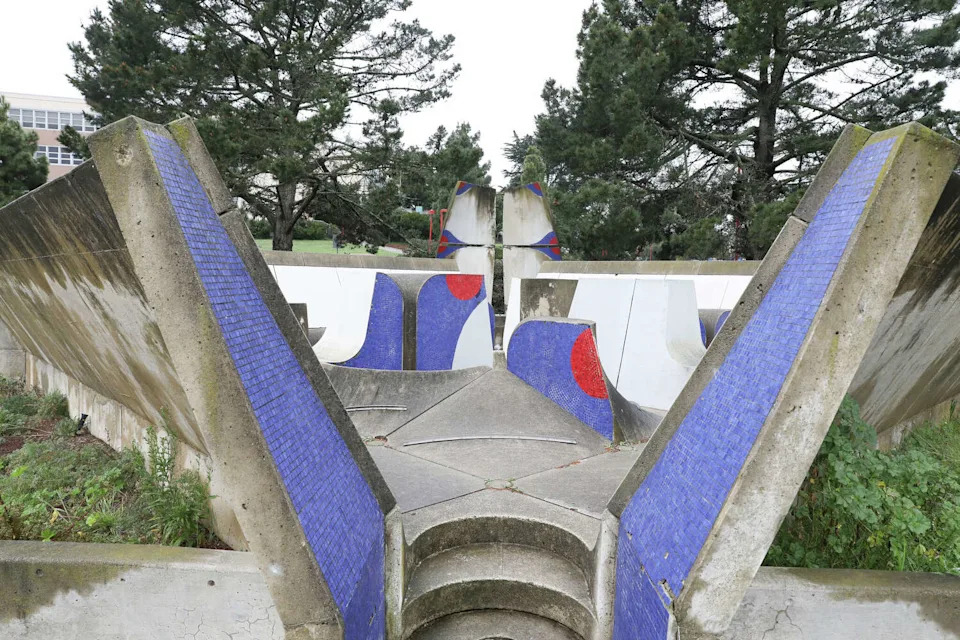
“Sculptural deck and Bicentennial Wings” by Jacques Overhoff is seen in front of Batmale Hall on the campus of City College of San Francisco. The school has amassed an impressive collection of public art. (Lea Suzuki/S.F. Chronicle)
Bufano’s “St. Francis of the Guns,” at the college’s Frida Kahlo Way entrance, is the most prominent and powerful piece. The prolific San Francisco artist built the striking statue of the city’s namesake saint from melted handguns and inlaid mosaics to honor assassinated leaders Abraham Lincoln, John F. Kennedy, Robert Kennedy and Martin Luther King Jr.
But the biggest joys come when I travel randomly, enjoying the panoramic southwest views as I bounce between open-air artworks. Jacques Overhoff’s 1979 “Sculpture Deck” and “Bicentennial Wings” are massive Brutalist-inspired installations in front of Batmale Hall, the former an open-top concrete cove with red and blue tiles that look like alien eyes. Students can crawl inside and shelter from the wind – an art piece and perfect study corner for group projects. (The latter is a twisting tower sculpture using the same materials.)
Precita Eyes muralists and student artists painted the colorful and poetic “Song of the Spirit” at the Student Union entrance in 1999, celebrating diversity at the school after Proposition 209 effectively removed affirmative action programs in the state. “We have a dream. The dream is alive. Empowered by love. We will survive,” one passage reads, over multi-ethnic dancing figures.
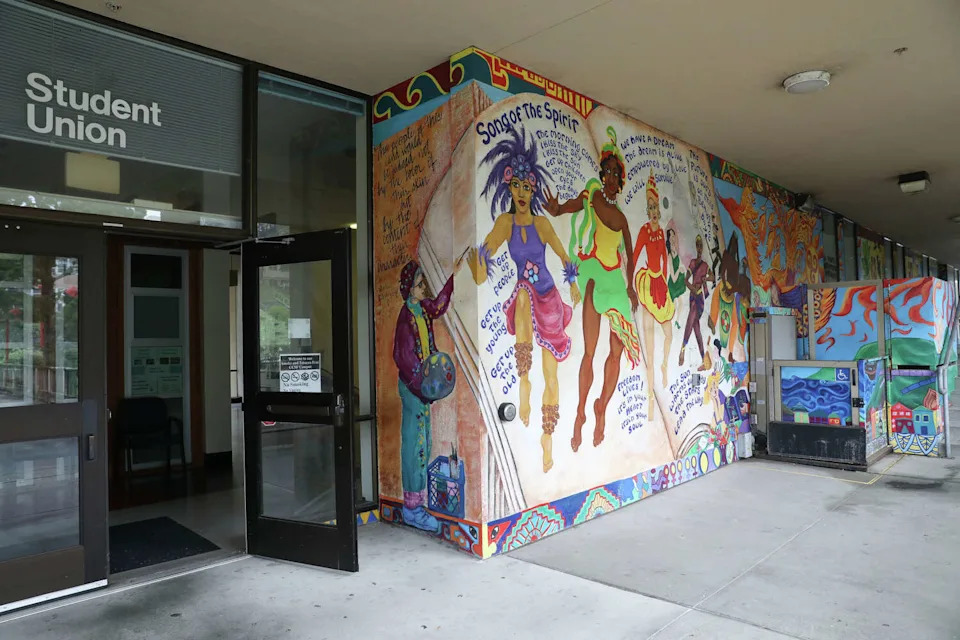
The mural “Song of the Spirit” by Precita Eyes Muralists with City College students is seen outside the Student Union at City College of San Francisco. (Lea Suzuki/S.F. Chronicle)
On my way back toward BART I pass Aristides Demetrios’ tree-like “Sentinals” sculpture in curved bronze and glance inside the student center to see Dudley Carter’s “Bighorn Mountain Ram,” carved out of a redwood log. (Good synergy: Rocky the Ram is CCSF’s mascot.)
Perhaps most exciting, Rivera’s 74-foot-wide “Pan America Unity,” recently on display at the San Francisco Museum of Modern Art, returns to campus in 2028, where it will finally be given the showcase it deserves inside the new Diego Rivera Performing Arts Center.
“Is City College one of our best art museums?” I think, as I bike in search of the next surprise.
Answer that question yourself. Some of San Francisco’s most nostalgic, majestic and accessible artwork is free to see, just a quick BART ride away.
This article originally published at This San Francisco school has become one of the city’s best free art museums.