
In a hangar 1½ miles from the Mexican border, airplane parts lay scattered across a concrete floor. Rising from the center of the bay is a Star Wars–style cockpit, neon-lit and hissing as the door opens to reveal a dashboard equipped with self-flying software. Orange tape on the floor traces where a wing will eventually end, while the real thing lies in front of the hangar — its multicolored cords exposed like veins.
Taken together, the pieces form a glimpse of aviation’s next chapter.
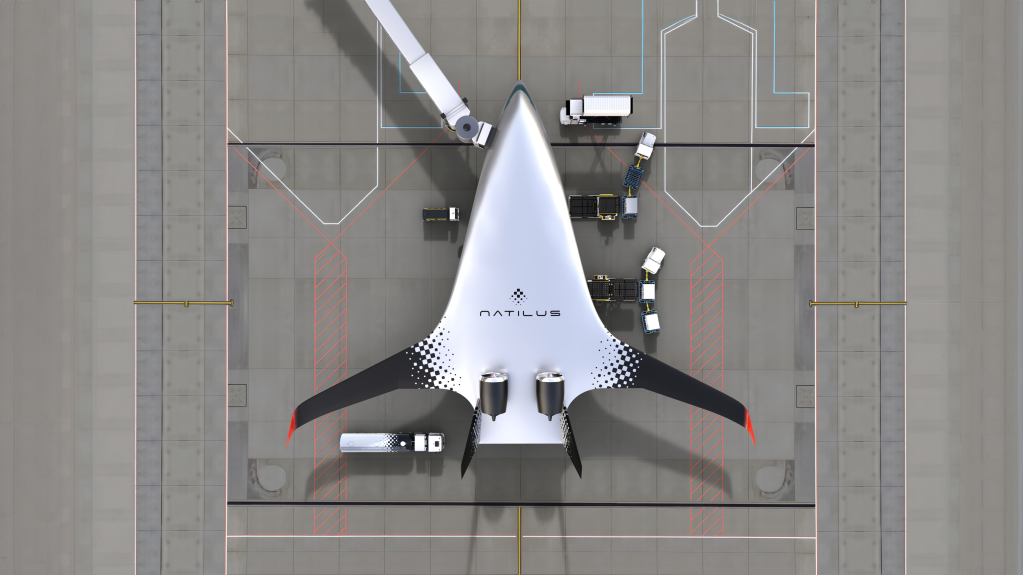
San Diego aerospace company Natilus recently debuted designs of its sleek, triangular commercial aircraft. The blended-wing-body plane — which kind of looks like a manta ray — requires 30% less fuel, cutting operating costs in half.
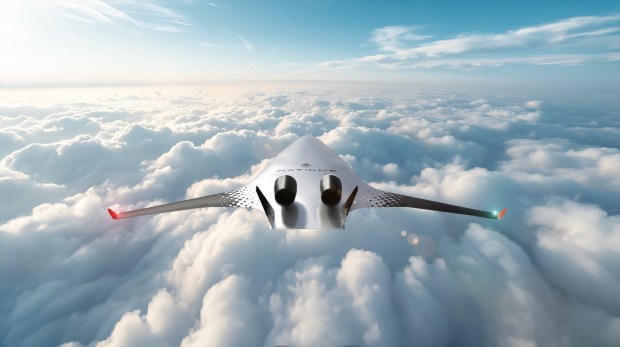 Renderings of the Horizon commercial aircraft, reviewed by the Federal Aviation Administration. (Natilus)
The new renderings are just one announcement of many this month. Natilus also secured $28 million in funding — for both its commercial and cargo plane — and added a high-profile executive to its board.
“We’re going to be the next Boeing,” said Aleksey Matyushev, CEO and co-founder of Natilus — and now he’s building the board to match that ambition. A former Boeing executive joined the board of directors, and more aerospace insider appointments will be announced in the coming months, Matyushev said.
While competition forms on the ground, it will be a few years until Natilus takes to the sky.
Today, the company is piecing together its first cargo plane, the Kona, for a test flight scheduled for 2028. The commercial passenger aircraft, the Horizon, will have its first test flight a year later.
If all goes to plan, both planes should take off in the early 2030s.
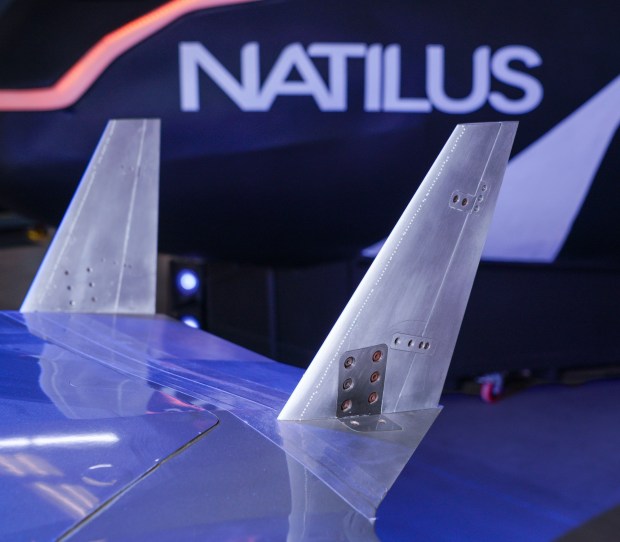 A one-tenth scale model of the startup’s cargo plane — called the Kona — is used for wind-tunnel tests. (Howard Lipin / For The San Diego Union-Tribune)
Progress paused
Traditional tube-and-wing airplanes have been circling the globe for 60 years, and Matyushev says it’s time for a change. The blended-wing-body concept has been explored since the 1920s — NASA and Boeing researched it in the 1990s.
“Nothing is stopping Boeing from developing a blended-wing-body airplane. There is nothing stopping Airbus from doing something like this, short of obviously imagination and a willingness,” said Henry Harteveldt, airline analyst at Atmosphere Research Group.
Boeing and Airbus already have backlogs of current models spanning years, and it takes billions of dollars to bring a new airplane to market. There is no incentive to innovate, Matyushev said.
Matyushev and co-founder Anatoly Starikov saw this stagnancy firsthand. They both worked in aviation and aerospace for almost a decade before they decided to innovate on their own.
Their “aha moment” came with the rise of Amazon and e-commerce, said Matyushev. Airplanes would often max out on space before they reached the weight capacity.
It was time to design a better plane.
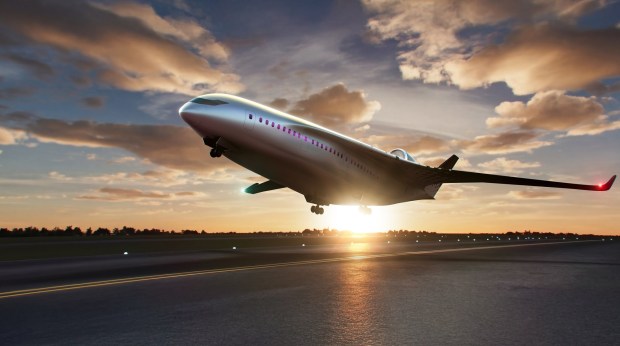 Natilus, founded a decade ago, is working on new designs for the Horizon, its commercial passenger aircraft. (Natilus)
Built differently
Recently released renderings of Natilus’s new plane show a double-decker design with seating for up to 200 passengers above a cargo cabin.
Commercial airlines can customize their floor plans, and Natilus offered ideas, like face-to-face four-seat configurations and video-conference pods.
That flexibility is enabled by scale: the Horizon offers about 40% more cabin space than a Boeing 737 or an Airbus A321, according to the company.
And while the design is innovative, much of the infrastructure is not. Natilus will use existing engines and airport facilities, ensuring easier compliance with safety standards and airport operations.
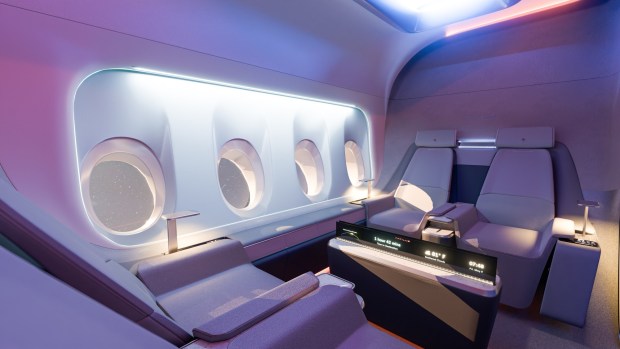 Renderings of a face-to-face seating configuration for the Horizon passenger aircraft. (Natilus)
Rivals in flight
Today, Natilus has a backlog of 580 aircraft orders, valued at up to $23 billion. Customers include commercial carriers such as Indian low-cost carrier SpiceJet, regional cargo operator Ameriflight and Nolinor Aviation, a charter airline based in Montreal.
Matyushev hinted at an additional potential airline partnership.
But Natilus isn’t the only one vying to build a better plane.
One hundred miles north, JetZero is experimenting with blended-wing-body aircraft in Long Beach. So far, the company has announced partnerships with Delta Air Lines, United Airlines, Alaska Airlines and the U.S. Air Force.
Despite surface-level similarities, Matyushev pushed back on the idea that JetZero is a direct competitor. “Just because it looks like we have the same airplane doesn’t make us competitors,” Matyushev said, noting that his Horizon plane targets a smaller aircraft segment serving a different market.
“There’s plenty of room for all of us,” Matyushev said. “The more successful they are, the more successful we’re going to be.”
But, “partnerships mean nothing at this point,” said Harteveldt. “They’re nice to have. You can put logos on your pitch deck … but at this point, if you were to talk to Delta or United, they’d say, ‘Yeah, we’re interested in what JetZero is doing. But if Natilus comes out with something better, we’re going to order it.’”
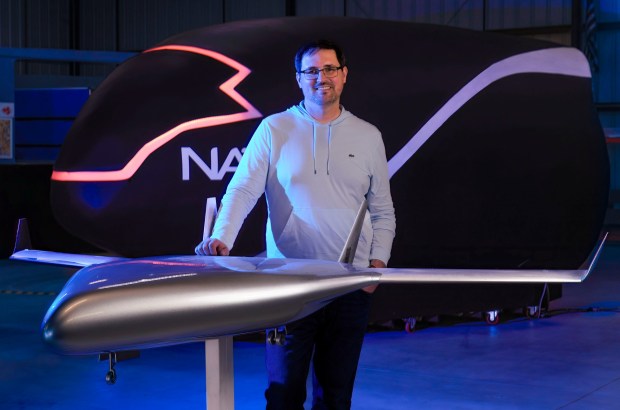 Aleksey Matyushev, co-founder and CEO of Natilus. He said their “aha moment” came with the rise of Amazon and e-commerce. Airplanes would often max out in space before they reached the weight capacity. (Howard Lipin / For The San Diego Union-Tribune)
The cabin crew
The lead investor of Natilus’s latest fundraising round is Tim Draper of Draper Associates. His firm manages more than $2 billion and has backed several unicorns, including Coinbase, Skype, Robinhood and Tesla.
“He was a big believer early on, especially when there’s a duopoly,” Matyushev said. “He hates a duopoly.”
But breaking the Boeing-Airbus dominance will take more than the $33 million Natilus has raised so far.
Matyushev acknowledged that. It takes $7 billion to deliver a new commercial aircraft and about $250 million to create a cargo plane.
“We know you can’t go raise $10 billion right away. We had to start small,” he said, explaining the true value of the latest fundraising round wasn’t the dollar amount, but the strategic partnerships it brought. “All of our investors work with us day to day. That’s the difference.”
One of those partners comes from Boeing’s highest ranks. Dennis Muilenburg, the former CEO of Boeing, invested through his firm, New Vista Capital. The firm’s senior partner, Kory Mathews, also a former senior Boeing defense executive, recently joined Natilus’ board.
While experienced leadership will help, the hardest part is still ahead.
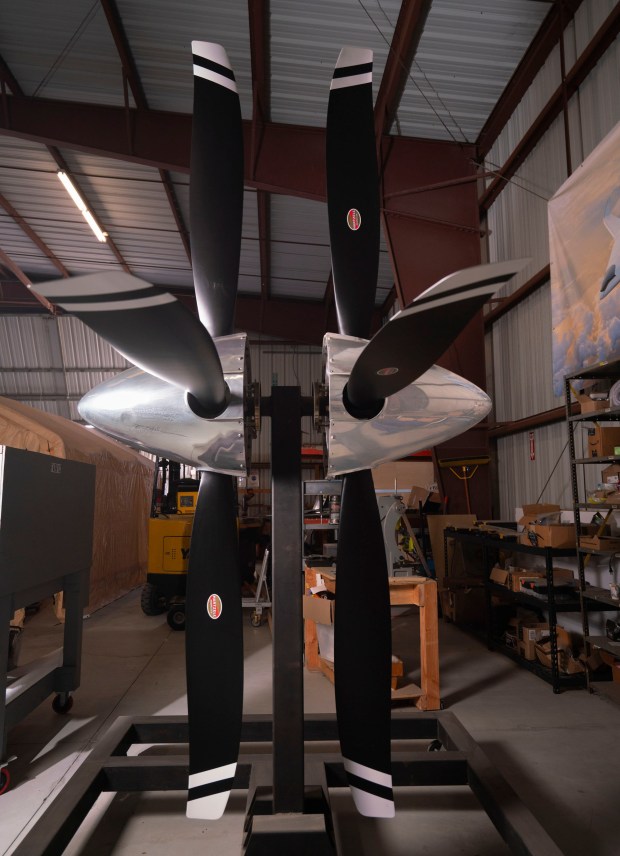 The propellers that will be used on an aircraft being developed by the startup Natilus. (Howard Lipin / For The San Diego Union-Tribune)
Manufacturing a fleet
“It’s one thing to build one airplane,” said Matyushev. “To do this five times every month, that’s a little bit more of a challenge. We need a new facility. We need to train the workforce … you need infrastructure, you need local support, usually you’re coming into a town that’s never built carbon fiber, so it’s a lot of challenges.”
They are doing site selection this year for the first 250,000-square-foot Kona factory and then a 3.5-million-square-foot phase‑two facility that could bring 11,000 jobs.
“They’re going to have to find the physical space, and it’s not just land. It’s going to require a huge amount of infrastructure, power, water and roadways, of course, but also railroad access, because some of these parts may need to be transported by train,” said Harteveldt.
He flagged a few states where Natilus may land: Texas is “a very business‑friendly” state; Wichita, Kansas, has a strong aviation manufacturing history; Missouri has ties to the St. Louis/McDonnell Douglas legacy.
And then, of course, there is San Diego, which has its own aerospace legacy.
“Obviously, we are talking to the city. Brown Field has got an incredible amount of space … But the city moves slow. California can be a little bit more challenging for these types of things,” said Matyushev. “But we are talking to the right folks to see if we could make it happen.”
For now, their 40 employees are working on building a single plane 1½ miles from the Mexican border, where there is plenty of space for manufacturing sprawl.
San Diego has a long history in aerospace and aviation. From North Island’s military aviation school, generations of engineers and airfields have grown. But with 21st‑century costs and regulations, “I can’t imagine they would choose to manufacture in California first,” said Harteveldt.