
In this week’s episode of The Envelope podcast, the “Sentimental Value” star reflects on growing up onscreen and following in big sister Dakota Fanning’s footsteps.
Kelvin Washington: Welcome to The Envelope. I’m Kelvin Washington, alongside Yvonne Villarreal. We also have Mark Olsen here. And you know, we’ve done it all when it comes to the Oscars. We’ve talked about nominations. We’ve talked about the Oscar nominee luncheon. And now we got to talk about what you actually want to see from the telecast. And there’s so many different ways we can go about this. If it is someone you just want to maybe win, but even more broader, it can be just things that you’re into, say, “This is why it’s going to be great or what I want to see.”
Yvonne Villarreal: Conan O’Brien.
Mark Olsen: Could you be more specific, please?
Washington: This is really a thing with you.
Villarreal: Yes.
Washington: As a person who always thought late night was in his future, Conan was always one of the guys I loved. The dry humor, the wit, the self-deprecation and all that.
Villarreal: I thought he did a wonderful job last year despite a lot of turmoil in his life that was happening at the same time. I’m really excited to see like what he’s going to deliver this time around. I could really use a laugh. I know I’m not alone. And he was in a film this year too. So it’ll be interesting to see if we get any gags with him in Rose Byrne. I would love that. She obviously is very funny. I’m also very much looking forward to — sorry, not sorry — a performance by the KPop Demon Hunters for “Golden.” I need to get up out of my seat. That’s what I’m excited for.
Washington: Well, trust me, my daughters will be right there with you. My goodness.
Villarreal: It’ll be a moment.
Washington: I’m like, “When did you learn all the lyrics?” Like, I don’t see this happening, yet they know every single word.
Villarreal: Osmosis.
Washington: What about you?
Olsen: I think it’s interesting — with Sean Baker sort of like sweeping and winning so many awards last year — that this year there seems to be this head-to-head battle happening between “Sinners” and “One Battle After Another.” And it’s going to be interesting to see if Oscar voters kind of go with the sweep, where they kind of lean heavily to one or the other, or if they kind of spread it around, if it does end up being, let’s say, like “One Battle” for best picture, but Ryan Coogler for best director or you can flip that around.
Another category I’m interested in is original screenplay. It’d be amazing to see the Iranian filmmaker Jafar Panahi win for best original screenplay, but then in like Oscar sort of calculus, then that means that you want Ryan Coogler to win in a different category. So it’s funny how the puzzle pieces all need to come together in a specific way. And it’s gonna be interesting to see if Oscar voters do what they did last year and just put all the chips on the table for one film.
Washington: You know, you took something I was looking for. My point was going to be with “Sinners” getting all of those nominations, it’s almost now the pressure of winning most of them. Maybe not all. Because you don’t want to be nominated 16 and you win two, win three. So it’s like, “Thanks for the noms, but we only won a handful.” So that’s what I’m gonna be watching. If you win 10 out of 16, that’s huge.
Olsen: Those craft categories that’ll be earlier in the show could be very telling as far as what’s gonna happen later in the night.
Washington: Yep. And then, gotta shout out producer Matt here. I’m stealing this one from him. Teyana Taylor, anytime she wears anything, becomes a thing, as we all know.
Villarreal: Anytime you wear anything, it becomes a thing. Look at that.
Washington: Thank you. I’m not an usher at a Laker game? I am not Harry Potter’s best friend?
Villarreal: After hours, we don’t know, but for now you’re not.
Washington: That’s what I always get when I wear this.
Olsen: When we spoke to Teyana Taylor at the Oscar nominees luncheon, she said that she had a vision for her Oscar dress. And so I’m like, “I can’t wait to see what that is.”
Washington: I’m not the only one here jumping on a limb — she’s gonna smoke it. Whatever it is, she’s going to absolutely crush that for sure.
All right, so swinging it back to you, Yvonne, I want to hear a little bit more about your conversation. You got to sit down with Elle Fanning, starring in “Sentimental Value.” How was that?
Villarreal: It was great. Elle is this veteran actress, and she’s not even 30 years old yet. She’s been in the scene for a long time. She’s nominated for “Sentimental Value” in this very meta role where she’s playing this American movie actress who’s really seeking a creative challenge and she’s cast in this Norwegian film that sort of gets caught up in some dysfunctional family drama. And we sort of dive into her own experience in Hollywood and the transition from child actor to adult actor and also seeking that challenge. And when she sort of came into her own and voicing her feelings about roles. It was a really fun conversation. I felt like I hadn’t accomplished a lot at my age.
Washington: Listen, we still have plenty of time to accomplish some more, all right? Yvonne and Elle, here’s their conversation now.
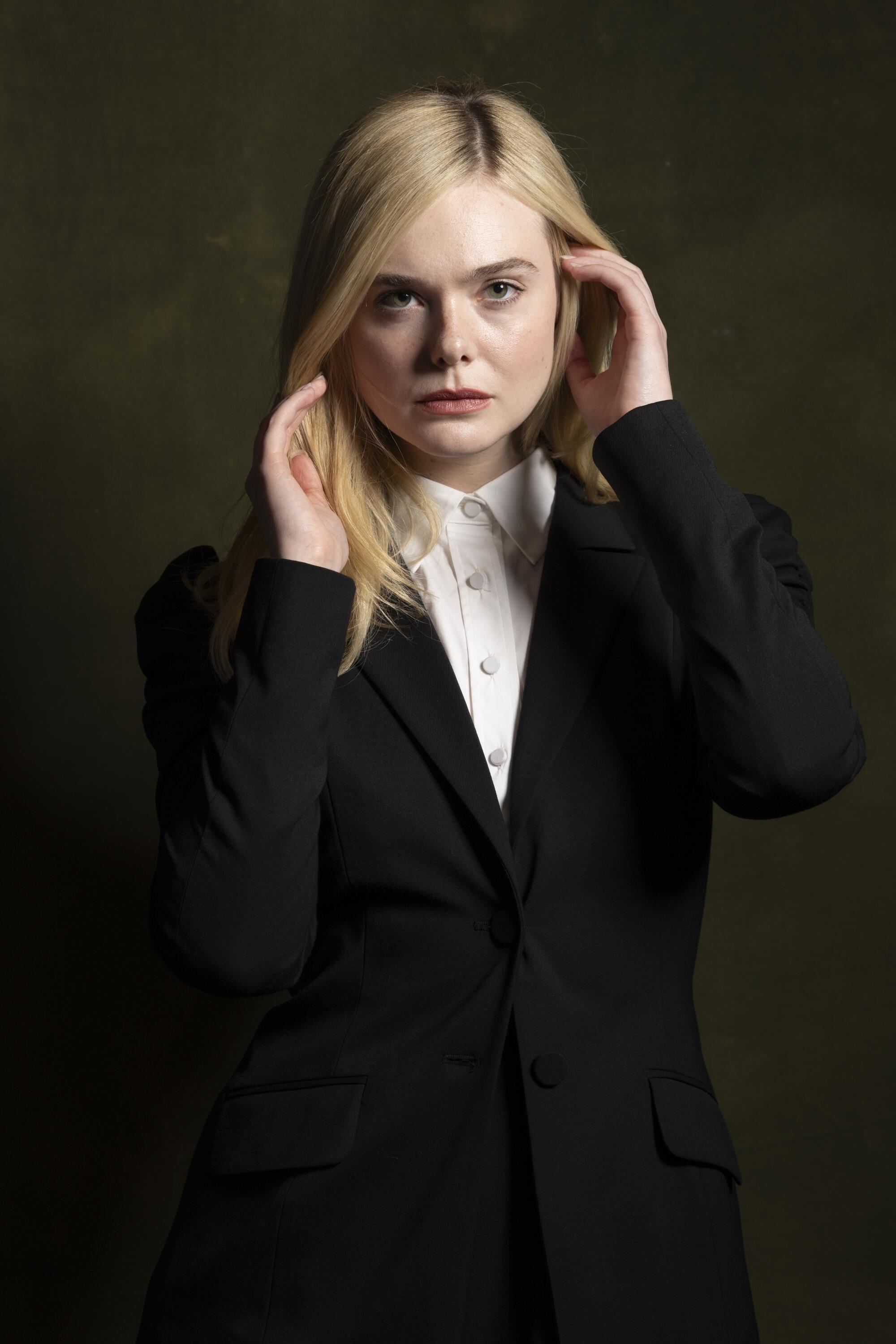
(Ian Spanier / For The Times)
Villarreal: Joining me today is Elle Fanning. Congratulations on your nomination for “Sentimental Value.” We’re at the Oscar nominees luncheon. Tell me what this experience has been like for you.
Fanning: I had an epic table. I was sitting next to Steven Spielberg. He worked with my sister in “War of the Worlds,” and I was like a 5-year-old running around on set, and we were kind of reminiscing about that. And his youngest daughter is one of my closest friends, so growing up we went to the same school and I’d have sleepovers at Steven’s house — not relatable. I understand that. But to be with him — someone that has known me since I was 5 years old — and to share this experience and get to sit next to him was really, really special. And Ruth E. Carter, who did the costumes for “Sinners,” was at my table and she comes up to me and she’s like, “I don’t know if you remember … “ And I’m like, “Gosh, she looks so familiar.” But I’m also like, “Well, you’re a super famous costume designer.” She said, “I did the costumes for ‘Daddy Daycare’” when I was 4 years old. That was one of my first movies ever. I was tiny. And she said, “You look exactly the same. You just look stretched out.” We actually got to stand next to each other in the class photo.
Villarreal: Were you taking lots of selfies in there?
Fanning: I was. My manager was with me, who’s been with me since I was like 8 or 9 years old, and so we were taking a lot of selfies together. I didn’t take my phone up to do the class photo, but I know some other people were, they were videoing, and I’m like, “Oh darn, I wish that I took the phone up.” But sometimes you gotta live in the moment.
Villarreal: Before we get into the film, I know you and Dakota spent a lot of time in your younger years playing make-believe. Was an Oscar something you guys like thought about then, doing your fake speeches at that age?
Fanning: Everyone’s done that, right? I think it’s Kate Winslet that says she keeps her Oscar in the bathroom so people can go in there and hold it and do that in the mirror. That is so fun. I don’t think I’ve ever held an Oscar before. I started doing this when I was 2 years old, watched my sister grow up in this business. And of course, we’ve dreamed of this. It’s something that feels unattainable. And you also have to know that you’re doing it for the right reasons and I’m doing this because I absolutely love it. This is a very magical experience. I’ve never gotten to have this experience before, but it does feel like a dream come true. It’s all the clichés that people say — it honestly is.
Villarreal: It’s an honor just to be nominated.
Fanning: It is. I’ve already won.
Villarreal: “Sentimental Value” is this meditation on complex family dynamics and the power of art in healing. You play Rachel Kemp, an American movie star searching for deeper artistic meaning in the work that she does. And she’s cast by a director, played by Stellan Skarsgård, to appear in his comeback film that he originally wrote for his estranged daughter to star in. Tell me what spoke to you about this film.
Fanning: Gosh, it was many things. I had come off of filming “A Complete Unknown” and I was in New York. I was about to go film another movie in New Zealand. And my agents called me and said Joachim Trier has a new film and there’s a part for an American actress, even though the film is predominantly in Norwegian. It’s gonna film in Oslo. And from that moment, I was like, “Oh, I have to do this.” I’m a really instinctual person and I get feelings — I feel like I’m a little psychic. I just knew, even before I read the script. I don’t know what I felt, but there was something really special, and because Joachim Trier also is someone — I mean, “The Worst Person in the World,” absolutely loved. It’s one of my top favorite films, and that moved me so much the year that it came out. He’s been on my bucket list to work with, but he predominantly works in Norwegian, and I don’t speak Norwegian, so I just was like, “I don’t know if they’ll ever be a part for me.” But then it appeared and they’re like, “OK, well, we’re going to set up a Zoom call. You’re in New York. He’s in Oslo. And so read it as quickly as possible.”
I read the script and it reads like a novel. If you get a chance to read the script, it is so beautiful. It opens describing the house. To me, the house should be nominated for an Oscar as well. It’s such an amazing character in the story. The way that they — Eskil [Vogt], who is also nominated, he’s the co-writer — describe this house is so moving. It holds so many memories and they just captured that about this childhood home. And then Rachel Kemp, she really struck me — sometimes you go into a role and you’re like, “I’m not sure how to play this” or “I don’t know my way in” but there was something about Rachel. I am an American actress, of course there are similarities, but I really saw the way I wanted to play her. I saw the pitfalls that I could have fallen into, of the clichés that maybe could happen, that she could become kind of a joke or a silly character and I really wanted to avoid that. When I talked to Joachim, I was happy to know we were on the same page of how we wanted Rachel to be presented. I knew it would be a challenge, but it really excited me.
Villarreal: You started acting when you were 2 years old. What insights do you have about what the public or culture thinks about young female actors that you brought into this role? And, like you said, the pitfalls that you strove to avoid as you were coming up in this business.
Fanning: It’s something that actually Joachim and I talked a lot about, maybe the struggles or the pressure that Rachel’s feeling in her own career. People are really quick to, especially [with] women, put us into a box of limitations and tell you what you can or can’t do. And I feel like I’ve been really lucky to navigate that. I will say, the show that I did, “The Great” — I really felt like I broke out of that mold a little bit. I had done so many things, but people probably knew me most for “Maleficent,” but it was then fun to be in “The Great” and I’m playing an empress, but she’s not the Disney version. I felt like I came into my own a little bit, and so just to find those meaty roles — but they don’t always come along. And I think that’s what Rachel, when we find her, that’s what she’s yearning for, that’s what she is struggling with. She feels this emotion inside her that she wants to unleash, but no one really saw her for her talent. They’ve maybe seen her for the shiny movie star, and you’re a bankable actress, but it’s not the meaty roles that she is wanting that she can finally kind of find another version of herself to show to the world. And when she meets Stellan’s character, there’s something that he sees in her that she hasn’t experienced before. So playing Rachel, I feel like she’s a very different actress than me, but there was part of me that felt like I was kind of drawing from my younger self of maybe how I felt in the past and kind of bringing that into Rachel.
And the discovery of also being moved by a text. There’s a monologue scene that I have that was kind of a tricky scene because we want to show that Rachel’s a good actress, but that she’s just not quite right for the part. But in that moment, she finds she is moved by the words. And I don’t think that she has ever had that feeling as an actress before. I remember having that experience for the first time.
Villarreal: Tell me.
Fanning: It was on this film called “Phoebe in Wonderland” and I was 9. … It was a scene with Patricia Clarkson. When you’re young, you’re also trying to follow orders; you’re looking at the scene and I’m, like “OK, this scene, here it wants me to cry or it wants me to get upset.” But the way that this scene was written, it didn’t describe what it wanted my character to do. I just had to listen to Patricia Clarkson. She has a long monologue she’s saying to my character, so I could really react to it any way. But we were sitting in these rafters of a theater filming and we’re in the middle of the scene, I’m on my close-up and Patricia is talking to me and I’m looking in her eyes and I start crying because she’s moving me, but that’s not how the scene was written. But I just remember [thinking], “Oh, this is what acting is” at 9 years old. It’s about the spontaneous moments, about like connecting with your fellow actors and looking and following their lead. Now I’m always striving for that moment. But I do remember that first moment.
Villarreal: What did that unlock for you? Because, like you said, when you’re maybe a child doing this work, you’re sort of not thinking about the deeper meanings of the things or you’re not thinking “I want to be challenged by a role” when you are young. Were you hungry for more of that? And how do you chase that feeling?
Fanning: No, I was hungry. I stay hungry. I’m always looking for a challenge. I did realize quite young that I like to scare myself a little bit. I think that nerves have been my friend and they actually do help me a lot and it means that I’m probably doing the right thing if I feel pretty scared about it. Of course, when you’re young and you’re a child actor, you’re having to audition for those roles and go in. You don’t know if you’re gonna get it. So there’s a lot of luck and people have to choose you and there’s a lot of that involved. But then as I got older and could really start to shape my career a little bit more, I was really looking for the challenging parts and I still am. I also kind of approach it in an athletic way, because my family, they’re all athletes. They wanted Dakota and I to be tennis stars. I played volleyball in school. And did basketball. Tall sports. When I approach a scene, I get that feeling that I would assume an athlete gets right before they go into a game. The discipline, I really enjoy that.
Villarreal: You don’t have the reaction like Renate [Reinsve]’s character does.
Fanning: No, well …
Villarreal: Have you had that moment where you’re like, “I don’t know if I can go out there and do this”?
Fanning: I don’t know if I’ve had like a panic attack to that degree. I did my first theater show, a Broadway show, “Appropriate.” That got my heart racing. And it was so odd, because I’m like, we have done this so many times and I was still nervous that I was gonna forget the lines and be caught there like in your underwear on stage. There’s just something about it for me. I was pretty nervous every show, and then you sink in and you start to be able to play with the audience a little bit. I think because I was so used to film, where sometimes the mistakes are the best part. And I guess theater, I’m just not so conditioned in it, but the mistakes can be also a beautiful part of that too. But I think just because I wanted to be perfect and it’s something that I hadn’t done before, I was a little hard on myself in that regard, which definitely made me nervous.
In “The Great,” sometimes I would — just the rhythm and the way that Tony [McNamara, the show’s creator] writes and he really wanted us to be word perfect, punctuation perfect; and I was doing a lot of speeches in front of background artists in these long, big castle halls and they’re all staring back at you and you’re like, “Oh gosh, if I go up there and flub this, they’re just gonna think, ‘Why is she here?’” So, it gets in your head. But then there’s something out of that, that are those magical moments that you can’t re-create that are captured on screen and then you blush — Renate does that so beautifully. She blushes on cue, you feel her blood. It’s so human. I always remind myself of that — that that’s OK. It’s welcome, but sometimes it can be an uncomfortable feeling.
Villarreal: We see Rachel really trying to connect with this part that she’s about to play. And she’s struggling and she’s trying to have these conversations and he’s not really giving her the insight that she wants to really lock in. We don’t often talk about the actor’s version of writer’s block. How do you work through that? Has there been a moment like that for you?
Fanning: You never feel fully prepared on the first day. You’re still finding it on the first day — for me, at least. Sometimes you finish the whole movie and then you’re like, “Wait a minute. Now I know. I gotta go back.” I really rely and lean on the directors. I think that also, when choosing films — I think this has developed — but I’m really more director-driven than ever or actor-driven than ever. Of people that I want to work with and that we can be on the same page and that you can just fully trust. I haven’t had a role quite like Rachel where I went so far into a project and then pulled out so last minute. But I’ve certainly outgrown roles or was offered roles that I was probably too young to play at the time. I remember I would be offered roles and I had 4-year-old son or something, way before I should have had a 4- year-old son. And I’m like, “This isn’t right yet.” That’s what Rachel’s finding herself in. Agnes’ son who’s hired and cast, it’s like “Well, he’s probably a little bit too old to be Rachel Kemp’s son.” She doesn’t fit into that character so much. You have to be honest with yourself to be able to walk away or say no to something or be like, “I’ve just outgrown this, give it to someone else, it’s not right for me anymore.” When you are struggling a bit on set with something, you could try to just lean on the director. It’s hard. I’ve also learned it starts from the script too. You have to have a good script.
Villarreal: How do you know to trust your intuition that it’s not right versus am I just uncomfortable and I need to figure out if this is the challenge that I actually am after?
Fanning: That’s such a good question. I am someone that when I get something in my head and it feels wrong, I just can’t let it go. I will talk about it until I’m blue in the face and I will go up to producers. Now I’m able to produce things, which is really nice to have a little bit more of a say, so your voice actually kind of counts more in those conversations.
Villarreal: Was there a moment like that on this film?
Fanning: On “Sentimental Value”? No. I have to say, I never had that on this. On set, I really am interested in the behind the scenes. I’m interested in where the camera is and I’m interested in how it’s gonna be shot and I like to know all those things. But there was something about this experience that I really let it all go. And I don’t know if it was because I couldn’t speak the language. On set, Joachim would talk to me in English, and Stellan would, but the whole crew, they’re speaking Norwegian or Swedish to each other. I kind of could have tunnel vision and just let it go and just hand it over to them to not micromanage anything or try to eavesdrop because I was like, “Well, that’s not really my job here” and I just trusted Joachim so much. I would ask myself constantly — and this is why I wish I kept a journal — but I would ask myself, “What is making the set run so smoothly?” It was so organized. We didn’t have a lot of time, but it felt like we had all the time in the world. For these scenes, we could experiment. I never felt rushed. Everything was so orchestrated perfectly to make the actor feel the most comfortable to try different things, and it’s just not always the case. Sometimes it’s like you’re there, they’ve been spending a long time on the lighting, and it’s, like, “OK, go.” There’s a beauty in that too, but not preferred.
Villarreal: I often hear actors talk about how hard it is to like play somebody that’s maybe drunk or something. What is it like playing an actor as an actor yourself — and playing one that’s striving to be really great and struggling to get there?
Fanning: When you said the drunk thing I thought you were gonna say, “What’s the hardest thing to do?” And I think it’s phone calls.
Villarreal: Or holding an empty cup.
Fanning: Oh, you can’t do that. That’s so bad. Or not eating. No, I’m going to eat. You go to a restaurant, you order and, then, in the movie, they put your food down. It’s like, you went to dinner because you’re hungry.
But talking about playing an actor — it was so meta. We would joke about the meta-ness, then we would talk seriously about the meta-ness because it just was so obvious. I was an American actress coming to Oslo for my first time to work with a Norwegian filmmaker exactly like Rachel and I think and we were talking about like the pitfalls of her character a little bit. She’s not completely serious either. There is lightness and there is a Hollywood sheen on her that you have to believe that she is a movie star, especially in Deauville, the beach scenes, that kind of feel like this dream, they feel like another movie within in the film. Those are my first scenes that I shot with Stellan, which was a really nice starting place.
But I thought a lot about maybe the pressures that she’s under — even going to the red carpets. We were like, “How do we want the dress to fit? Is it constrictive, is it tight?” And then I get to wear this gold one on the beach where she gets to let loose and ride off into the sunset when she’s an actress that probably doesn’t get that escapism. I don’t feel like that myself. I had to play a bigger star. I was like, “OK, I’m really playing someone that’s super famous.” Someone that maybe was in a big franchise. She’s just someone that is really known, but not known in the way that she wants to be known. And every character in the movie is so flawed and has their own version of depression in a way. She might quit acting, honestly, if she doesn’t meet Gustav [Skarsgard]. And then the beauty of her is the surprise that she walks away from something she wants so badly and instead of needing it to be captured on the screen, it’s the experience that she had in rehearsing with him, in discovering things about herself, in being seen in a different way and seen for her talents, which she hasn’t really felt before. Probably the next thing that she goes on to do will be a great one, but she just got caught up into this [role as a] surrogate daughter.
Villarreal: Even the accent, too, is it like, how good do I need to sound or how bad do I need to make it?
Fanning: What is so funny is, I probably should have done a lot more work on the accent than I did because it was written in the script that I had to do this, but I also saw it as, “Oh, I’m putting it on.” I listened to some tapes or Joachim would repeat, “I vant three whatever … “ — I can’t even do it — “glass ev yuice.” So cliched. And I would repeat, just like what Rachel would do. It’s not terrible, but it’s not quite right.
Villarreal: In doing research as I was preparing to talk with you, I read an interview that you did where you said you sometimes watch old interviews of yourself and that you were looking at one you did for Sofia Coppola’s “Somewhere,” which you shot when you were a tween. Tell me more about that. What drives you to do that?
Fanning: I think it’s like watching an old movie, like a home video of yourself. I also have those, like a normal child. But then there’s like a plethora of these phases of my life that are marked on YouTube, pinpointing the different ages. It also reminds me of like, “I remember that person and working on that set” — and just brings back those memories. And there’s something about it, it’s like, “Gosh,” I look at that little girl and I’m like, “She’s trying to answer the question so good.” There’s nothing so sweet about it that you do feel a little disconnected. I feel like I’m looking at myself from outside.
Villarreal: It made me think of this quote that George Clooney gave in promoting “Jay Kelly,” where he plays a veteran actor assessing his career. He said that you’re “acting twice if you’re famous; your job is to be an actor and your other job is act the part of a movie star.” Do you agree with that?
Fanning: I mean George Clooney — he is the movie star. I don’t know if feel that exactly, but I feel that there is a piece of myself that I keep private for me. Yes, we do the movies and we play the characters, and that’s a whole other section, and then there’s a whole other part of it where we’re doing this, we’re doing interviews — you can’t help but think, “Well, how do I want to present myself? What do I think about that?” There is a part that I like to keep to myself. There’s not a lot of mystery in the world these days, especially with social media. I have all that, but I also choose [what] to share [of] my personal life because truly what I love is doing movies and I want people to be able to escape into my roles. You can’t predict that, but maybe there’s something to do that.
Villarreal: To stay on the themes of the movie, which are family and filmmaking, you’re going to be working with your sister [Dakota] soon on the film adaptation of “The Nightingale.” It’s the first time you’re starring together. What excites you about it? And also what is it like to develop as an actor alongside your sister and to have that kind of experience?
Fanning: It could make me cry thinking about it because it’s so special. I’ve said this before, but I’m like a nepo sister. My sister, she started from 6 years old. My mom, who came out with her, had no clue about the business, navigating being on set with my 6-year-old sister on “I Am Sam,” and Sean Penn is Method in character — my mom’s 32, going “OK, so how are we going to deal with this?” My sister was very, very mature and they would have like serious talks about it, but it could break my heart, thinking about my young mom navigating this world and what she sacrificed for her girls. And we’re very family-oriented in our family. When someone succeeds, it’s like we all succeed together. And this is another stepping stone, to get to finally act on screen together. We don’t run lines together. We work now together [as producers], we have a company together and we really balance each other out in that regard and we also are now getting to produce this film. If we did it in 2020, when it was originally set [to begin filming], we weren’t producing it at the time, so you can see our growth.
Villarreal: Are you gonna be like, “Don’t boss me around”?
Fanning: Yes. Yes. I’ve told her, [teasingly] “You cannot act like the big sister and boss me around on set.”
Villarreal: Before we wrap, not to put you on the spot, but ranking the awards season moments, where does being nominated rank against Jack Black finding out you’re obsessed with him and taking a selfie at the Golden Globes?
Fanning: Oh my God, they’re high! They’re really high! They’re neck and neck! They’re NECK AND NECK!
Villarreal: That moment just took off for you.
Fanning: I know, I know. He probably has a restraining word against me. You know that thing where it’s like I feel exposed, that I’m kind of like nervous to see him? Like, “Oh no, now I’m the creepy freak. I’m sorry, Jack Black.”