
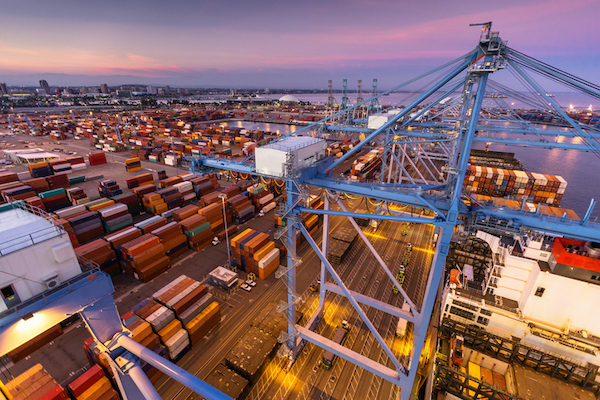
January volumes at the Port of Los Angeles (POLA) and the Port of Long Beach (POLB) saw declines to begin 2026, according to data respectively issued by the ports.
POLA reported that January volume, at 812,000 TEU (Twenty-Foot Equivalent Units) fell 12% annually, following a 14.1% annual decline in December. Imports, at 421,594 TEU, were down 13% annually, and exports, at 104,297 TEU, decreased 8% annually. Empty containers, at 286,110 TEU, fell 12% annually.
“There are several factors at play,” said POLA Executive Director Gene Seroka. “First, we’re comparing January to 2025 elevated numbers when importers were scrambling to get cargo in ahead of tariffs. Second, inventories remain slightly higher, reflecting the earlier cargo surge and a more cautious restocking pace. Finally, U.S. trade policy continues to keep everyone on edge. However, the American consumer has shown remarkable resilience. And purchase orders that go out three months in advance to Asia look stable, a good sign.”
POLB data: The Port of Long Beach reported that January volume, at 847,765 TEU, was down 11% annually, while posting the highest volume of any U.S. port in January, as well as the second highest-volume month in POLB’s 115 years of operation.
January POLB imports, at 409,418 TEU, saw a 13.1% annual decline, and exports, at 99,478 TEU, eked out a 0.8% annual increase. Empty containers, at 338,470 TEU, were off 11.5% annually.
POLB CEO Dr. Noel Hacebaga said on a port-hosted media call that at this time last year, the goods movement industry was deeply concerned about the potential effects of tariffs, adding that no one knew for sure if or when new tariffs would hit.
“There was more than a fair share of doom and gloom scenario planning going around at that time,” he said. “This uncertainty led retailers and shippers to frontload an extraordinary amount of cargo in an effort to bring their shipments ahead of new tariffs. All that front loading at the beginning of the year catapulted us to a record year in 2025, when we moved 9.9 TEU. “Today, warehouse inventories continue to reflect last year’s frontloading activity, and consumers are still buying goods, and we are expecting another strong year in 2026 with a projected 9.5 million TEU, which would make it one of our top five busiest years ever.”
The top POLB executive added that he anticipates continued uncertainty following the U.S. Supreme Court’s ruling last week, declaring two-thirds of tariffs imposed last year under the International Emergency Economic Powers Act, or IEEPA, unconstitutional.
“While this decision ruled on the legality of the IEEPA tariffs, it did little to remove the uncertainty we’ve seen—and continue to see—across the global supply chain,” Hacegaba said. “Our customers are seeking clarity on whether tariffs already paid will be refunded, and consumers are seeking relief from higher prices.”
