
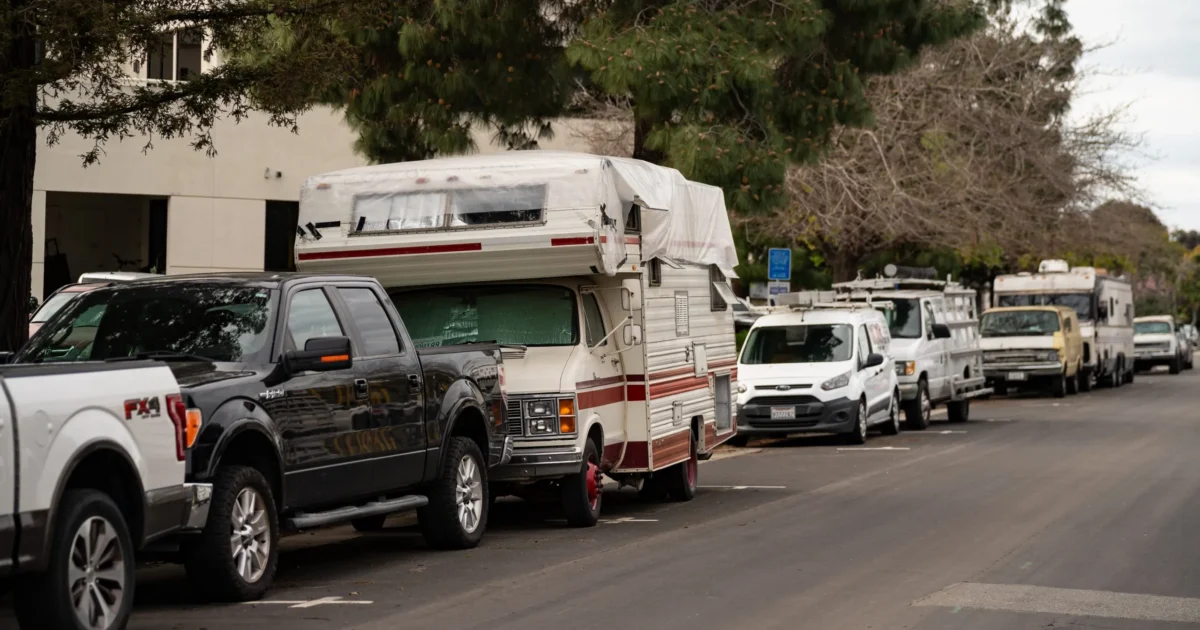
Palo Alto leaders are increasingly looking to regional partners to help address widespread RV parking throughout the city after months of increased enforcement has seemingly done little to alleviate concerns from residents and business owners.
The effort is being led by the City Council’s recently established oversized vehicle ad hoc committee, which is made up of Council members Ed Lauing, Julie Lythcott-Haims and Keith Reckdahl. The group has met nearly every week since its inception in October last year, and on Monday night issued its first report to the full council.
In addition to establishing a set of goals for Palo Alto’s RV policy, including a focus on sanitation, safety and regional collaboration, the committee is exploring a parking permit pilot program and a regional convention to address the issue.
The permit program would set aside certain streets throughout the city as places where oversized vehicles could park overnight, excluding residential zones. The committee discussed eligibility requirements for permit seekers and a requirement that participants be good neighbors and actively seek permanent housing.
While the idea remains a preliminary discussion, Reckdahl said the biggest advantage is that the program would introduce a cap on the number of parked RVs in Palo Alto, while giving the city leverage to root out “bad actors.”
Not everyone on the council was as enthusiastic about the approach. Mayor Vicki Veenker noted that commercial areas in south Palo Alto are host to many more RVs than other parts of the city.
The number of RVs parked on Palo Alto streets had doubled between 2023 and 2025, according to staff, with most of the city’s roughly 400 unhoused individuals living in vehicles. Many are parked on commercial blocks along East Meadow Circle and San Antonio Road, in the Ventura neighborhood and around Embarcadero Road, near the Baylands.
“I’m afraid we’ll perpetuate some disproportionate impact,” Veenker said.
Some residents and business owners also expressed concern Monday night that the permit program would unfairly burden those who live and work near any designated RV parking zones.
Maia Harris with Jay Paul Company, which owns two buildings on Park Boulevard, asked the council to exclude the corridor from any permit program in the future.
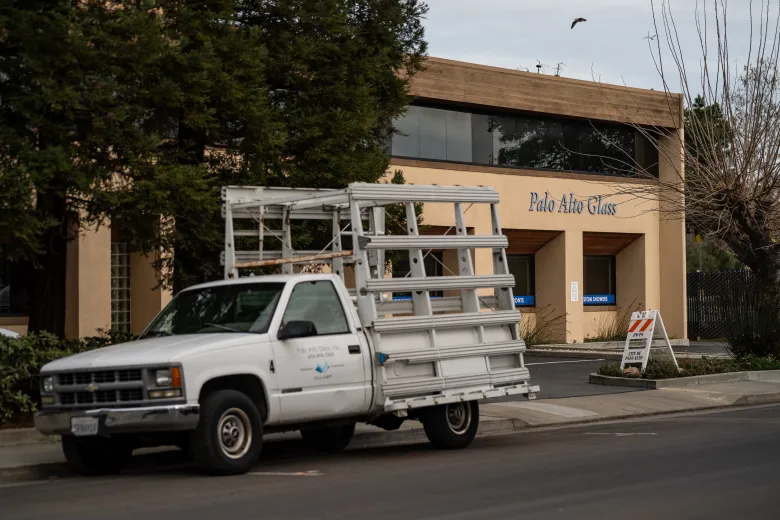 A company pickup truck parked outside Palo Alto Glass on Transport Street in Palo Alto on Feb. 23, 2026. Photo by Seeger Gray.
“A permit system authorizes and regularizes the use it governs,” she said. “In a commercial corridor, steps from the California Avenue Caltrain station, we don’t believe long-term vehicle dwelling and a Class A office environment can coexist.”
What remains unclear about the permit pilot program is where everyone else would go once those spots fill up. Neighboring cities to the north and south have all but banned overnight oversized vehicle parking, driving much of the rise in the population of vehicle dwellers in Palo Alto.
The committee hopes a regional response could be the answer.
The OSV ad hoc committee is convening a regional meeting on April 17, co-sponsored by Santa Clara County Supervisor Margaret Abe-Koga, the Santa Clara County Office of Supportive Housing and Joint Venture Silicon Valley. Nonprofit leaders, elected officials, academics and other experts will also be in attendance.
“It’s important that we don’t participate in a race to the bottom in terms of shuffling OSVs around different jurisdictions,” Council member George Lu said.
The committee also listed eight goals in its report indicating that the city wishes to prioritize oversized vehicle parking for low-income individuals with ties to Palo Alto, whether that’s through employment, historical residency or a child enrolled in a Palo Alto school. In doing so, committee members hope to weed out those whom they refer to as “bad actors,” characterized by “angry verbal outbursts, an excessive amount of belongings on the street and sidewalk and accumulation of trash and unsanitary disposal of sewage which can attract rodents.”
Although the committee members have emphasized a commitment to more permanent solutions to address RV homelessness, they conceded in their report that options to do so are limited in Palo Alto.
For example, options to expand safe parking sites for vehicle dwellers has been a fruitless endeavor thus far. Congregations told the committee that they feel it’s “someone else’s turn” to offer parking spots to vehicle dwellers, and private businesses have been less than eager to take up the baton, citing safety concerns. There is no vacant city land available, according to the committee report, and it would not be a simple task to expand the existing safe parking site on Geng Road because it’s surrounded by dedicated parkland.
“The high cost of land and a scarcity of suitable locations make it difficult to increase the number of off-street safe parking spots, and off-street parking alone will not fully address Palo Alto’s significant OSV challenges,” the committee wrote in the report.
The lack of housing and shelter options has not slowed enforcement. Palo Alto police have towed 33 vehicles since Oct. 20 of last year, when the council passed its phased policy response to RV parking. Lauing said the majority of that actually occurred after Dec. 8, when the City Council passed additional ordinances banning “vanlording” and detached trailers from parking on public streets — a rate of about 11 tows per month. The majority of those vehicles were unregistered, according to the committee report, because state law does not require prior signage before towing of unregistered vehicles. While progress is limited by local towing companies’ capacity, especially for oversized vehicles, the city has continued to enforce the 72-hour parking limit to facilitate street sweeping and tree trimming.
The committee reported that deep cleaning has been completed in about half of the areas where RV parking is clustered, and that compliance from vehicle residents with the 72-hour limit has been high.
However, city staff also noted that increased enforcement is having a detrimental effect on future efforts to transition RV residents into more permanent housing.
“Multiple service providers shared the observation that enforcement actions undermine trust and reduce individuals’ willingness to engage with City programs,” city staff wrote in a supplemental report.
But a number of Palo Alto residents and business owners remain dissatisfied with the city’s progress, and have begun taking matters into their own hands when it comes to their streets.
Bill McLane, president and owner of Palo Alto Glass, urged fellow business owners to take up as much street parking as possible with their own vehicles to prevent RV residents from staying there overnight. Palo Alto Glass is located in an industrial area of south Palo Alto near the U.S. Highway 101, where many RV residents have been staying.
“This would be a great start to helping deter them from hanging out in our neighborhoods any longer,” McLane wrote in an email that was sent to the City Council as well as to dozens of businesses, residents and this publication. “We need to be together in this effort. I plan to have all of my vehicles out in the street to block as much as possible.”
On a separate but similar email thread, Ventura neighborhood resident Raphael Zahnd wrote that he and his wife were initially excited to see new signage prohibiting detached trailer parking on their street. But a single individual who owns multiple vehicles continues to move his belongings directly in front of Zahnd’s home.
Zahnd described a similar tactic as McLane to prevent more RVs from parking out front.
“We are constantly anxious, rushing to park our own cars on the street just to prevent new oversized vehicles parking in front of our home,” Zahnd wrote. “We understand the complexities of the housing crisis, but we are struggling too. We work hard to pay our rent and contribute to this city.”
Not everyone is defaulting to parking vigilantism to address RV parking. During the City Council meeting Monday night, at least one neighbor who owns a mobile RV services company offered to buy land locally to convert into a safe parking site.
Others suggested allowing RV residents to park on the roads near the Stanford Dish, such as Deer Creek Road, while prohibiting oversized vehicle parking elsewhere in the city. At least one other resident questioned whether Stanford University should also shoulder some of the parking space responsibility.
The ad hoc committee will continue to explore options based on the concerns raised by the council and residents over the coming months.
“We’re feeling the unfairness that Palo Alto remains open, as public commenters would say, while neighbors to the north and south have shut their doors,” Lythcott-Haims said. “But this whack-a-mole approach is silly, it’s a waste of money, it’s a waste of time and effort, and it does nothing to acknowledge the dignity of human beings who have no better choice than to live in their vehicles.”
This story originally appeared in Palo Alto Weekly. Riley Cooke is a reporter at Palo Alto Weekly and Palo Alto Online focusing on city government.