
key takeaway
AANHPI women’s experiences vary widely across ethnicities, making disaggregated data essential to understanding the impacts of recent federal and state decisions. By examining the Women’s Well-Being Index indicators across multiple AANHPI ethnicities, this report highlights distinct challenges facing AANHPI women in California and identifies key steps state and local leaders can take to advance equity and well-being.
Recent federal and state budget cuts threaten to undermine the health and well-being of Californians, including those with AANHPI identities. The 2024 Women’s Well-Being Index (WWBI) points to long-standing disparities between men and women in California, suggesting that women — especially those facing intersecting barriers shaped by race, income, and immigration status — will face even greater hardship as a result of harmful budget actions.
About This Report
This report was co-authored by Nina Long, Policy Manager at Asian Americans and Pacific Islanders for Civic Empowerment–Education Fund (AAPI ForCE-EF)
AAPI ForCE-EF is a statewide network that builds progressive Asian American and Pacific Islander governing power in California through campaign organizing, policy advocacy, integrated voter engagement, and narrative change.
Asian Americans, Pacific Islanders, and Native Hawaiians (AANHPI) have a rich history in California and reflect a wide variety of backgrounds and experiences with over 50 ethnic groups. However, data collection using the “umbrella label” of AANHPI often homogenizes this diversity into a misleading single story about the experiences of AANHPIs. Aggregated data perpetuates the model minority myth and hides the struggle of working-class AANHPIs by obscuring differences between subgroups. Given the unique experiences among AANHPI ethnicities, to meaningfully understand the impact of recent federal decisions, it is paramount to understand unique impacts for individual identities within the AANHPI umbrella. Moreover, state leaders’ current response to federal actions further jeopardizes the well-being of AANHPI Californians. AANHPI women in California therefore face the compounding factors of federal threats and state inaction.
This report takes the Women’s Well-Being Index one step further by exploring key indicators of well-being across multiple AANHPI ethnicities to understand how recent federal and state decisions may influence this California population (see Technical Appendix for more information about the ethnicities reflected in this report). This report also highlights key steps that state and local leaders can take to address pressing challenges among AANHPI women and the several organizations that are leading the way.
How might recent federal and state action impact AANHPI Californians?
The harmful Republican megabill (referred to as H.R. 1), passed in the summer of 2025, includes historic cuts to health care and food assistance to fund tax breaks for the well-off. These cuts fall particularly hard on immigrants, with several of the most vulnerable classes of legally documented immigrants — like refugees, asylees, humanitarian parolees, and trafficking survivors — losing access to care.
Around a third of the California state budget comes from federal funding, and a projected multi-year budget deficit means the state — without bold action — may be unable to backfill some or all of these cuts. Rather than pursuing revenue solutions, the state has instead balanced its budget on the backs of its most vulnerable residents.
Immigrant Californians, many of whom are AANHPI, have borne the brunt of cuts to the social safety net in the state budget. The 2025-26 state budget included an enrollment freeze for undocumented Californians in Medi-Cal, a cut to dental benefits for certain groups of immigrants, and the introduction of unaffordable premiums for certain groups of immigrants.
The impacts of H.R. 1 and state budget policies stand to exacerbate the economic security challenges AANHPI women already face. Importantly, different AANHPI ethnicities face distinct challenges in health, economic mobility, and economic security, and policy approaches must account for these disparities.
Native Hawaiian and Pacific Islander Women Face Barriers to Accessing Quality, Affordable Health Care
Affordable, accessible health care is critical for all Californians to be healthy and thrive. Health insurance helps lower out-of-pocket expenses and ensures access to preventive care, which in turn supports workforce participation and education. While California has made historic progress towards lowering the rate of people without health insurance, significant racial disparities persist. As seen in the chart below, access to health care differs among AANHPI women, Native Hawaiian and Pacific Islander women in particular.
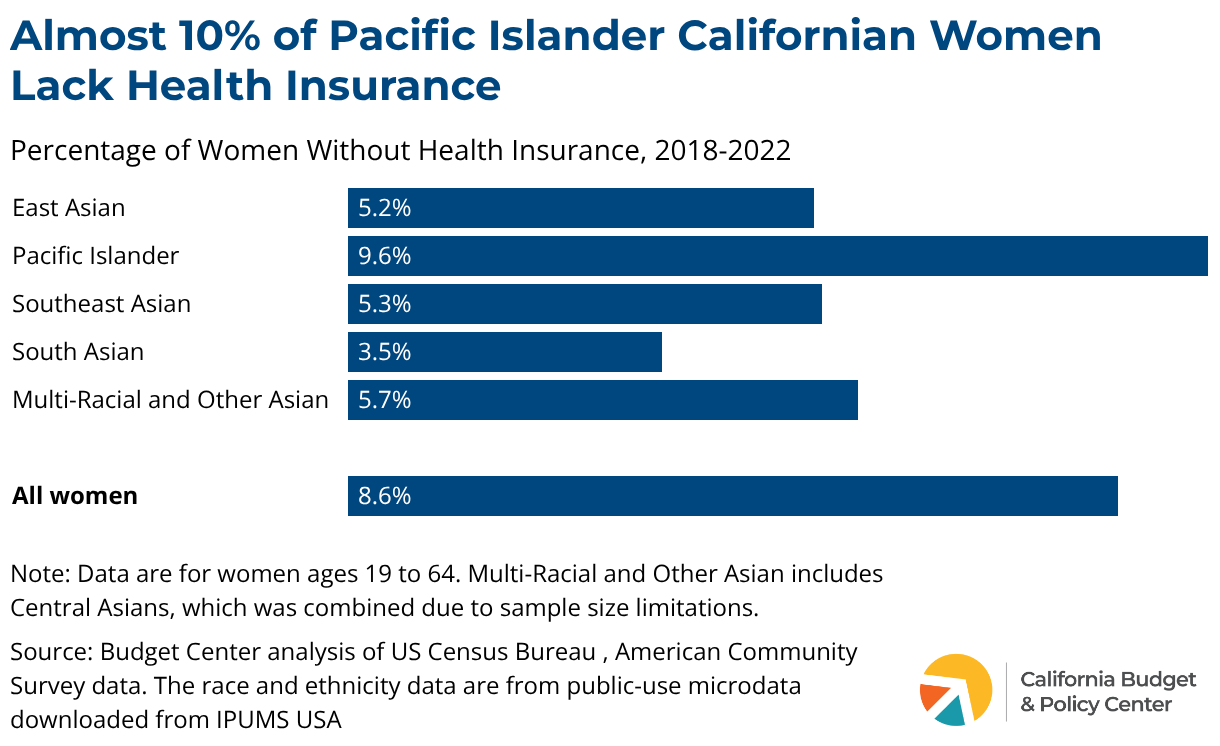
According to a report from AAPI Data, Native Hawaiian and Pacific Islander Californians are less likely to enroll in Medi-Cal when compared to other racial and ethnic groups. In general, AANHPI women face structural barriers in accessing health care, such as challenges navigating enrollment, higher rates of poverty, racism in health care, and limited availability of culturally and linguistically appropriate care.
The Central Valley Pacific Islander Alliance (CVPIA) is an organization dedicated to service, cultural work, civic engagement, and advocacy for NHPIs across eleven counties in California’s Central Valley. Founded in 2021 by eight NHPI volunteers responding to urgent community needs during the COVID-19 pandemic, CVPIA hosted the region’s first NHPI vaccine site, where about 150 community members were vaccinated and received resources for groceries. CVPIA continues to offer critical NHPI resource navigation surrounding leadership development for youth and young adults, higher education, employment, support for elders, and community access to housing, Calfresh, and health insurance.
Racial disparities in health coverage highlight the enduring impact of racism, which blocks Californians of color from equal access to health care. Addressing the racial disparities in health coverage requires targeted outreach and education efforts along with other antiracist policy actions to improve health and well-being for Californians of color.
However, federal budget cuts from H.R. 1 and state budget cuts restrict access to health care for many Californians, particularly for immigrants and other low-income Californians. Stricter federal restrictions on who is eligible for Medicaid, new burdensome reporting requirements, more frequent eligibility checks, and state Medi-Cal premiums for certain groups of immigrants all jeopardize health care access for Californians, including AANHPI women who are more likely to be immigrants.
As a result of state and federal cuts, we estimate:
Nearly 300,000 employed Asian American and 16,000 employed Pacific Islander adults ages 26-64 in California will be at risk of losing Medi-Cal due to monthly premiums and burdensome recertification requirements
Nearly 50,000 unemployed Asian American adults ages 26-64 and 4,000 Pacific Islander unemployed adults on Medi-Cal are at risk of losing coverage due to work requirements
Together, these cuts will likely worsen existing health disparities, especially for Pacific Islander women.
Central Asian and Pacific Islander Women Face Significant Barriers to Economic Mobility
Having a job that pays enough for women to support themselves and their families is crucial to ensuring that everyone can thrive. Unfortunately, AANHPI women have historically endured discrimination, occupational segregation, and other structural barriers that create obstacles for achieving economic security.
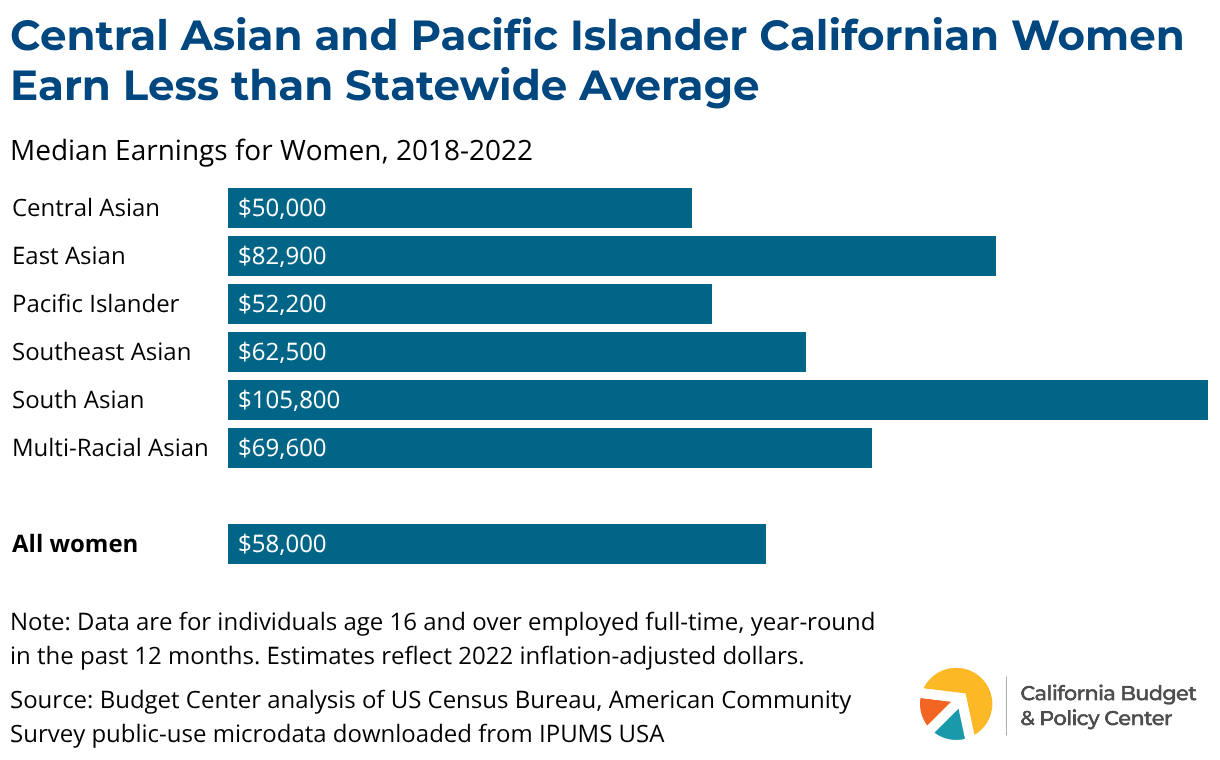
There is a wide range in earnings of AANHPI women, with Central Asian and Pacific Islander women earning the least at $50,000 and $52,200 annually, respectively. Disparities between different Asian American identities are influenced by unequal educational opportunities, differences in historical immigration patterns, and discrimination in labor markets.
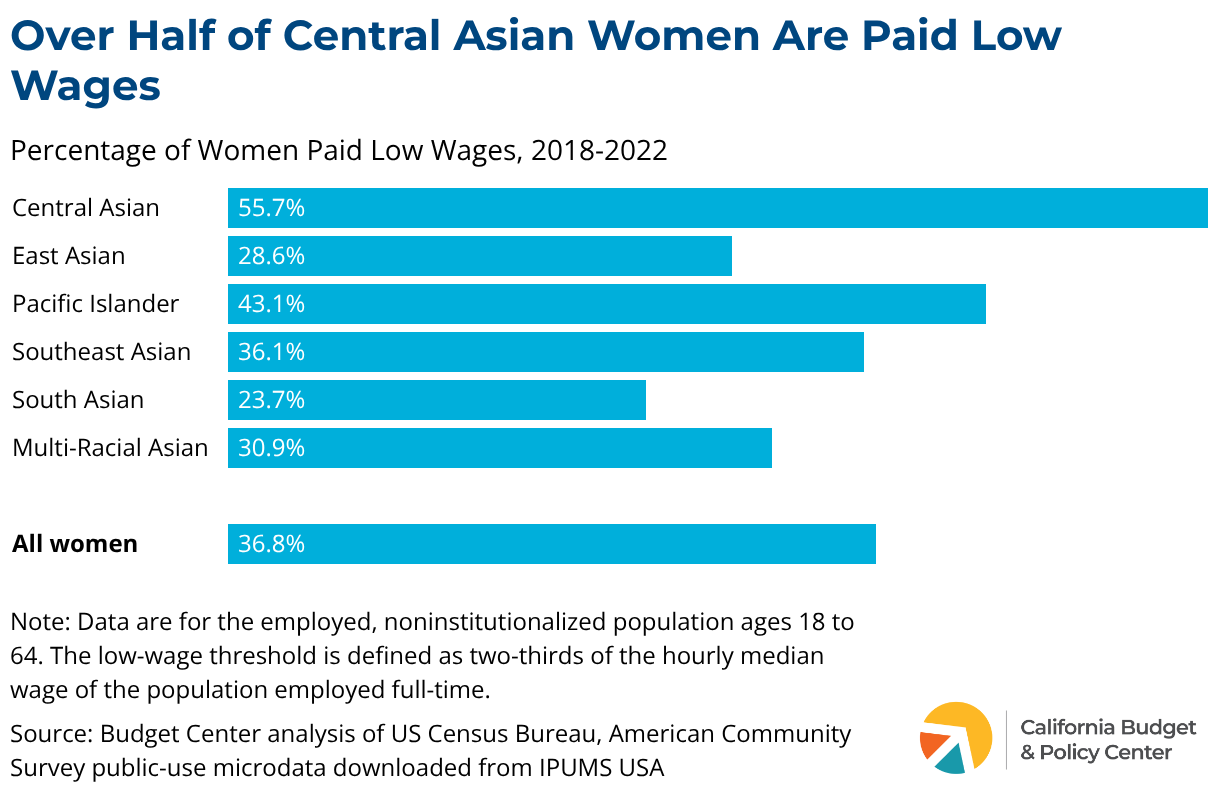
Over half (55.7%) of Central Asian women and over 40% (43.1%) of Pacific Islander women are paid low wages. These are both significantly higher than the statewide average, where roughly 37% of women in California are paid low wages. AANHPI women are overrepresented in low-wage work and in service jobs that typically earn much less than white men, such as home care workers and nail salon workers. This concentration in low-wage work widens the wage gap between AANHPI women and white men, as shown in the following chart.
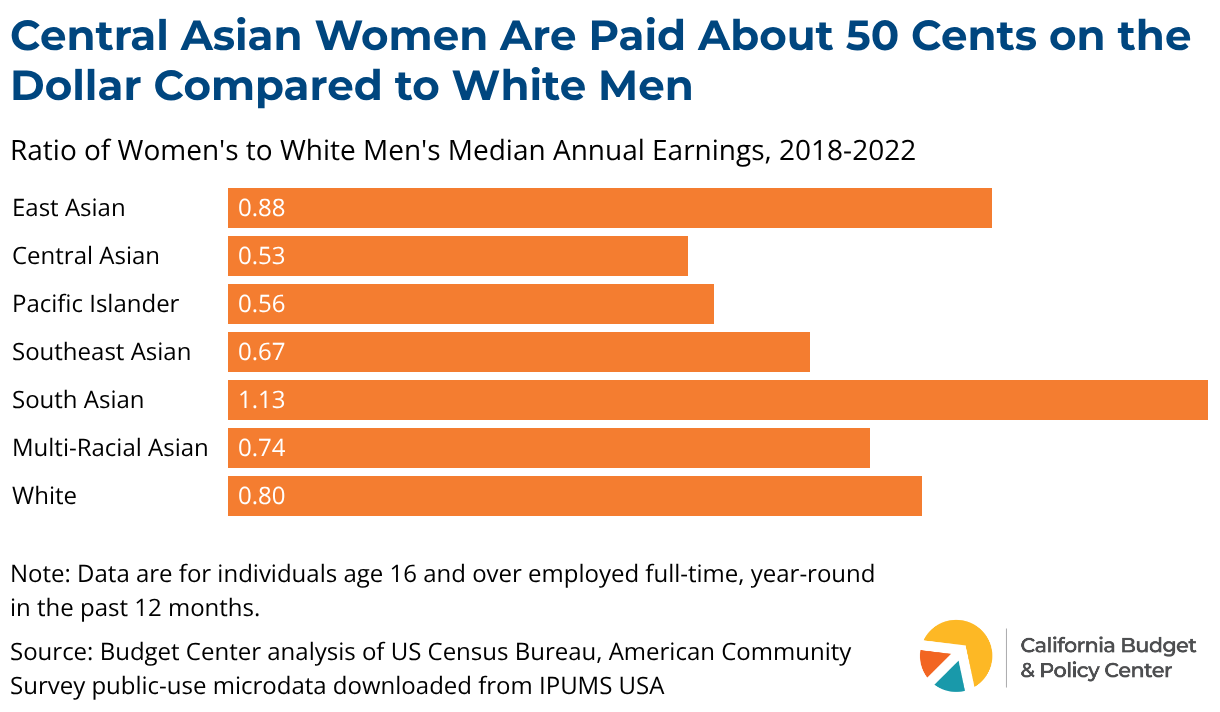
Central Asian women are paid only $0.53 for every $1 white men are paid, and Pacific Islander women earn only $0.56. AANHPI women are over-represented in low-wage work and underrepresented in higher-paying jobs. Even when AANHPI women can access higher-paying jobs, the earnings gap persists.
Occupational Segregation Pushes AANHPI Women into Low-Wage Service Jobs That Limit Economic Mobility and Fair Pay
Occupational segregation pushes many AANHPI women into low-wage service jobs. Many AANHIPI women — especially those who are undocumented — are relegated to jobs where they are easily exploited, that lack labor protections, and have limited pathways to upward economic mobility.
Specifically,
Certain groups of AANHPI women tend to disproportionately work in low-wage occupations like cashiers, waitresses, and personal appearance workers.
Service-based occupations have been shown to have the largest wage gaps, demonstrating the larger disparity for AANHPI women.
Native Hawaiian and Pacific Islander women are more likely to work as personal care aids, waitresses, and cashiers, working long hours for low wages.
In California, AANHPI women make up the largest share of nail salon and personal care workers. In addition to health and safety risks — particularly exposure to chemicals in cosmetics products linked to reproductive harm, respiratory issues, and cancer — this predominantly Vietnamese refugee women workforce face ongoing wage and hour labor violations, including pay below the minimum wage and misclassification as independent contractors.
The California Healthy Nail Salon Collaborative (CHNSC) — a statewide grassroots organization that addresses health, environmental, reproductive justice, and labor issues faced by its low-income, female, Vietnamese immigrant and refugee workforce — has made notable strides to protect the nail salon workforce. In the state legislature they championed bills like AB 647 (Kalra, 2019) requiring manufacturers to post Safety Data Sheets for cosmetics and disinfectants on their websites in Spanish, Vietnamese, Korean, and Chinese; AB 2762 (Muratsuchi, Wicks, & Quirk, 2020) banning 24 commonly used toxic chemicals in cosmetic products; and HR 5540 (Schakowsky & Blunt-Rochester, 2022) requiring product ingredient disclosure and translated Safety Data Sheets access, and research grants to develop safer alternatives to chemicals of concern.
High Poverty and Housing Costs Threaten Economic Security for AANHPI Women
Different AANHPI ethnicities face distinct poverty challenges. Namely, East Asian and Pacific Islander women have relatively higher poverty rates, and East Asian women have a significantly higher poverty rate as compared with all women. While there are many reasons contributing to poverty among AANHPI women in California, affordability challenges are paramount.
Central to affordability challenges is the high cost of housing in California. As shown in the chart below, women in California spend approximately 38% of their income on rent and are thus rent burdened. Rent burden is even more extreme for some AANHPI women.
Key points specific to AANHPI women include:
Most AANHPI ethnicities are rent burdened. Most AANHPI ethnicities spend over 30% of their income on rent. Housing affordability is therefore a central issue for AANHPI women when it comes to meeting basic needs. H.R. 1 will further strain AANHPI women’s budgets, exacerbating the high cost of housing challenges these women already face.
Rent burden estimates are likely underestimated. Housing overcrowding is a known issue among some AANHPI communities. More specifically, many AANHPI women live in housing that is considered ‘overcrowded’ in order to reduce rent burden and other housing costs. Overcrowding can result in negative outcomes, including increased exposure to environmental hazards, lower educational outcomes, poor physical health, and mental health challenges.
AANHPI women are less likely to seek support for precarious housing situations. As shared in the University of California, Los Angeles AANHPI Housing Report, one Orange County community leader described this situation as follows: “The other thing [AANHPI Californians] don’t use is free and reduced lunch, and they don’t use the McKinney-Vento Act to get additional resources for their kids because they’re worried. They’re worried the authorities will say they’re not taking care of their kids and take them away.” As a result, AANHPI women and families are less likely to see and utilize available services to address rent burden, even if they are available.
Overall, state and federal cuts will negatively impact affordability challenges for all Californians, including AANHPI women. State leaders should work to mitigate the harm of these cuts to all Californians and collaborate with their AANHPI constituents to ensure policy solutions are responsive to the unique needs of AANHPI women.
What can state leaders do to help mitigate the potential impacts from federal actions?
California’s state leaders can make budget and policy choices that actively address federal actions that will harm AANHPI women. State leaders should pursue revenue solutions to invest in vital programs and services that mitigate the harm caused by federal actions to AANHPI women and all vulnerable Californians. For example, state leaders can focus on ensuring that corporations and wealthy individuals, who were recently showered with massive federal tax cuts, contribute more in state taxes. Ensuring that the state has sufficient resources to fund the programs and services that California — including AANHPI women — needs is critical.
More specific recommendations for supporting AANHPI women are as follows:
Health Care
Continue to seek opportunities to challenge and backfill cuts to federal funding for critical programs like Medi-Cal and CalFresh, such as by raising new, ongoing state revenue.
Restore and protect access to Medi-Cal and food assistance programs for immigrants whose access has been restricted due to federal and state budget cuts, including:
Allow continued enrollment in Medi-Cal, eliminate premiums, and restore dental coverage; and
Ensure a seamless transition of newly SNAP-excluded immigrants to the California Food Assistance Program (CFAP).
Establish an Office of Language Access within the California Health & Human Services Agency (CalHHS) to provide oversight, accountability, and coordination across CalHHS’ departments and offices to ensure individuals who speak a language other than English have meaningful access to the government’s health and human services programs.
Require local and state agencies to collect accurate, disaggregated data in order to identify hidden disparities among AANHPIs.
Preserve and continue to expand commitments to culturally and linguistically appropriate outreach and supports, including:
Restoring the 2018–2019 Safety Net Reserve Fund to support community-based organizations;
Restoring funding for the California Health Enrollment Navigator Program;
Building a pipeline for bilingual/ bicultural licensed therapists, and incentivizing them to train with and subsequently work at LEP-serving community-based organizations;
Continuing to fund the California Reducing Disparities Project, which is aimed at reducing mental health disparities for five key populations including AANHPIs; and
Conducting more culturally and linguistically specific outreach to AANHPI communities for mental health supports and general assistance programs.
Continue to enforce and strengthen laws protecting patient data and privacy, including:
Ensuring state and local agencies do not share sensitive information with the federal government; and
Implementing and enforcing Assembly Bill 352 and Assembly Bill 254, which make significant changes to California privacy and health information interoperability laws.
Workers Rights
Ensure labor protections and quality jobs for low-wage workers through state programs and agency enforcement.
Safeguard worker wages and benefits, such as minimum wage, overtime pay, paid sick leave, and meal breaks, through enforcement of labor laws.
Address issues of misclassification, where employees are incorrectly categorized as independent contractors.
Investment in culturally competent job training and workforce development.
Support workplace protections and enforcement via culturally competent education and training opportunities.
Strengthen protections for immigrant workers against employer coercion.
Prohibit employers and others from leveling immigration-related threats meant to preemptively silence them.
Housing
Increase access to safe and affordable housing for AANHPI families.
Prioritize funding, producing, and preserving housing that will be permanently affordable to low-income households, including multigenerational households, seniors and families with children.
Invest in in-language housing counseling programs that assist households with applying to and accessing housing resources.
Invest in measures to increase AANHPI participation in state housing programs, including rental assistance programs.
Consider and implement legislative recommendations made in the Senate Bill 555 (Wahab, 2023) social housing study, which will include a comprehensive analysis of opportunities, resources, and obstacles.
Authorize general obligation bonds to be used for affordable rental housing programs for lower income families and supportive housing for people experiencing homelessness, among other uses. Include carveout for alternative models for permanently affordable housing and other social housing models.
Protect low-income AANHPI tenants.
Enact strong baseline relocation protections for tenants to disincentivize displacement and speculation, particularly in the context of jurisdictions with an aging housing stock or housing stock vulnerable to climate change or natural disasters.
Strengthen and clarify language access rights for tenants in their preferred language.
Strengthen protections and create greater stability for renters by narrowing exemptions in the state’s just cause for eviction laws.
Lower the rent cap to a figure more closely aligned with inflation in order to help keep families in their homes and prevent homelessness and overcrowding.
Fund proven emergency rental relief programs in perpetuity.
Protect individuals and families most at-risk of housing instability and homelessness, particularly under the current federal administration.
Allocate funding to local and state governments to provide emergency rental relief to mixed status tenant households, which face the loss of income due to immigration enforcement and other harmful federal actions.
Condemn the criminalization of homelessness, and commit to Housing First policies in order to end the cycle of homelessness in our communities.
Provide state funding to continue ongoing support of homelessness services and permanent housing placement and to backfill federal cuts.
To overcome harmful stereotypes and ineffective policies, state leaders should recognize the multitude of identities and needs underscoring the AANHPI population in California. As federal cuts begin to impact Californians, the need for policies that support the well-being of AANHPI women is even more critical. Policymakers can make this possible by raising sustained, ongoing revenue to support AANHPI women and all vulnerable Californians as the state continues to reel from a harmful federal policy agenda.
We thank the California Healthy Nail Salon Collaborative and the Central Valley Pacific Islander Alliance for their valuable contributions to this report.
Technical Appendix
The 2024 Women’s Well-Being Index was able to disaggregate many of the 30 indicators by race and ethnicity. However, we know that the identity of Asian and Asian/Pacific Islander incorporates many different ethnicities within those labels, so we have disaggregated some of the indicators further to provide a better understanding of how Asian women are doing in the state. The Asian subgroups were created via the US Census Bureau’s American Community Survey using this resource, and the breakdown is as follows:
Central Asians: Afghan, Armenian, Azerbaijani, Georgians, Kazakh, Kyrgyz, Mongolian, Tajik, Turkmen, Uzbek.
East Asians: Chinese, Japanese, Korean, Okinawan, Taiwanese, Tibetan.
Native Hawaiians and Pacific Islanders: (in the U.S. Jurisdictions & Territories) Carolinian, CHamoru, Chuukese, Fijian, Kosraean, Marshallesse, Native Hawaiian, Niuean, Palauan, Pohnpeian, Papua New Guinean, Samoan, Tokelauan, Tongan, Yapese.
Southeast Asians: Bruneian, Burmese, Cambodian, Filipino, Hmong, Indonesian, Laotian, Malaysian, Mien, Singaporean, Timorese, Thai, Vietnamese
South Asians: Bangladeshi, Bhutanese, Indian, Maldivians, Nepali, Pakistani, Sri Lankan.
We created the group Multi-racial Asian to account for individuals who identify as more than one Asian identity. Additionally, due to sample size issues, we sometimes had to group Central Asians with Multi-Racial Asians. We also chose not to include the West Asian group due to limitations with Census data. In 2024, the Census announced they will be including a new Middle Eastern and North African ethnicity option, which will help provide more data on this population.