
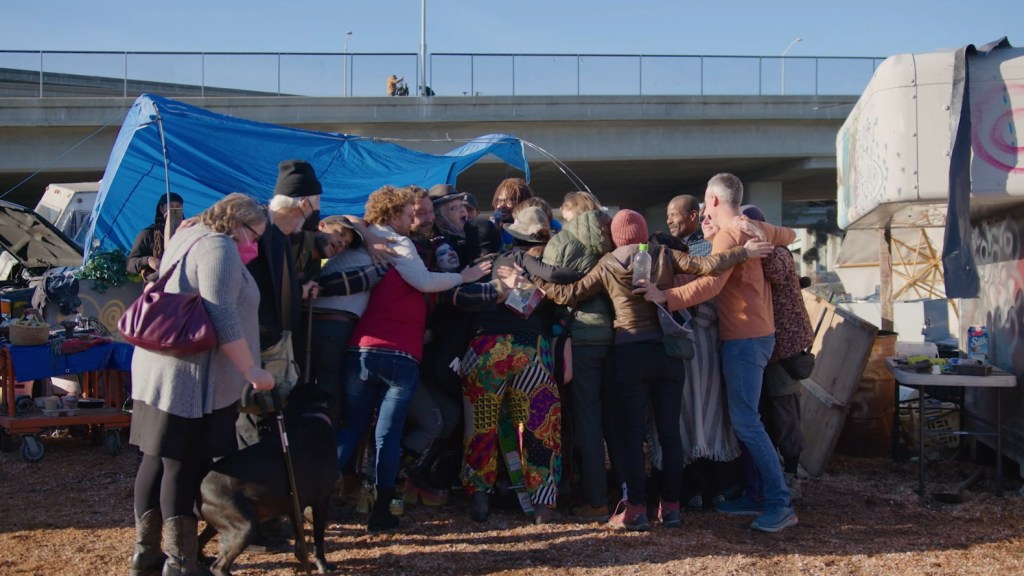
I will never forget the group hug.
There must have been 15 or 20 of us. I remember at least one dog. An injured woman inched into the circle with a cane. An elderly, white-bearded man clutched a walking staff, like an urban Gandalf, disseminating wise vibes. One person wore clown makeup. “Somebody’s gonna die in here,” joked someone smushed between bodies in the center of the lovefest. “We’re gonna take over the world!” someone else shouted. Everyone giggled.
We were in a homeless camp on Wood Street in West Oakland, one of the largest in California at the time. It has since been bulldozed, but around 300 people lived there at its peak. Amid the piles of trash and burnt-out cars, I found extensive infrastructure, including systems for power and water, a “free” store, a health clinic with Narcan and herbal tinctures, guest quarters and multiple event venues, with stages, lighting and sound systems.
These facilities were built in partnership with housed friends of the camp, of which I was one. The group hug happened in the midst of a party I had helped put on with the residents. Kev Choice, a local MC who is one of Oakland’s Cultural Affairs Commissioners, performed a set with his band. Flyaway, an aerial dance company, performed hanging from the back of the overpass at the camp, guerilla-style theatre that thankfully eluded detection by the highway patrol. There was food, drink and merriment of all stripes. The crowd was about 50-50 housed and unhoused — the invisible veil that normally segregates these two worlds had been lifted.
“One thing that’s apparent is the love that exists there,” said Monte, one of the camp’s leaders. “It’s infectious.”
I’ve spent the past several years immersed in the Bay Area’s homeless communities. While each one is unique, the common denominator I’ve observed is a special kind of love. It’s the sort of love one finds in a family — you might have strong differences of opinion, gossip behind each other’s back and even do hurtful things to each other at times, yet you remain bound by a common understanding that you will be there for each other when needed most.
Part of being in a family is the unspoken feeling of sharing a common plight. In a biological family, that feeling may be rooted in genetics — maintaining the family line. My observation is that in the family of a homeless camp, it emerges from the shared experience at the life-or-death edge of physical, emotional and spiritual survival. It also emerges in response to shared antagonists: the government actors perpetually trying to sweep you away and the housed neighbors urging them to do so.
These forced evictions have a devastating effect on our nation’s unhoused tribes, physically dispersing their members, destroying the fragile sense of security they’ve built, literally crushing their hand-crafted infrastructure with heavy machinery, and carting off personal belongings to the landfill. Unsurprisingly, the unhoused don’t see sweeps — a central, if little discussed, prong of homeless policy — as doing anything to help them pull themselves up by their bootstraps. It unquestionably pushes them down.
Allowing camps to exist may sound like a radical proposition, but it is in fact deeply pragmatic. There are certainly ways to mitigate some of their negative attributes without bulldozing them. And there are certainly ways that government-funded homeless services could be rejiggered to keep street families intact, build on their foundation and embrace their informal approach.
One assumes that homeless folks would want to move indoors if given the chance, but this is not necessarily the case.
Dave, a man I met in a camp next door to Apple’s $5 billion campus in Silicon Valley, told me, “A lot of us want to be here. We love the compassion of it. We love the fact that we belong. Out here, I can cry and be pathetic or loud and angry, whatever I need to be.”
The ethos of the camp, he said, is “they accept you and they love you,” no matter your flaws. “Which is a really magical thing. I would never be able to heal anywhere else.”
Brian Barth, the author of “Front Street: Resistance and Rebirth in the tent cities of Techlandia,” is an award-winning journalist with bylines in the New Yorker, Washington Post and National Geographic, among other publications. This column emerged from his reporting between 2021 and 2023.