
San Diego Gas & Electric turned a profit of $563 million in 2025, according to figures the utility’s parent company, Sempra, filed Thursday afternoon with the U.S. Securities and Exchange Commission.
That’s a lot less than the $891 million SDG&E earned in 2024.
According to Sempra’s annual 10-K report submitted to the SEC, the much lower profit number was mostly due to the California Public Utilities Commission disallowing $432 million in collections from SDG&E as part of the utility’s 2024 General Rate Case.
However, after SDG&E filed a separate submission — called a Track 2 request — to the commission, the CPUC last month issued a final decision that will enable the utility to collect $417 million in revenue related to wildfire mitigation activities that took place through 2022, so the lower profit number for 2025 could end up being an outlier.
SDG&E spokesperson Anthony Wagner said the utility works “to keep bills as low as possible,” while at the same time, “we are making strategic investments to modernize the grid and advance clean-energy solutions — including expanding energy storage, leading the state in solar interconnections, and preparing the grid for electrification.”
Before the earnings numbers were released, about 30 demonstrators gathered in front of Sempra’s corporate headquarters in downtown San Diego, protesting how much SDG&E has made over the years.
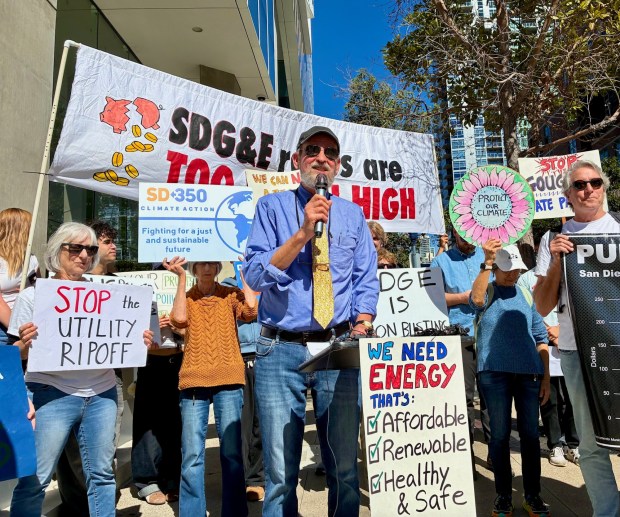 Craig Rose, a member of Public Power San Diego, speaks at a protest in front of Sempra headquarters in downtown San Diego ahead of the release of San Diego Gas & Electric’s 2025 earnings report. About 30 demonstrators gathered on Thursday. (Rob Nikolewski/The San Diego Union-Tribune)
“SDG&E could cover 100% of customer debt with just the money they made (in 2024) and still profit hundreds of millions,” said Anthony Dang, policy and community outreach manager for the Climate Action Campaign. “But they choose greed over communities and basic needs.”
“For the money SDG&E earns, you could tear down Petco Park and rebuild it — you could do that every year forever with SDG&E’s profits,” said Craig Rose, board member of Public Power San Diego, which wants the city to create a municipal utility. “It makes no sense to give SDG&E a stranglehold on an essential service, a service that everyone needs, and allow them to make an enormous profit.”
There are two other big investor-owned utilities in California — Southern California Edison, serving the greater Los Angeles area, and Pacific Gas & Electric in Central and Northern California.
Earlier this month, PG&E filed its 10-K for 2025 and showed net profits of $2.593 billion.
In the 10-K of parent company Edison International, Southern California Edison reported net income of $4.889 billion in 2025.
According to a legislatively mandated report the CPUC publishes each year on limiting utility costs, SDG&E’s average residential rate in 2023 was the second-highest among 200 investor-owned utilities across the country. The highest came from a power company in Hawaii. (2023 was the most recent year for which national annual data were available.)
The debate over affordability comes as the complaints about high utility rates across California intensify.
A host of bills have been introduced in the current legislative session in Sacramento, including Assembly Bill 2611, which aims to shield public schools and lower-income customers in hot climate zones from high electricity rates, and Assembly Bill 2463, which would require the California Public Utilities Commission to conduct a system-wide review of the financial returns that power companies are allowed to receive.
In a related matter, the CPUC in December voted 4-1 to slightly lower the authorized return on equity that investor-owned utilities earn by 0.3 percentage points. For SDG&E, that means the rate for 2026 dropped from 10.23% to 9.93%.
In its proposed decision, the commission said the change “balances the interests between shareholders and ratepayers” and represents “the lowest amount that is reasonably sufficient to assure confidence in the financial soundness of the utility and to improve and maintain investment grade credit ratings.”
High utility rates in California are attributed to several factors.
One of them is wildfire mitigation. Since the Witch Creek, Guejito and Rice fires in 2007 ravaged large swaths of San Diego County, SDG&E has spent roughly $6 billion in ratepayer funds to reduce the risk of widespread fires.
Other expenses include transmission and distribution costs, as well as money spent to build clean energy projects such as microgrids, electric vehicle charging stations and battery storage facilities, with costs getting folded into rates.
Corporatewide, Sempra on Thursday announced 2025 adjusted earnings of $3.07 billion, up from $2.97 billion in 2024. Sempra’s subsidiaries include SDG&E, Southern California Gas, Texas-based electric utility Oncor and Sempra Infrastructure, which is based in Houston and includes liquefied natural gas facilities.
“We believe Sempra offers investors an attractive combination of current yield, durable earnings growth and long-term capital appreciation,” Sempra Chairman and CEO Jeff Martin said during the company’s earnings call with Wall Street analysts Thursday. “We’re pleased with our 2025 performance and view it as a foundational year that sets us up for long-term success.”
Sempra finished the New York Stock Exchange trading day at $95.20 per share, up 0.74%.