
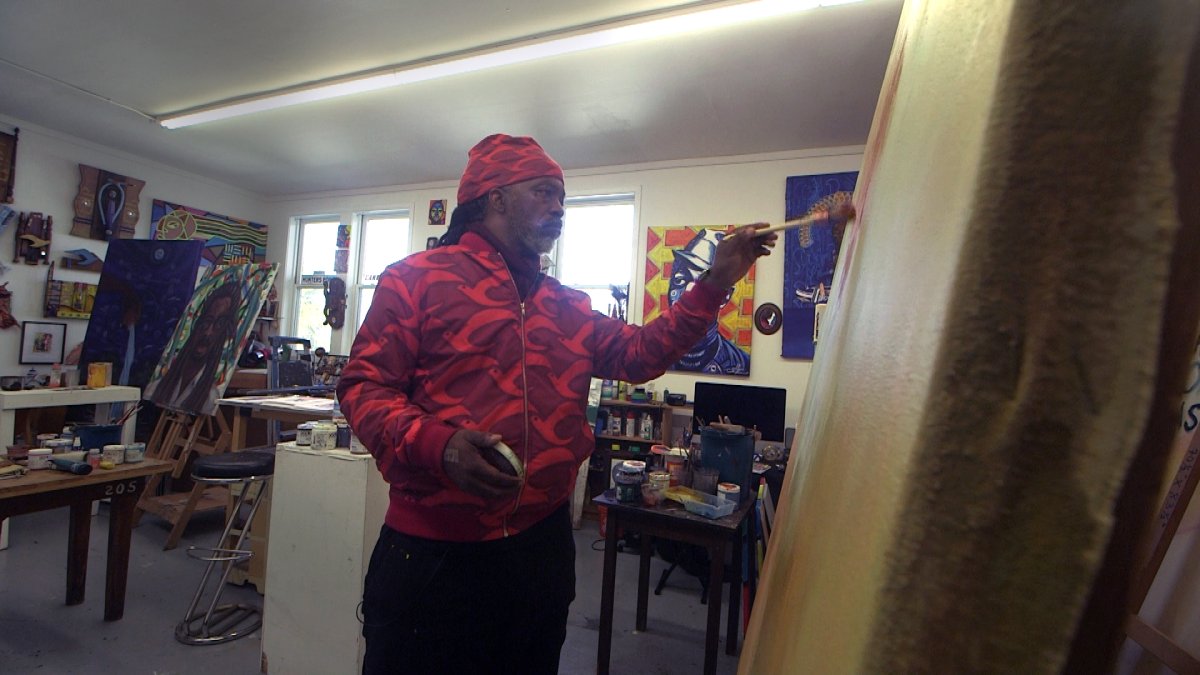
San Francisco’s Bayview-Hunters Point has been the lifelong home base for artist Malik Seneferu in a lot of ways. It’s the neighborhood where he was raised and returned to after moving around San Francisco with his single mom. His art studio sits in a building in the Hunters Point Shipyard — the same shipyard where his parents first got together.
“That’s really the foundation of everything I do,” Seneferu said as he swiped at a blank canvas with a giant paint brush. “Coming back to Hunters Point to give it what it has given me, which is life.”
Seneferu’s expansive studio in the midst of the former Navy base turned artist colony is stuffed to the brim with his works: paintings, triptychs, ceramics and even refrigerator magnets bear his distinctive art. Almost everything is a portrait of an African American or infused with a color palette inspired by a years ago trip to Africa.
“Give this sort of sun, cloudy sun vibe here,” he whispered to himself outlining the beginnings of a large painting resting on his easel.
When Seneferu begins a piece, he doesn’t work from drawings or preconceived ideas. The ideas flow as he squares up with the canvas, waiting for inspiration to come. The ideas come from a place he can’t exactly name, though his hunch is they come from someplace within his history.
“I often say my ancestors,” he said between swipes of the brush. “Someone told me, We want clouds. Start off with a sunny day, sunny morning.'”
Sometimes the layers of his early life lay thick in his memory like layers of paint on a canvas. He knows his parents met in the Hunters Point Shipyard while his dad was in the Navy, though he never actually knew his dad. He was raised by a single mom who moved around San Francisco — shifting from the Bayview to the Fillmore District to Visitacion Valley and back to the Bayview.
His family was living in the Fillmore when mass redevelopment forced many Black families, including his, out of the neighborhood.
“Through the new development that was going on in the city, they tore it down,” Seneferu said of his former home. “We ended up having to move and that’s when we moved back to Hunters Point.”
An outsider’s view of Hunters Point might focus on its gritty reputation for street violence and gangs. Seneferu remembers it different. It was a place where you could go to the next-door neighbor and borrow a cup of sugar or some eggs or bread. It was a true community.
“Hunters Point was always like that,” he said. “It was a place of love.”
Seneferu felt the entire city of San Francisco was his playground and a MUNI Fast Pass was his ticket to it all. He’d ride the bus from one end of the city to the other and back. He’d catch the cable car up Powell Street, riding to Fisherman’s Wharf where he watched street artists making paintings of tourists and came away with the idea he could do that too. As he rode the cable car, he’d bring along his sketchbook and make drawings whenever he felt inspired.
“I was actually 14 years old when I started deciding I was going to go into business as an artist,” he recalled.
Seneferu turned his bedroom into an art studio and started doing exhibits out of his mother’s home. She in turn sent him to the first Head Start program in the Bayview where he fell under the tutelage of its legendary director, artist Joe Sam, who proved the catalyst for Seneferu’s career in art.
Today, if you were to draw Seneferu’s trajectory on a map of San Francisco, it would look like a big circle, always winding back to Hunters Point.
“Gotta sorta garner the history of African Americans coming to the West,” he muttered to himself as he painted a team of horses onto his current canvas.
Flanked by his many paintings and artworks of African Americans, it’s clear Seneferu’s brushes are dipped in his sense of his culture and history.
“I reintroduce folks to who Black people were in San Francisco,” he said of his art. “And who they are and who they will be.”
Through his career, Seneferu has etched his place in the roster of San Francisco’s great artists. He’s known for channeling the African Diaspora with a unique artistic voice. His art is infused with his experiences growing up in San Francisco, but also a trip to Africa he self-funded years ago in which he witnessed people making art with anything they could find. The experience influenced a set of art pieces he made, painting with only things he’d found on the ground as brushes.
“Always like to involve found objects in my work,” he said. “My mantra is remain creative — so that’s how I’ve always pushed myself through.”
There’s a dream Seneferu had as a kid as he walked around San Francisco’s downtown, visiting the once-ubiquitous art galleries. He imagined his own art hanging from their walls. He never imagined he could also be the gallery owner.
That dream was realized back during the pandemic as empty storefronts multiplied around Union Square. Seneferu and his wife Karen Seneferu, also a noted artist, opened the Marlowe Gallery with the idea of showing local artists, especially those focused on the Black experience.
The gallery has hosted shows by both its owners, as well as artist like San Francisco venerable Michael Rios.
“I was like, ‘Oh, yeah, this has a beautiful curb appeal and we can do amazing exhibits,'” Seneferu said.
As he toiled in his studio back in Hunters Point where it all began, Seneferu is filled with the same artistic impulses that propelled him as a kid. He steps in front of the canvas and waits for the inspiration to come as the ancestors tell him where to put the clouds, the horses and the sunny vibe.
“I came to an early stage of my life where I realized it was my purpose on this planet,” Seneferu said. “It’s the reason that I’m here.”